

Darwin's Arch
Images

Springhare (Pedetes capensis)


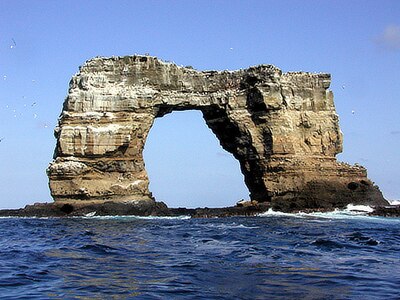


Geological Genesis and Coastal Dynamics
Darwin's Arch, a striking natural rock arch, was a prominent feature of the Galápagos Archipelago, located southeast of Darwin Island in the Pacific Ocean. This geological marvel was situated on an irregular, submerged rocky plateau, aptly nicknamed 'the theatre' by divers and marine biologists due to its rich biodiversity and dramatic underwater topography. The arch itself was a product of eons of geological processes, likely formed through differential erosion, where softer rock layers were worn away by the relentless forces of the sea, leaving behind a more resistant rock structure to form the arch.
Its existence was a testament to the dynamic interplay between volcanic origins and oceanic erosion that shapes coastal landscapes. The plateau it rested upon provided a unique habitat, supporting a complex marine ecosystem that attracted significant scientific and tourist attention.
A Monument to Scientific Discovery
The arch and its adjacent island were deliberately named in honor of Charles Darwin, the pivotal English naturalist whose transformative voyage on HMS Beagle in the 1830s led to the Galápagos Islands becoming synonymous with his revolutionary work. Darwin's meticulous observations of the islands' endemic flora and fauna, particularly the variations in finch beaks and tortoise shells, provided critical evidence for his theory of evolution by natural selection.
Darwin's Arch, therefore, was more than just a geological curiosity; it was a living monument, a physical landmark intrinsically linked to the birthplace of one of modern science's most fundamental concepts. The naming served as a perpetual tribute to Darwin's intellectual legacy and the profound impact his discoveries had on our understanding of life itself.
The Inevitable Collapse
On May 17, 2021, Darwin's Arch succumbed to the persistent forces of natural erosion, collapsing entirely into the sea. This event, while visually dramatic, was the culmination of a long and gradual process. The arch's structure was continuously subjected to the erosive power of wave action, tidal currents, and salt spray.
Over geological timescales, these forces weaken rock, creating fissures and accelerating the breakdown of the formation. The collapse serves as a powerful, albeit poignant, illustration of geological impermanence and the continuous reshaping of Earth's surface. It underscores that even seemingly solid and ancient natural structures are subject to the ongoing processes of weathering and erosion, highlighting the dynamic nature of our planet's geography.
Enduring Legacy
Despite the arch's disappearance, its legacy endures through the remaining rock formations. The two large pillars that once supported the arch now stand as solitary sentinels in the ocean, having been aptly nicknamed 'the Pillars of Evolution' by locals and the diving community. This renaming is a fitting tribute, acknowledging their continued connection to Darwin's work and the scientific significance of the region.
These pillars continue to be a vital part of the underwater landscape, offering a unique diving experience and serving as a habitat for marine life. The story of Darwin's Arch thus transitions from a geological landmark to a symbol of scientific heritage, reminding us of both the transient nature of physical forms and the lasting impact of groundbreaking ideas.
Geographical Context and Ecological Importance
Darwin's Arch was situated within the Galápagos Marine Reserve, a UNESCO World Heritage site renowned for its exceptional biodiversity and endemism. The surrounding waters, including the submerged plateau known as 'the theatre,' are critical feeding grounds for a variety of marine species, including hammerhead sharks, Galapagos sharks, manta rays, and sea turtles. The collapse of the arch has altered the physical structure of the underwater environment, but the ecological importance of the area remains undiminished. Conservation efforts continue to focus on protecting the unique marine life that inhabits these waters, recognizing the Galápagos as a living laboratory for evolutionary studies.
The site remains a powerful reminder of the interconnectedness of geological processes, biological evolution, and the ongoing need for environmental stewardship.
See also
Frequently Asked Questions
What was Darwin's Arch?+
Why was it named after Charles Darwin?+
How did Darwin's Arch collapse?+
What are the Pillars of Evolution?+
Where can people see the remains of Darwin's Arch?+
Based on content from Wikipedia · Licensed under CC BY-SA 4.0