

Czech Language
Images

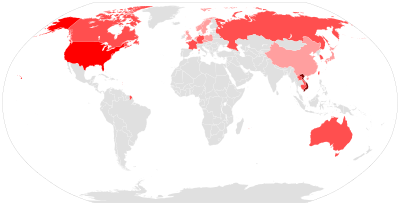
Proportion of French speakers by country (1-100% gradation)




Geographical Roots and Linguistic Connections
The Czech language, endonymously 'čeština', is a West Slavic language spoken primarily in the Czech Republic, a landlocked nation in Central Europe. With over 12 million speakers, including a significant number of second-language learners, it serves as the official language of the country. Czech belongs to the Czech-Slovak subgroup of West Slavic languages, a classification that highlights its close genetic relationship with Slovak.
This kinship is so profound that Czech and Slovak exhibit a high degree of mutual intelligibility, allowing speakers of each language to comprehend the other with relative ease, a rare phenomenon among distinct national languages. Its influence also extends, to a lesser degree, to Polish, another member of the West Slavic family. The language's historical development is deeply intertwined with the region's political and cultural history, evolving from common Slavic roots.
A Chronicle of Standardization and Influence
The genesis of the Czech-Slovak language group can be traced back to the high medieval period within the broader West Slavic expansion. The distinct standardization of Czech and Slovak emerged later, during the early modern period, from a shared dialect continuum. The modern written standard of Czech was meticulously codified during the Czech National Revival, spanning the late 18th to mid-19th centuries.
This era was crucial for fostering national identity through language. Historically, Czech was also referred to as Bohemian, reflecting its origins in the historical region of Bohemia. Throughout its existence, Czech has absorbed influences from other languages, most notably Latin and German, due to centuries of cultural and political interaction.
These borrowings have enriched its vocabulary and grammatical structures, creating a language that is both ancient and dynamic.
Phonetic Wonders and Morphological Richness
Czech boasts a moderately sized phoneme inventory, featuring ten monophthongs, three diphthongs, and twenty-five consonants. These consonants are categorized into 'hard,' 'neutral,' and 'soft' groups, contributing to the language's distinct sound. A remarkable characteristic of Czech phonology is its capacity for complex consonant clusters, and even words that entirely lack vowels, a feature that can pose a significant challenge for learners.
Perhaps its most distinctive phonetic element is the raised alveolar trill, represented by the grapheme 'ř'. This sound is exceptionally rare, occurring as a phoneme in only a handful of other languages worldwide. Czech is also a highly inflected, or 'fusional,' language, characterized by a rich system of morphology.
This means that word endings change extensively to indicate grammatical functions such as case, number, gender, and tense, allowing for a relatively flexible word order while maintaining clarity.
Vernaculars, Revival, and Modern Usage
Beyond the standardized literary language, Czech exhibits significant dialectal variation. The most widely spoken non-standard variety is 'Common Czech' (obecná čeština), which is largely based on the vernacular of Prague, the capital. However, Common Czech has evolved into an interdialect, used across most of Bohemia, blurring regional distinctions.
In contrast, the Moravian dialects, spoken in the regions of Moravia and Czech Silesia, are considerably more diverse and distinct from Bohemian dialects. The codification efforts during the National Revival were essential in establishing a unified written standard that could bridge these regional differences and serve as a national symbol. Today, Czech continues to be a vibrant language, reflecting both its deep historical roots and its adaptation to the modern world, serving as a cornerstone of Czech culture and identity.
See also
Frequently Asked Questions
What is the Czech language and where is it spoken?+
How many people speak Czech?+
Why is Czech sometimes called Bohemian?+
What makes Czech sound special?+
How is Czech related to Slovak?+
Based on content from Wikipedia · Licensed under CC BY-SA 4.0