

Cygnus: The Amazing Flying Swan in the Sky!
Images
Cygnus (constellation)


The Celestial Swan
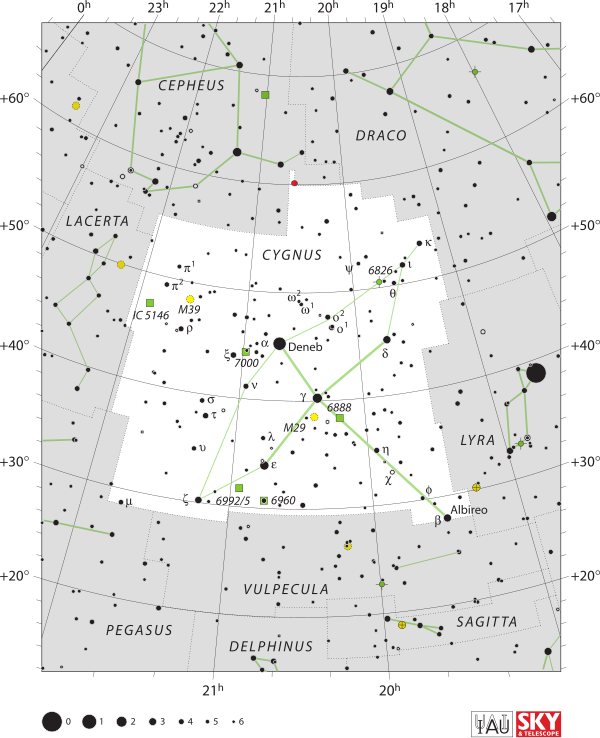
Cygnus, the Swan, is a large and ancient constellation situated in the northern sky, notable for its prominent position along the Milky Way's galactic plane. Its most recognizable feature is the 'Northern Cross' asterism, a striking pattern of five bright stars that forms the swan's body and outstretched wings. The brightest star, Deneb (Alpha Cygni), marks the swan's tail and is one of the most luminous stars visible to the naked eye, a blue-white supergiant.
The constellation's vastness and its alignment with the galactic center make it a significant area for astronomical observation, particularly during the summer months in the Northern Hemisphere. Its distinctive shape has made it a constant presence in human culture and astronomical study for millennia, serving as a celestial anchor point.
Mythological Roots and Astronomical Evolution
The constellation's origins are deeply embedded in ancient mythology, most famously in Greek lore where it represents Zeus in his swan form, seducing Leda. This myth, along with others, underscores the human tendency to find meaning and narrative in the stars, shaping early astronomical understanding and cultural identity. Historically, Cygnus was cataloged by Ptolemy in the 2nd century CE and has remained a fundamental part of celestial maps.
The development of the telescope allowed for a deeper exploration of its stellar contents, revealing a wealth of objects far beyond the naked eye's perception. The evolution from mythological interpretation to scientific cataloging highlights the changing relationship between humanity and the cosmos, driven by technological advancement and scientific inquiry.
Galactic Crossroads
Cygnus's location on the Milky Way's galactic plane is paramount to its astronomical significance. This vantage point offers a direct view into the dense stellar populations, nebulae, and dust clouds that constitute our galaxy's core. It is home to several prominent star-forming regions, including the North America Nebula (NGC 7000) and the Pelican Nebula (IC 5070), which are vast clouds of ionized hydrogen gas and dust where new stars are actively being born.
Furthermore, Cygnus hosts some of the most intriguing celestial objects known. Cygnus X-1, a powerful X-ray source, was one of the first astronomical candidates identified as a black hole, a testament to the extreme physics occurring within the constellation. The presence of such diverse and energetic phenomena makes Cygnus a crucial laboratory for studying stellar evolution, galactic structure, and high-energy astrophysics.
Modern Astronomy's Focus
In contemporary astronomy, Cygnus has become a prime target for exoplanet research. The Kepler Space Telescope, a revolutionary instrument for discovering planets outside our solar system, dedicated a significant portion of its mission to observing a field within Cygnus. This focused observation led to the discovery of thousands of exoplanets, including many potentially habitable ones, profoundly altering our understanding of planetary system prevalence and diversity in the universe.
Beyond exoplanets, Cygnus continues to be studied for its unique stellar populations, including variable stars, binary systems, and massive stars like Deneb, which provide insights into stellar lifecycles and the processes that shape galaxies. The ongoing study of Cygnus contributes vital data to our efforts to comprehend the vastness of the universe and our place within it.
The Swan's Legacy
The legacy of Cygnus extends from ancient navigation to cutting-edge scientific discovery. For centuries, its prominent stars served as reliable guides for mariners and travelers. Today, its scientific importance is immense, particularly in the search for extraterrestrial life through exoplanet detection.
The constellation's rich tapestry of stars and nebulae offers continuous opportunities for research, from understanding the formation of planetary systems to probing the nature of black holes and the structure of our galaxy. As astronomical technology advances, Cygnus will undoubtedly remain a key area of exploration, promising further revelations about the universe and our cosmic origins. Its enduring presence in the night sky serves as a constant reminder of the vastness and wonder that awaits our continued study.
See also
Frequently Asked Questions
What is Cygnus?+
Why is Deneb important?+
How can we see Cygnus?+
What special places are inside Cygnus?+
Why do scientists study Cygnus?+
Based on content from Wikipedia · Licensed under CC BY-SA 4.0