

Cressida (moon)
Images

Cressida (moon)


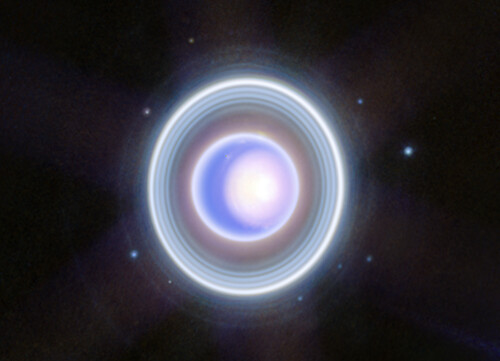


Cressida's Physical Characteristics and Formation
Cressida is classified as an inner moon of Uranus, characterized by its small size and irregular, non-spherical shape. With a mean diameter of approximately 82 kilometers (51 miles), it falls into the category of smaller satellites. Its irregular morphology strongly suggests that it has not undergone sufficient self-gravitational differentiation to achieve hydrostatic equilibrium.
Instead, its shape is likely a relic of its formation process, possibly as a fragment from a larger, disrupted parent body, or through accretion of smaller debris in the chaotic early Uranian system. The moon's surface is presumed to be composed of dark, carbonaceous materials, contributing to its low albedo and making it a challenging target for direct observation. The absence of a substantial atmosphere further implies a surface environment shaped primarily by impacts and space weathering, rather than geological activity or atmospheric processes.
Orbital Dynamics and the Uranian Environment
Cressida orbits Uranus at a mean distance of about 48,000 kilometers (30,000 miles), placing it within the planet's magnetosphere. This close proximity subjects it to intense radiation and charged particle bombardment, which likely plays a role in its surface composition and evolution. Its orbital period is remarkably short, completing a full revolution in just over 12 hours and 25 minutes.
This rapid orbit results in an average orbital speed of approximately 15.5 miles per second (25 kilometers per second). The gravitational influence of Uranus is dominant, dictating Cressida's swift path and likely contributing to its non-spherical shape by tidal forces. Cressida is part of a complex system of inner moons, and its orbit is influenced by gravitational interactions with its neighbors, particularly Desdemona and Belinda, which are in resonant or near-resonant configurations that can lead to orbital exchanges or instabilities over long timescales.
Discovery and Observational Challenges
Cressida was first discovered on January 9, 1986, by Stephen P. Synnott, based on images taken by the Voyager 2 spacecraft during its flyby of Uranus. The Voyager 2 mission provided the first detailed close-up views of Uranus and its moons, revealing a system far more complex than previously imagined.
Due to its small size, low reflectivity, and immense distance from Earth, Cressida remains difficult to study with ground-based telescopes. Its dark surface makes it blend into the background, and its proximity to the bright glare of Uranus further complicates observations. Modern astronomical techniques, including advanced imaging and spectral analysis, continue to refine our understanding of Cressida and its place within the Uranian satellite system, though much remains to be learned about its precise composition and surface features.
Significance and Broader Implications
The study of Cressida and other irregular inner moons of Uranus offers crucial insights into the processes of satellite formation and evolution in planetary systems. Their shapes and compositions provide clues about the conditions present during the early solar system and the dynamic interactions within giant planet magnetospheres. Cressida's existence and characteristics contribute to our understanding of how planetary systems assemble and how smaller bodies are sculpted by gravitational forces and impacts.
Furthermore, its dark, rocky nature and lack of atmosphere make it a representative example of many small moons found throughout the solar system, highlighting the diversity of celestial bodies beyond our immediate experience. Understanding these distant worlds helps us piece together the grand narrative of planetary formation and the potential for diverse environments beyond Earth.
See also
Frequently Asked Questions
What is Cressida?+
How big is Cressida compared to Earth?+
How fast does Cressida orbit Uranus?+
Why is Cressida dark?+
When was Cressida discovered?+
Based on content from Wikipedia · Licensed under CC BY-SA 4.0