

Cosmic Rays: Speedy Space Visitors!
Images

Cosmic ray


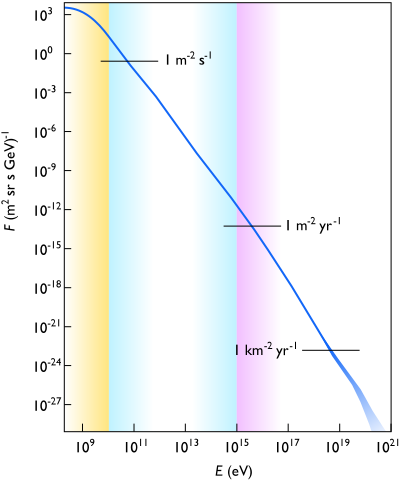


The Nature and Origin of Ultra-High-Energy Particles
Cosmic rays, or astroparticles, represent the most energetic particles known in the universe, primarily consisting of protons and atomic nuclei. They traverse interstellar and intergalactic space at velocities infinitesimally close to the speed of light. Their origins are diverse and span a vast range of cosmic phenomena.
Some are produced by our Sun during solar flares, but the majority, particularly those with the highest energies, originate from outside our solar system. These include powerful events like supernova remnants within the Milky Way, and even more extreme sources such as active galactic nuclei (AGN) and blazars in distant galaxies. The discovery in 2013 by the Fermi Space Telescope that a significant fraction of primary cosmic rays stem from supernova explosions revolutionized our understanding.
Further observations in 2018, linking neutrinos and gamma rays from blazar TXS 0506+056 to cosmic ray production, expanded the known sources to include these supermassive black hole-powered engines.
A Century of Cosmic Ray Exploration
The scientific journey into understanding cosmic rays began in 1912 with the pioneering work of Victor Hess. His daring balloon experiments, ascending to altitudes of over 16,000 feet, provided the first empirical evidence that these energetic particles were extraterrestrial in origin. Hess's meticulous measurements revealed an increase in radiation with altitude, a phenomenon inexplicable by terrestrial sources.
This discovery was so significant that it earned him the Nobel Prize in Physics in 1936, marking a pivotal moment in astrophysics. The advent of the space age in the late 1950s, with the launch of the first satellites, ushered in a new era of direct measurement. Spacecraft equipped with sophisticated particle detectors, similar to those used in terrestrial high-energy physics experiments, allowed for unprecedented study of cosmic rays, especially at lower energies, providing detailed insights into their composition and flux.
Cosmic Rays
Cosmic rays are indispensable tools for modern astrophysics and cosmology. They act as messengers from the universe's most violent and energetic events, carrying information about processes that are otherwise inaccessible. By analyzing their energy spectrum, composition, and arrival directions, scientists can infer the mechanisms of particle acceleration in astrophysical sources like supernova remnants and AGN.
This research helps us understand stellar evolution, galaxy formation, and the fundamental physics governing extreme cosmic environments. Furthermore, cosmic rays have practical implications. On Earth, they can affect electronic equipment, particularly in aircraft and satellites, necessitating the development of radiation-hardened technologies.
Understanding their flux and energy distribution is crucial for space exploration and for protecting astronauts and equipment from harmful radiation.
Earth's Shielding Mechanisms
Earth is constantly bombarded by cosmic rays, but our planet possesses robust natural defenses. The heliosphere, a vast bubble of magnetized plasma generated by the solar wind, extends far beyond the planets and deflects a significant portion of lower-energy cosmic rays. Closer to home, Earth's magnetosphere, generated by the motion of molten iron in its core, acts as a powerful magnetic shield.
This field deflects most charged cosmic ray particles, guiding them around the planet. However, the most energetic cosmic rays can still penetrate these shields. Upon entering the atmosphere, they initiate extensive air showers (EAS), a cascade of secondary particles like muons, electrons, and photons.
While the magnetosphere and heliosphere protect life on the surface, understanding the penetration and interaction of cosmic rays is vital for space travel and for studying atmospheric physics.
See also
Frequently Asked Questions
What are cosmic rays?+
Where do the fastest cosmic rays come from?+
How did scientists first discover cosmic rays?+
Why do cosmic rays matter for space travel?+
How does Earth protect itself from cosmic rays?+
Based on content from Wikipedia · Licensed under CC BY-SA 4.0