

Corvus the Crow: A Starry Friend
Images

Corvus (constellation)




An Astronomical Profile
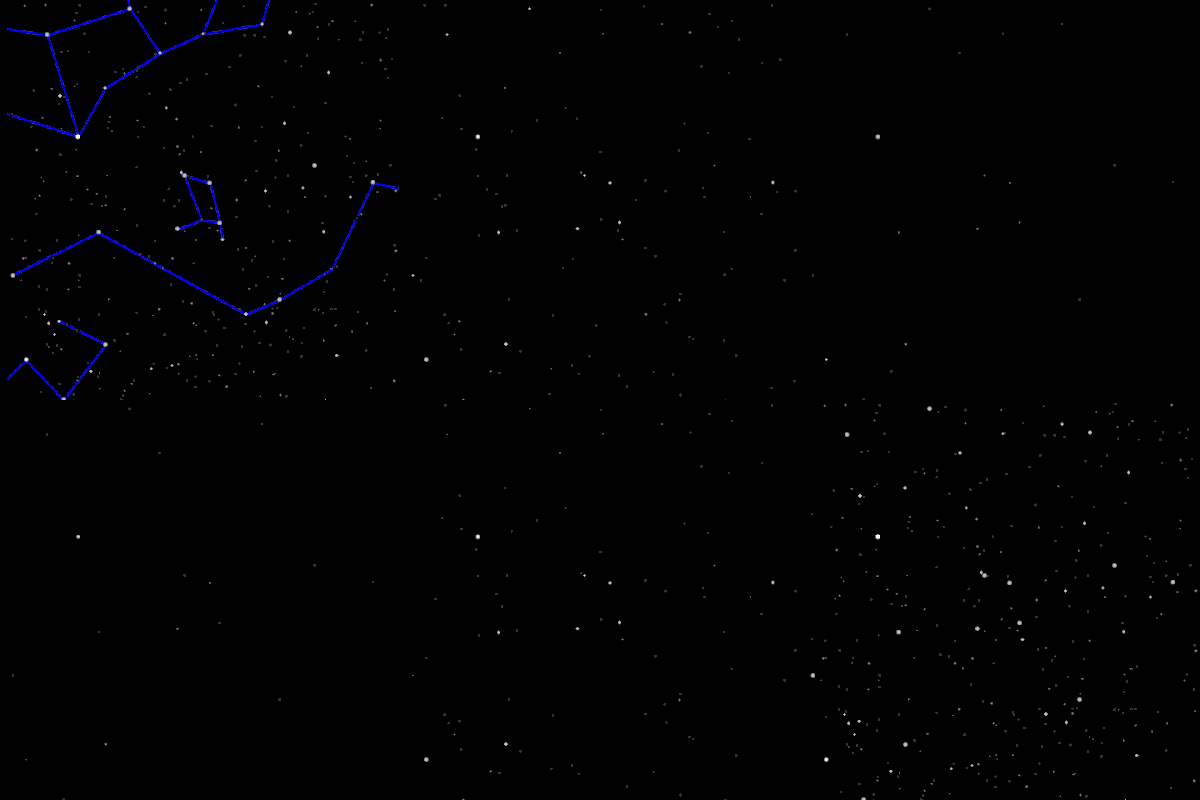
Corvus, the crow, is a constellation of modest size, occupying a mere 184 square degrees of the celestial sphere, making it the 71st largest of the 88 officially recognized constellations. Its primary asterism, a trapezoidal shape formed by four stars-Gienah (Gamma Corvi), Algor (Delta Corvi), Kraz (Beta Corvi), and Minkar (Alpha Corvi)-is easily identifiable. Gienah, a blue-white subgiant, is the brightest star, while Minkar, a red giant, is the most massive.
These stars are not gravitationally bound; their apparent proximity is a result of our perspective from Earth. Corvus resides in the southern celestial hemisphere, situated between the constellations Hydra, Crater, and Virgo, making it a prominent fixture in the spring night sky for observers in the Northern Hemisphere and visible year-round from many southern latitudes. Its relative lack of bright stars means it is less susceptible to light pollution, offering a decent viewing experience even in moderately light-polluted areas.
Echoes of Antiquity
The constellation Corvus boasts a rich history, recognized since antiquity. It is one of the 48 constellations listed by the 2nd-century astronomer Ptolemy in his Almagest. Its mythological associations are primarily rooted in Greek lore, most famously linked to Apollo.
One prevalent myth describes Apollo sending a white crow to fetch water from a sacred spring. The crow, however, became distracted and lingered, delaying its return. Enraged, Apollo cursed the crow, turning its feathers black and placing it in the sky as a perpetual reminder of its tardiness, forever flying near the constellation Hydra, the water snake.
This narrative served not only as an entertainment but also as a mnemonic device, helping ancient peoples navigate the celestial sphere and remember their cultural stories. The constellation's presence in ancient star charts underscores its enduring significance in human civilization.
Corvus as a Celestial Landmark and Scientific Tool
Beyond its mythological appeal, Corvus plays a practical role in modern astronomy as a celestial landmark. Its distinct shape and location in the southern sky make it a useful reference point for locating other, fainter objects. For instance, its proximity to the constellation Virgo and the bright star Spica aids in astronomical navigation.
While Corvus itself does not contain exceptionally bright or scientifically groundbreaking celestial bodies, its study contributes to our understanding of stellar populations and galactic structure. The relative simplicity of its star pattern makes it an excellent target for introductory astronomy education, helping students develop observational skills and an appreciation for the vastness of the cosmos. Its consistent appearance in the night sky provides a stable reference frame for tracking celestial movements over time.
The Broader Context
The constellation Corvus is a testament to humanity's long-standing practice of celestial cartography and pattern recognition. Its inclusion in ancient catalogs and its continued presence in modern astronomical charts highlight its enduring place in our understanding of the night sky. The naming conventions and mythological associations of constellations like Corvus reflect cultural values and historical narratives.
In contemporary astronomy, while the focus has shifted to cataloging individual stars, galaxies, and phenomena, constellations remain fundamental for organizing and communicating astronomical information. Corvus, though small, is an integral part of this grand celestial map, connecting us to the observational traditions of our ancestors and serving as a constant reminder of the universe's intricate beauty and the human drive to comprehend it.
See also
Based on content from Wikipedia · Licensed under CC BY-SA 4.0