

Cork Oak: The Tree That Gives Us Bouncy Stoppers!
Images

Tablet identifies the cork oak tree planted and dedicated by Governor Arnall on the capitol grounds at Arbor Day exercises assisted by Robert Dees and Vincent Orr of the Georgia Association Future Farmers of America.


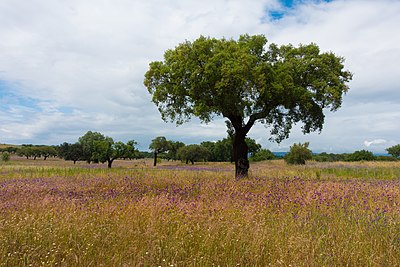

Biological Adaptations and Geographic Distribution
The cork oak (Quercus suber) is a member of the beech family (Fagaceae), native to the western Mediterranean basin. Its geographic distribution is primarily concentrated in Portugal and Spain, with significant populations also found in Algeria, Morocco, Italy, France, and Tunisia. This species thrives in Mediterranean climates characterized by hot, dry summers and mild, wet winters.
Its most remarkable biological adaptation is its thick, suberized bark, known as cork. This outer layer is composed of dead cells with heavily thickened, waxy cell walls, providing exceptional insulation against heat, fire, and water loss. This allows the tree to survive frequent wildfires that are endemic to its habitat, a crucial factor in its ecological persistence.
The cork layer can reach thicknesses of up to 5 centimeters, and it is this protective, yet harvestable, tissue that defines the tree's economic and ecological value.
The Art and Science of Cork Harvesting
Cork harvesting, or 'stripping,' is a highly skilled and labor-intensive process that has been practiced for centuries. The process begins when a cork oak tree reaches maturity, typically around 25 years of age, and its bark has developed sufficiently. Specialized workers, known as 'extractors,' use specialized axes to make precise vertical and horizontal cuts in the bark, carefully peeling away the outer layers without damaging the vascular cambium, the living tissue responsible for growth.
The tree then regenerates a new layer of cork over the subsequent 9 to 12 years, allowing for repeated harvests throughout its long lifespan, which can exceed 200 years. This regenerative capacity makes cork a truly renewable resource. The harvested cork is then subjected to a boiling process to sterilize it, flatten it, and make it more pliable before being sorted and processed into various products.
This sustainable harvesting model ensures the long-term viability of both the trees and the industry.
Economic Significance and Product Versatility
The economic importance of cork oak extends far beyond its most iconic application: wine stoppers. The unique combination of properties-low density, elasticity, impermeability, buoyancy, and excellent thermal and acoustic insulation-makes cork highly versatile. It is extensively used in flooring and wall coverings, providing comfort, sound dampening, and natural aesthetics.
In the automotive and aerospace industries, cork's insulating and vibration-dampening qualities are utilized in components for thermal protection and noise reduction. It also finds applications in fashion (shoe soles, handbags), sports equipment (handles, balls), and even in high-tech fields like microelectronics for thermal management. The sustainable nature of cork harvesting also contributes to rural economies, supporting traditional livelihoods and fostering a circular economy model where waste products can be repurposed.
Ecological Keystone
Cork oak forests, particularly the traditional agroforestry systems known as 'montados' in Portugal and 'dehesas' in Spain, are biodiversity hotspots and critical ecosystems. These managed woodlands provide essential habitat and food sources for a wide array of flora and fauna, including numerous endemic and endangered species. Iconic examples include the Iberian lynx (Lynx pardinus) and the Spanish imperial eagle (Aquila adalberti), both of which rely heavily on these habitats for survival.
The open canopy structure and diverse understory support a rich variety of insects, birds, and mammals. Furthermore, cork oak forests play a vital role in environmental conservation by preventing soil erosion, combating desertification, and acting as significant carbon sinks. The trees absorb substantial amounts of atmospheric carbon dioxide, contributing to climate change mitigation efforts.
The sustainable management of these forests is therefore crucial for both biodiversity preservation and global climate stability.
See also
Frequently Asked Questions
What is a cork oak tree?+
How does a cork oak give us cork stoppers?+
Why can we shave the bark without hurting the tree?+
How long does it take for a cork oak to grow enough bark?+
What other things can cork be used for besides wine stoppers?+
Based on content from Wikipedia · Licensed under CC BY-SA 4.0