

The Amazing Compass Rose!
Images

Compass rose


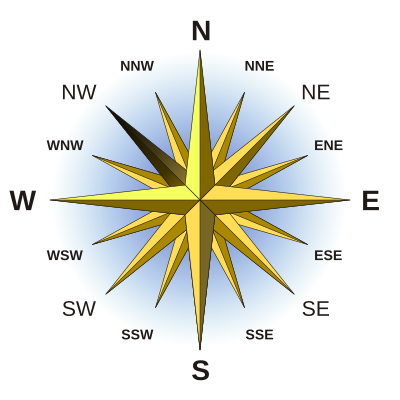

From Lodestone to Chart
The compass rose, a graphical representation of directional indicators, emerged as a critical navigational aid, evolving from rudimentary observations to sophisticated cartographic elements. Its development is intrinsically linked to the discovery and application of magnetism. Early mariners utilized lodestone, a naturally magnetized mineral, to create rudimentary compasses.
The challenge lay in interpreting the needle's orientation, especially in adverse conditions. This led to the development of the compass card or wind rose, often depicted on charts and compasses themselves. Initially, these diagrams might have focused on wind directions, crucial for sailing, but they quickly standardized to represent the cardinal directions (North, South, East, West) and their subdivisions.
The proliferation of these roses on nautical charts from the 14th century onwards facilitated more precise course plotting and dead reckoning, fundamentally transforming oceanic exploration and global trade by enabling voyages beyond visual landmarks.
Cartographic Precision and Navigational Science
The compass rose is a cornerstone of cartography and navigation, providing essential orientation for map users. Its structure, typically radiating from a central point, illustrates the relationship between cardinal and intercardinal directions. The most common form displays 32 points, each representing a specific bearing.
This level of detail allowed navigators to accurately determine their heading and track their progress. Understanding the compass rose also necessitates an awareness of the difference between true north (geographic North Pole) and magnetic north (where the compass needle points). This discrepancy, known as magnetic declination, varies by location and time, and skilled navigators had to account for it to achieve precise navigation.
The rose thus represents not just directions but also the scientific understanding required to interpret them accurately, bridging the gap between theoretical magnetism and practical seafaring.
The Compass Rose in the Age of Digital Navigation
Despite the advent of sophisticated electronic navigation systems like GPS, the compass rose retains its relevance. It continues to be a standard feature on virtually all maps, both physical and digital, serving as an immediate visual cue for orientation. For many users, it provides a more intuitive understanding of direction than abstract coordinates.
Furthermore, the compass rose is often integrated into the user interface of GPS devices and mapping applications, allowing users to align the map display with their current heading or with true north. This hybrid approach leverages the strengths of both traditional and modern navigation techniques. The enduring presence of the compass rose underscores its fundamental role in human spatial awareness and our innate need for directional reference points, even as the underlying technology evolves.
Symbolism and Cultural Resonance
Beyond its practical navigational function, the compass rose has acquired profound symbolic meaning across cultures. It represents guidance, direction, purpose, and the journey of life. Its radiating points can symbolize the four corners of the world, universal truths, or the interconnectedness of all directions.
Consequently, it is frequently employed in art, architecture, heraldry, and as a motif in jewelry and tattoos. It signifies a quest for knowledge, a commitment to a path, or the ability to find one's way through challenges. The compass rose acts as a potent reminder of humanity's enduring drive to explore, understand, and navigate not only the physical world but also the complexities of existence, making it a timeless emblem of human endeavor and aspiration.
Educational Significance and Future Applications
The compass rose is a foundational element in geography and spatial reasoning education. Teaching children about the compass rose introduces them to fundamental concepts of directionality, mapping, and the Earth's magnetic field. It fosters critical thinking skills related to orientation and problem-solving.
In educational settings, it serves as a tangible link to historical navigation methods, providing context for the development of modern technologies. Looking forward, while digital tools dominate, the principles embodied by the compass rose remain vital. Understanding its historical context and symbolic weight enriches our appreciation for the journey of exploration and discovery.
Future applications might involve novel ways to integrate its symbolic representation into augmented reality experiences or educational platforms, ensuring its continued relevance in teaching spatial literacy and the spirit of adventure.
See also
Frequently Asked Questions
What is a compass rose?+
Why did sailors use the compass rose?+
How many points does a typical compass rose have?+
What is the difference between true north and magnetic north?+
Why is the compass rose still on maps today?+
Based on content from Wikipedia · Licensed under CC BY-SA 4.0