

Colorless Green Ideas Sleep Furiously!
Images
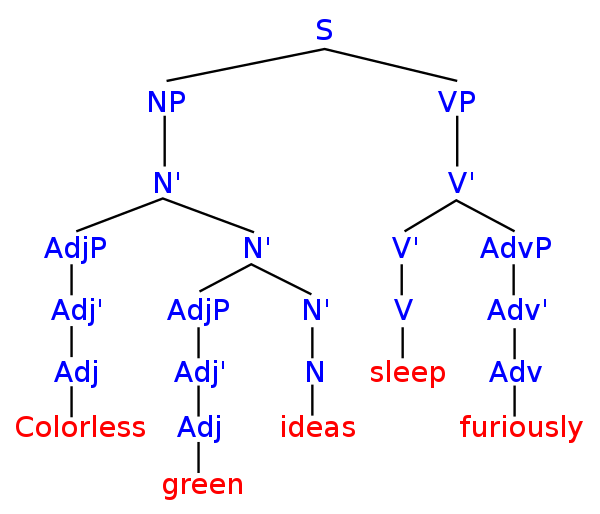
Colorless green ideas sleep furiously
The Architecture of Meaning
Noam Chomsky's famous utterance, 'Colorless green ideas sleep furiously,' stands as a cornerstone in the field of linguistics, serving as a potent illustration of the critical divergence between syntactic well-formedness and semantic coherence. Introduced in his seminal works, including 'Syntactic Structures' (1957), Chomsky crafted this sentence not as a poetic expression, but as a deliberate counterexample to prevailing theories of language.
At its core, the sentence adheres flawlessly to English grammatical rules: 'ideas' is a plural noun functioning as the subject, modified by the adjectives 'colorless' and 'green,' followed by the verb 'sleep,' and modified by the adverb 'furiously.' This syntactic integrity means that if one were to parse the sentence using a grammar-checking algorithm, it would likely pass without error. However, the semantic interpretation collapses entirely. The concept of 'ideas' is abstract and lacks physical attributes, making the application of color terms ('colorless' and 'green') a logical contradiction.
Furthermore, ideas, being non-corporeal entities, cannot perform actions such as 'sleeping,' especially not with the intensity implied by 'furiously.' This stark contrast between grammatical structure and meaningful content is precisely what Chomsky intended to highlight.
Genesis of a Linguistic Landmark
The intellectual journey that led to 'Colorless green ideas sleep furiously' began in Chomsky's doctoral dissertation, 'The Logical Structure of Linguistic Theory' (1955), and was further elaborated in his 1956 paper, 'Three Models for the Description of Language,' before its prominent appearance in 'Syntactic Structures.' At that time, linguistic models, particularly those influenced by behaviorism, often focused on statistical probabilities of word co-occurrence. The idea was that if words frequently appeared together in a language corpus, their combination was likely grammatical.
Chomsky vehemently challenged this approach. He argued that such probabilistic models were insufficient to capture the generative and creative nature of human language. To demonstrate this inadequacy, he needed a sentence that defied semantic interpretation despite its perfect grammatical form. 'Colorless green ideas sleep furiously' served this purpose brilliantly, proving that a purely statistical or surface-level analysis of language could not account for our intuitive understanding of meaning and grammaticality.
It underscored the necessity for deeper, structural principles governing language.
The Profound Significance
The enduring significance of Chomsky's sentence lies in its pivotal role in establishing the autonomy of syntax from semantics. It provided compelling evidence that a sentence's grammatical correctness does not guarantee its meaningfulness, and conversely, that semantically meaningful utterances must also conform to syntactic rules. This insight was foundational to Chomsky's development of transformational-generative grammar, a theory that posits an underlying deep structure from which surface sentence structures are derived through transformations.
The sentence also has profound implications for cognitive science and artificial intelligence. It highlights the complex cognitive machinery humans employ to process language, enabling us to instantly recognize semantic anomalies. For AI researchers, it posed a significant challenge, demonstrating that creating machines capable of truly understanding language required more than just pattern recognition; it demanded an ability to grasp abstract meaning and logical relationships, a feat that remains a frontier in AI development.
The sentence forces us to consider the mental representations and rules that allow us to distinguish between coherent communication and linguistic absurdity.
A Category Error and Its Theoretical Ramifications
At its heart, 'Colorless green ideas sleep furiously' is a textbook example of a 'category mistake,' a philosophical error identified by Gilbert Ryle. A category mistake occurs when properties or predicates are ascribed to a subject that belongs to a fundamentally different logical type or category, rendering the statement nonsensical. In this case, abstract entities ('ideas') are endowed with physical properties ('colorless,' 'green') and biological actions ('sleep'), which are categories to which they cannot logically belong.
Chomsky's use of this specific type of error was strategic. It wasn't just about random nonsense; it was about demonstrating that the rules governing semantic combination are distinct from, though related to, the rules governing syntactic combination. This distinction is crucial for understanding how humans acquire and use language, suggesting that our linguistic competence involves not only mastering grammatical structures but also an innate understanding of semantic categories and logical constraints.
The sentence continues to be a vital tool for exploring the nature of meaning, reference, and the cognitive architecture that underpins human linguistic ability.
See also
Frequently Asked Questions
What does the sentence "Colorless green ideas sleep furiously" mean?+
Why did Noam Chomsky make up this sentence?+
How is the sentence grammatically correct?+
Where does this sentence appear in Chomsky's work?+
Are there other sentences that are like this?+
Based on content from Wikipedia · Licensed under CC BY-SA 4.0