

Portugal's Awesome Shield!
Images

Stone engraved with the coat of arms of Portugal (near Lin Fong Temple) 26-08-2023


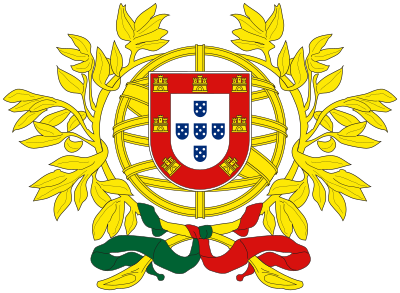


From Royal Crest to Republican Emblem
The coat of arms of Portugal, universally recognized as 'as Quinas,' represents a profound continuity of national symbolism, bridging centuries of history from medieval monarchy to the modern republic. Its core element, the shield displaying five escutcheons (quinas) each charged with five bezants, traces its lineage back to the personal arms of Afonso Henriques, the first King of Portugal in the 12th century.
The bezants themselves are subject to various interpretations, most commonly linked to the five wounds of Christ or, more historically, to the five Moorish kings defeated by Afonso Henriques. The transition to a republic in 1910 necessitated a formal adoption of a new national emblem. However, rather than discarding its heritage, the new design, officially promulgated in 1911, deliberately retained the established Quinas, albeit with minor stylistic adjustments and the addition of a crowned celestial sphere.
This strategic preservation underscores the Quinas' deep entrenchment in the Portuguese psyche, serving as a powerful, unifying symbol that transcends political regimes and connects contemporary citizens to their historical narrative.
Adaptive Heraldry
The utility of the Portuguese coat of arms is demonstrated through its varied applications, reflecting a sophisticated approach to national symbolism. Three primary versions exist, each tailored for specific contexts. The most elaborate form is reserved for the national flag and the naval jack, serving as the paramount visual identifier of the sovereign state.
A secondary, slightly simplified rendition appears on military regimental colours and official travel documents like passports, reinforcing national allegiance and identity in contexts of defense and international engagement. A tertiary, more minimalist design was conceived for use on seals, coinage, and other minor emblems, ensuring the symbol's presence across a broad spectrum of national representation without compromising its recognizability. This tiered system allows the Quinas to function effectively across diverse media and purposes, from grand national displays to subtle official markings, maintaining a consistent yet contextually appropriate representation of Portugal.
The Quinas as a Nexus of National Identity and Governance
The coat of arms of Portugal is intrinsically linked to the functioning of the state and the cultivation of national identity. Its ubiquitous presence across governmental institutions, judicial bodies, and military organizations signifies the overarching authority and unity of the Portuguese nation. The Quinas serve not merely as a decorative emblem but as a functional heraldic device that underpins the legitimacy of state actions and institutions.
The enduring appeal and consistent use of this symbol, even through significant political transformations, highlight its deep resonance with the populace. It acts as a constant, tangible link to Portugal's historical trajectory, fostering a sense of shared heritage and collective pride. In an era of globalization, such potent national symbols are crucial for maintaining distinct cultural identities and reinforcing social cohesion within the citizenry.
Historical Evolution and Symbolic Interpretation of the Quinas
The evolution of the Quinas from medieval royal insignia to a republican emblem is a testament to its symbolic power and adaptability. The five escutcheons, or 'quinas,' are widely accepted to represent the five kingdoms or provinces that formed Portugal, or more specifically, the five sons of the first king, Henry of Burgundy, and Teresa of León. The bezants within each quina are often interpreted as representing the five wounds of Christ, a common motif in medieval Christian symbolism, or as coins, possibly signifying tribute paid or victories won.
The adoption of the crowned celestial sphere in the republican version adds a layer of navigational and exploratory significance, alluding to Portugal's Age of Discovery. This complex layering of historical, religious, and geopolitical meanings imbues the Quinas with a rich narrative that continues to be explored and reinterpreted, solidifying its status as a profound emblem of Portuguese history and identity.
See also
Based on content from Wikipedia · Licensed under CC BY-SA 4.0