

Mozart's Magical Clarinet Song
Images

Mozart Symphonie Concertante K.297b For Hautbois Clarinette Basson Cor And Orchestra - Concerto For Clarinet And Orchestra K.622 - sinfonia Concertante K. 297b For Oboe Clarinet Bassoon Horn And Orchestra - concerto For


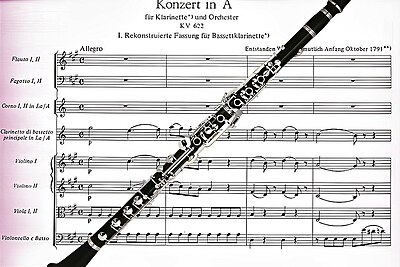
The Poignant Culmination of a Career
Wolfgang Amadeus Mozart's Clarinet Concerto in A major, K. 622, stands as a monument of late Classical repertoire, completed in October 1791. Its significance is amplified by its proximity to the composer's death, occurring just weeks before his passing. This work is often referred to as Mozart's 'swan song,' a poignant descriptor for a piece created at the twilight of his prolific career.
It was his second-to-last completed composition, preceded only by the Masonic cantata 'Laut verkünde unsre Freude' (K. 623). The concerto’s premiere date is uncertain, but historical speculation points to October 16, 1791, in Prague, a performance that would have introduced audiences to a work of unparalleled grace and depth. The very act of composing such a masterpiece under the shadow of his own mortality imbues the concerto with an extraordinary emotional resonance, inviting listeners to contemplate the intersection of artistic creation and human finitude.
The Enigma of the Basset Clarinet and Manuscript
A crucial element of the Clarinet Concerto's history is its original conception for the basset clarinet, an instrument favored by its intended performer, Anton Stadler. This specialized clarinet possessed an extended lower register, allowing for a richer harmonic palette and melodic possibilities not available on the standard instrument. Mozart masterfully exploited these unique capabilities in the concerto's solo part. However, the original manuscript score has been lost to time, creating a historical lacuna.
Following Mozart's death, the concerto was published with modifications to the solo part, adapting it for conventional clarinets to ensure wider accessibility. This adaptation inevitably altered the sonic landscape Mozart originally envisioned. In response, contemporary musicians and scholars have undertaken 'conjectural reconstructions,' meticulously attempting to recreate the concerto as Mozart might have intended it, often performing it on modern basset clarinets to approximate the original sound.
Architectural Brilliance
The Clarinet Concerto adheres to the traditional three-movement structure of fast–slow–fast, a framework Mozart consistently employed to create compelling musical narratives. The opening Allegro is characterized by its elegant lyricism and spirited dialogue between the soloist and orchestra, establishing a mood of sophisticated joy. It sets a tone of refined brilliance that is characteristic of Mozart's mature style.
The central Adagio is the emotional core of the work, a movement of profound beauty and introspection. Here, the clarinet's voice sings with unparalleled expressiveness, conveying a sense of deep feeling and contemplative serenity. This movement is often cited as one of Mozart's most sublime slow movements.
The finale, a Rondo, returns to a more vivacious character, offering a playful and virtuosic conclusion that leaves the listener with a sense of exhilaration and satisfaction. Each movement is a perfectly crafted gem, contributing to the concerto's overall impact.
Enduring Resonance and Modern Relevance
The Clarinet Concerto's enduring appeal lies not only in its melodic invention and emotional depth but also in its historical context and the ongoing scholarly and performance-based efforts to understand its original form. It represents a pinnacle of Mozart's late instrumental writing, showcasing his unparalleled ability to blend technical brilliance with profound emotional expression. The challenges posed by the lost manuscript and the basset clarinet have fostered a unique scholarly and performance tradition, encouraging a deeper engagement with the work's historical genesis.
Today, the concerto remains a cornerstone of the clarinet repertoire, performed and cherished by musicians and audiences worldwide. Its continued relevance speaks to the universal power of Mozart's music to connect with the human spirit, transcending the centuries and the specific circumstances of its creation.
Thematic Threads and Stylistic Innovations
Mozart's Clarinet Concerto is a testament to his late stylistic period, characterized by a refined balance of classical form and burgeoning romantic sensibility. The thematic material, particularly in the first and third movements, exhibits a remarkable clarity and grace, yet it is infused with a subtle complexity that rewards repeated listening. The interplay between the solo clarinet and the orchestra is masterful, creating a seamless integration rather than a mere juxtaposition.
The concerto explores a wide emotional spectrum, from the effervescent joy of the outer movements to the profound melancholy and introspection of the Adagio. This emotional range, combined with the idiomatic writing for the clarinet, particularly the extended range of the basset clarinet, showcases Mozart's innovative approach to instrumental composition. The work’s influence can be seen in subsequent concertos, solidifying its place as a pivotal work in the evolution of the concerto genre.
See also
Frequently Asked Questions
What is Mozart's Clarinet Concerto and why is it special?+
Why did Mozart write the concerto for a special kind of clarinet?+
When did Mozart finish the concerto?+
What are the three parts of the concerto?+
How do musicians try to hear the original music today?+
Based on content from Wikipedia · Licensed under CC BY-SA 4.0