

Chloroplast: The Tiny Food Factories Inside Plants!
Images

Chloroplast


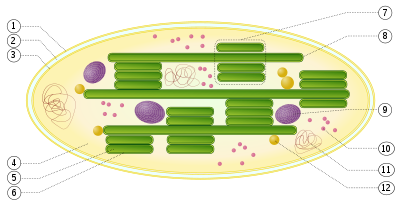


The Molecular Machinery of Photosynthesis
Chloroplasts are sophisticated organelles, roughly oval-shaped and enclosed by a double membrane, that are the sites of photosynthesis in eukaryotic cells. Their internal architecture is highly organized to facilitate this complex process. The stroma, a dense fluid, houses enzymes for the Calvin cycle (light-independent reactions), while the thylakoid membranes, organized into stacks called grana, contain chlorophyll and other pigments, electron transport chains, and ATP synthase for the light-dependent reactions.
Chlorophyll a and b, along with carotenoids, capture photons across a spectrum of light, initiating the conversion of light energy into chemical energy. This energy is then used to fix atmospheric carbon dioxide into glucose, a fundamental energy currency for life.
Endosymbiotic Origins
The prevailing theory for the origin of chloroplasts is endosymbiosis, proposed by Lynn Margulis. It posits that chloroplasts evolved from free-living cyanobacteria that were engulfed by an early eukaryotic host cell. Rather than being digested, these bacteria established a symbiotic relationship, providing the host with the ability to photosynthesize in exchange for protection and nutrients. Evidence supporting this includes the presence of a circular DNA genome within chloroplasts, distinct from nuclear DNA, and the similarity of their ribosomes to bacterial ribosomes.
Furthermore, chloroplasts replicate independently within the cell through a process resembling binary fission, mirroring bacterial division.
Biochemical Pathways and Energy Conversion
Photosynthesis within chloroplasts is broadly divided into two stages. The light-dependent reactions, occurring in the thylakoid membranes, involve the absorption of light energy by photosystems I and II, leading to the splitting of water (photolysis), the release of oxygen, and the generation of ATP and NADPH. These energy-carrying molecules are then utilized in the light-independent reactions (Calvin cycle) in the stroma.
Here, carbon dioxide is fixed and reduced to form glyceraldehyde-3-phosphate, a precursor to glucose and other organic molecules. This intricate biochemical pathway is the primary mechanism by which solar energy enters the biosphere.
Ecological Significance and Global Impact
The role of chloroplasts in sustaining Earth's ecosystems cannot be overstated. As primary producers, photosynthetic organisms utilizing chloroplasts form the base of virtually all food webs. They convert inorganic matter and solar energy into organic compounds, fueling the growth and survival of heterotrophic organisms.
Crucially, photosynthesis releases oxygen as a byproduct, replenishing the atmospheric oxygen essential for aerobic respiration in most life forms. Chloroplasts also play a significant role in global carbon cycling, sequestering atmospheric CO2 and mitigating its greenhouse effect, thus influencing climate regulation.
Modern Applications and Future Research
The study of chloroplasts continues to yield insights with significant practical applications. Research into artificial photosynthesis aims to mimic chloroplasts' efficiency in converting solar energy into fuels, offering potential solutions for renewable energy. Understanding chloroplast function is also vital for improving crop yields and developing more resilient plant varieties to address food security challenges. Furthermore, ongoing research into chloroplast genetics and their endosymbiotic origins deepens our understanding of cellular evolution and the intricate interconnectedness of life on Earth.
See also
Frequently Asked Questions
What is a chloroplast and what does it do?+
How do chloroplasts get their own DNA?+
Why do plants release oxygen during photosynthesis?+
How did chloroplasts evolve?+
What happens to the food made by chloroplasts?+
Based on content from Wikipedia · Licensed under CC BY-SA 4.0