

The Amazing Canadian Shield!
Images
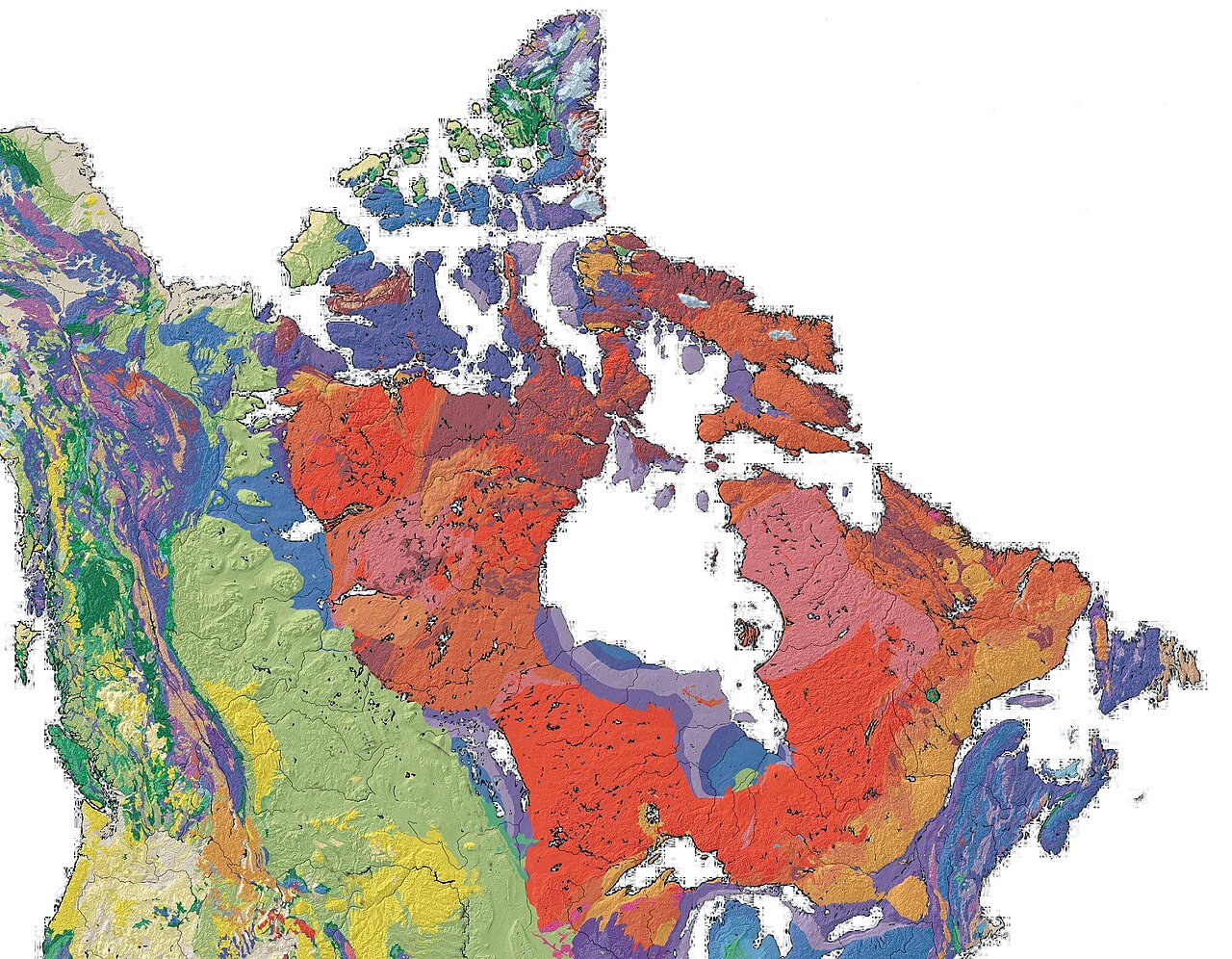
Canadian Shield
The Laurentian Plateau
The Canadian Shield, also known as the Laurentian Plateau or Laurentian Shield, represents one of the planet's most significant geological provinces. It is a vast expanse of exposed Precambrian igneous and high-grade metamorphic rocks, forming the North American Craton, the ancient and stable geologic core of the North American continent. This immense shield covers over half of Canada's landmass, extending from the Great Lakes region northward to the Arctic Ocean, and also encompasses most of Greenland and parts of the northern contiguous United States.
Its geological origins trace back to the Archean and Proterozoic eons, making its bedrock some of the oldest on Earth, estimated to be between 2.5 billion and 4 billion years old. The Shield's composition reflects a long and complex history of volcanic activity, mountain building, and deep crustal processes, resulting in a diverse array of crystalline rocks like granite, gneiss, and schist, which are frequently visible due to minimal soil cover.
Glacial Legacy
The contemporary topography of the Canadian Shield is profoundly shaped by its Quaternary glacial history. During the Pleistocene epoch, massive ice sheets, notably the Laurentide Ice Sheet, repeatedly advanced and retreated across the Shield. These colossal glaciers exerted immense erosional power, stripping away much of the pre-existing regolith and exposing the underlying bedrock.
The scouring action of the ice carved out numerous depressions that subsequently filled with meltwater, creating the characteristic landscape of millions of lakes and intricate drainage systems that define the Shield today. This glacial legacy also resulted in a thin, discontinuous layer of glacial till and outwash deposits, which form the relatively poor soils found across much of the region. The Shield's topography is generally low-lying and undulating, with elevations typically ranging from 300 to 600 meters, punctuated by isolated hills and eskers formed by glacial deposition.
Economic Powerhouse
The Canadian Shield is not only a geological marvel but also an economic powerhouse, primarily due to its exceptionally rich mineral endowment. The ancient geological processes that formed the Shield created vast deposits of valuable minerals, including gold, diamonds, nickel, copper, zinc, platinum-group metals, and uranium. Major mining centers are scattered throughout the Shield, supporting significant industrial activity and contributing substantially to Canada's economy.
Beyond mineral resources, the Shield's extensive network of rivers and lakes provides immense potential for hydroelectric power generation. Numerous dams have been constructed to harness this energy, supplying electricity to major urban centers and industrial operations across Canada. The Shield's natural resources have thus played a pivotal role in the historical development and ongoing economic prosperity of the nation.
Ecological Resilience and Biodiversity
Despite its rocky and often challenging terrain, the Canadian Shield supports diverse ecosystems and a surprising array of biodiversity. The boreal forest biome dominates large portions of the Shield, characterized by coniferous trees such as spruce, pine, and fir, interspersed with deciduous species like aspen and birch. These forests provide critical habitats for a wide range of wildlife, including moose, caribou, black bears, wolves, and numerous species of birds and small mammals.
The abundant freshwater lakes and wetlands are vital for migratory birds and support various fish species. While human activities, particularly mining and forestry, have impacted some areas, the vastness and relative remoteness of much of the Shield allow for significant ecological resilience. Conservation efforts are crucial to maintaining the ecological integrity of this unique and expansive natural region.
A Continental Cornerstone
The Canadian Shield's significance extends beyond its natural resources and ecological value; it is a fundamental component of the North American continent's geological framework. As the North American Craton, it provides a stable foundation that influences tectonic stability and the distribution of geological features across a vast area. Scientifically, the Shield is an invaluable natural laboratory for studying Earth's early history, plate tectonics, and the processes of rock formation and metamorphism.
Its exposed Precambrian rocks offer direct insights into conditions on the early Earth, aiding geologists in understanding planetary evolution. Geopolitically, its strategic location and resource wealth have shaped settlement patterns, economic development, and national identity in Canada. The Shield's enduring presence is a constant reminder of the deep geological time that underpins our modern world.
Go deeper
Frequently Asked Questions
What is the Canadian Shield?+
How old are the rocks in the Canadian Shield?+
Why does the Canadian Shield have so many lakes?+
Where can you find the Canadian Shield?+
What minerals can be found in the Canadian Shield?+
Based on content from Wikipedia · Licensed under CC BY-SA 4.0