

Calabi–Yau manifold
Images

'Above each point in our space lies a 6D Calabi-Yau Manifold'
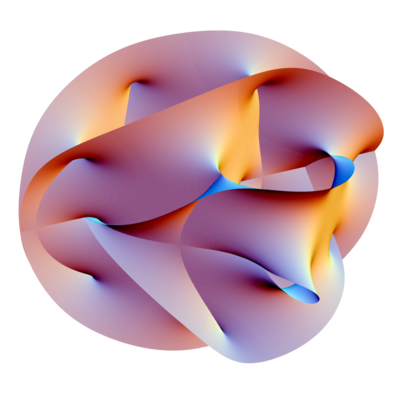


Defining the Calabi-Yau Manifold
A Calabi-Yau manifold, also known as a Calabi-Yau space, is a sophisticated object in differential and algebraic geometry. It is fundamentally a complex manifold that possesses a vanishing first Chern class and admits a Ricci-flat Kähler metric. This means it is a space that locally resembles Euclidean space but can be globally more complex, like the surface of a sphere.
The 'complex' nature implies it has coordinates that are complex numbers, and 'Kähler' refers to a specific type of geometric structure. The 'Ricci-flat' property is crucial; it signifies that the manifold has zero Ricci curvature, a measure of how much the volume of a small ball changes as it moves along the manifold. This property is analogous to flatness in Euclidean space but applies to curved manifolds.
These manifolds are generalizations of K3 surfaces and can exist in various even numbers of real dimensions, though the most studied are six-dimensional ones.
The Historical Trajectory
The theoretical journey of Calabi-Yau manifolds began with Eugenio Calabi's conjectures in 1954 and 1957. Calabi proposed that compact complex manifolds of Kähler type with a vanishing first Chern class would always admit Ricci-flat Kähler metrics. This was a bold statement about the existence of specific geometric structures.
The proof of this conjecture, known as the Calabi conjecture, was provided by Shing-Tung Yau in 1978, a monumental achievement in differential geometry that earned him the Fields Medal. The term 'Calabi-Yau manifold' was later coined by Candelas, de la Vega, Hobbs, and Strominger in 1985, recognizing the foundational work of Calabi and Yau. Their immediate application was in theoretical physics, particularly in the nascent field of superstring theory, where these manifolds were proposed as the geometric form of the universe's hidden dimensions.
The Pivotal Role in Superstring Theory
The significance of Calabi-Yau manifolds is most pronounced in superstring theory, a leading candidate for a unified theory of fundamental forces and particles. Superstring theory posits that the universe has more than the four spacetime dimensions we perceive. These extra dimensions are theorized to be compactified, meaning they are curled up into incredibly small spaces.
Calabi-Yau manifolds are the prime candidates for the geometry of these compactified dimensions, typically six-dimensional ones in the context of heterotic string theory. The specific topological and geometric properties of a Calabi-Yau manifold dictate the spectrum of particles and forces that emerge in the lower-dimensional effective theory. For instance, the number of holes (Betti numbers) in the manifold influences the number of particle generations and the types of gauge symmetries observed in our universe, providing a potential explanation for the Standard Model's features.
Mechanisms of Influence
The way Calabi-Yau manifolds influence physics is through the process of compactification. When the extra six spatial dimensions are curled up into a Calabi-Yau manifold, the vibrations of the fundamental strings are constrained by this geometry. The allowed modes of vibration correspond to the elementary particles and their interactions.
A key aspect is that the Ricci-flatness of the metric ensures that the compactification process does not break supersymmetry, a theoretical symmetry between bosons and fermions. Furthermore, the topology of the Calabi-Yau manifold, particularly its Hodge numbers, determines crucial physical parameters such as the number of massless particles, the coupling constants of the forces, and the existence of chiral fermions, which are essential for describing the observed asymmetry in particle physics (like the difference between left-handed and right-handed electrons).
Mirror Symmetry
One of the most astonishing discoveries concerning Calabi-Yau manifolds is the phenomenon of mirror symmetry, first observed by Candelas et al. in 1991. This principle states that for every Calabi-Yau manifold, there exists a distinct 'mirror' Calabi-Yau manifold such that string theory compactified on the original manifold yields the same physical predictions as string theory compactified on its mirror. These mirror manifolds often have different topological properties but share the same physical spectrum.
This duality has been an incredibly powerful tool, allowing physicists and mathematicians to translate difficult problems in one geometry into simpler problems in its mirror. For example, calculating certain quantities related to the complex structure of one manifold can be mapped to calculating simpler quantities related to the Kähler structure of its mirror, greatly advancing our understanding of both algebraic geometry and string theory.
See also
Frequently Asked Questions
What is a Calabi–Yau manifold?+
Why do scientists use Calabi–Yau manifolds in string theory?+
How many dimensions does a Calabi–Yau manifold have?+
What does Ricci-flat mean for a Calabi–Yau manifold?+
Who proved that Calabi–Yau manifolds have Ricci‑flat metrics?+
Based on content from Wikipedia · Licensed under CC BY-SA 4.0