

Brompton Oratory
Images

Cardnial John Henry Newman, Brompton Oratory, South Kensington, London


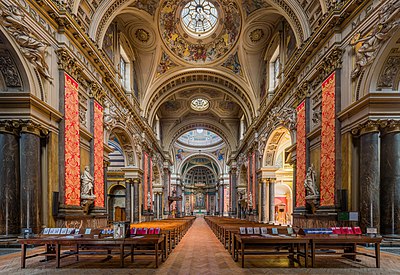


The Genesis and Architectural Splendor of the Oratory
The Brompton Oratory, officially the Church of the Immaculate Heart of Mary, stands as a monumental testament to faith and artistry in London's Brompton district. Its establishment in 1884 by the Oratorians, a religious congregation founded by Saint Philip Neri, marked a significant addition to the city's ecclesiastical landscape. The Oratorians, who reside in the adjacent Oratory House, are integral to the church's ongoing spiritual and pastoral mission, continuing a tradition of preaching, teaching, and communal living.
Architecturally, the Oratory is a striking example of Neo-Baroque style, a revivalist movement that drew inspiration from the dramatic and ornate aesthetics of the Baroque period. This is evident in its majestic three-bay nave, expansive transepts, and the commanding dome that crowns the crossing. The interior is designed to inspire awe and reverence, with rich ornamentation and a sense of grandeur that reflects its spiritual purpose.
Its profound architectural significance is recognized by its Grade II* listing, a designation that underscores its importance as a heritage asset of national importance, ensuring its preservation for future generations. This architectural ambition was not merely for show but was intended to create a space conducive to profound spiritual experience and communal worship.
A Resonant Legacy
The Brompton Oratory is perhaps most widely celebrated for its unparalleled contribution to liturgical music. It has cultivated a reputation for musical excellence that draws both devout worshippers and discerning music lovers. The church actively maintains three distinct choirs, each contributing to a rich and varied musical program that accompanies daily services.
This dedication to high-quality music is not a recent development but a deeply ingrained aspect of the Oratory's identity, reflecting the Oratorian charism of evangelization through beauty and art. The presence of notable musicians, such as the late Ralph Downes, a distinguished organist and composer, further solidifies its status as a center for sacred music. The Oratory's influence extends to the educational sphere through its close association with The London Oratory School.
This school, founded by the Oratorians, has a strong musical tradition, often providing choristers and instrumentalists for the church's services, thus ensuring a continuous pipeline of talent and fostering a lifelong appreciation for sacred music among its students. This symbiotic relationship between the church and the school amplifies the Oratory's impact on musical culture.
A Global Parish and a Post-War Sanctuary
The Brompton Oratory's significance extends beyond its architectural and musical achievements; it serves as a vital spiritual and social hub, attracting a diverse congregation. Its location in a cosmopolitan city like London naturally draws expatriate communities who find solace and a sense of belonging within its hallowed walls. The church has historically played a crucial role in supporting immigrant populations, most notably after World War II.
It temporarily became the spiritual home for the Polish diaspora in London, offering a sanctuary and a place of continuity for a community displaced by conflict. This role highlights the Oratory's capacity for compassion and its commitment to serving those in need, demonstrating that its mission transcends mere religious observance to encompass social responsibility and community building. The church's ability to welcome and integrate people from various backgrounds underscores its enduring relevance as a place of refuge and fellowship in a rapidly changing world.
The Oratorian Charism
The Oratorians themselves are central to the enduring vitality of the Brompton Oratory. Their communal life, lived in the Oratory House, is dedicated to the pursuit of holiness and the service of the Church through preaching, teaching, and the administration of the sacraments. The daily celebration of Mass in both the Ordinary (Novus Ordo) and Extraordinary (Traditional Latin Mass) forms demonstrates a commitment to offering diverse liturgical expressions, catering to a broad spectrum of faithful and reflecting a nuanced approach to tradition.
This dual liturgical practice is a hallmark of many Oratorian foundations worldwide. Furthermore, the Oratory's influence is amplified through its educational apostolate, embodied by The London Oratory School. This institution is not merely an academic establishment but a place where the Oratorian ethos of faith, reason, and virtue is instilled in young minds.
The school's success and its deep connection to the church are integral to the Oratory's long-term mission of forming well-rounded individuals who contribute positively to society.
See also
Frequently Asked Questions
What is the Brompton Oratory?+
Why is the Brompton Oratory known for music?+
Where is the Brompton Oratory located?+
Who built the Brompton Oratory?+
How does the Brompton Oratory help people?+
Based on content from Wikipedia · Licensed under CC BY-SA 4.0