

Bianca (moon)
Images

Bianca (moon)


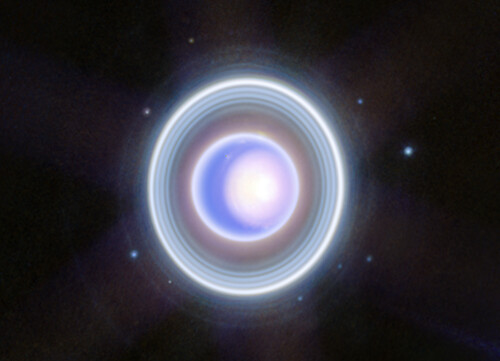


Characterizing an Irregular Uranian Moon
Bianca is classified as an inner moon of Uranus, situated within the planet's complex system of rings and other satellites. Its irregular shape is a common characteristic among smaller celestial bodies, suggesting it has not undergone sufficient gravitational differentiation to become spherical. With an estimated diameter of approximately 52 kilometers (32 miles), Bianca is considerably smaller than the larger Uranian moons like Titania or Oberon.
Its composition is thought to be primarily rocky, with a surface dominated by dark, non-icy materials. This low albedo, estimated to be around 0.05, makes Bianca one of the darkest known moons in the solar system, absorbing most of the incident sunlight. The dark surface material is a key area of scientific interest, potentially offering insights into the primordial composition of the Uranian system or the effects of space weathering and impacts over billions of years.
Orbital Dynamics and Proximity to Uranus
Bianca's orbital path around Uranus is characterized by its speed and closeness to the planet. It completes a full revolution in a remarkably short period of about 9 hours, at an average distance of roughly 60,000 kilometers (37,000 miles) from Uranus's center. This orbital period is significantly shorter than that of the larger, outer moons, placing Bianca within the more dynamic inner region of Uranus's magnetosphere.
Its proximity means it is subject to strong tidal forces and gravitational interactions with Uranus and potentially other inner moons. Understanding Bianca's orbit is crucial for modeling the stability and evolution of the inner Uranian satellite system, including potential orbital resonances and collision probabilities within this crowded celestial neighborhood.
Discovery and Observational Challenges
The existence of Bianca was first confirmed through images captured by the Voyager 2 spacecraft during its historic flyby of the Uranian system in January 1986. The discovery was made by R. J.
Terrile and colleagues, who analyzed the high-resolution images taken by Voyager 2's narrow-angle camera. Identifying such small, dark moons presented a significant observational challenge, requiring sophisticated image processing techniques to distinguish them from background stars and planetary features. Bianca was one of several small inner moons discovered during this mission, which revolutionized our understanding of Uranus and its satellites.
Subsequent observations, though limited, have continued to refine our knowledge of Bianca's orbit and physical characteristics, often relying on advanced ground-based telescopes and space-based observatories.
Compositional Clues and Formation Theories
The extremely low albedo of Bianca suggests a surface composition rich in dark, non-reflective materials. Carbonaceous compounds, similar to those found on some asteroids and comets, are prime candidates for this dark coating. Theories regarding Bianca's formation often involve either accretion within the primordial Uranian disk or capture of an existing body.
Its irregular shape and dark surface could indicate that it is a fragment of a larger body that was shattered by a past impact. Alternatively, it might have formed from the leftover material after Uranus's major moons coalesced. The dark material could also be a result of micrometeoroid bombardment over eons, or it might be related to material ejected from the planet itself.
Further spectral analysis and potential future missions are needed to definitively determine Bianca's precise composition and origin.
Bianca's Role in the Uranian System
While Bianca may seem insignificant due to its size, it plays a role in the dynamics of Uranus's inner satellite system. As one of the moons within the ring plane, it likely influences the structure and stability of the faint epsilon ring, although its exact contribution is debated. Its gravitational interactions with other inner moons, such as Cressida and Desdemona, are significant and contribute to the complex orbital choreography observed in this region.
The potential for collisions between these closely packed moons is a dynamic aspect of the Uranian system, and Bianca's current orbital path places it in a region where such events are theoretically possible over geological timescales. Studying Bianca helps scientists understand the processes that shape planetary satellite systems and the long-term evolution of celestial bodies in our solar system.
See also
Based on content from Wikipedia · Licensed under CC BY-SA 4.0