

Belinda (moon)
Images

Belinda (moon)


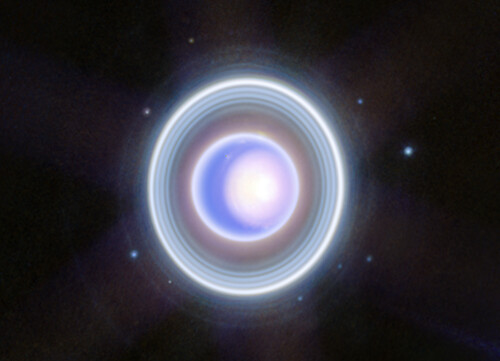


Belinda's Place in the Uranian Satellite System
Belinda is one of Uranus's inner, irregular moons, distinguished by its non-spherical, likely prolate spheroid or potato-like shape. With a diameter of approximately 80 kilometers, it is significantly smaller than the major Uranian moons like Titania or Oberon. Its irregular form suggests it did not undergo sufficient self-gravitation to achieve hydrostatic equilibrium, a state where gravitational forces are balanced by internal pressure, leading to a spherical shape.
This characteristic points towards a formation scenario involving accretion of smaller bodies or fragmentation of a larger parent body, rather than co-formation with Uranus itself. The surface of Belinda is presumed to be heavily cratered, a testament to the bombardment history of the Uranian system, and its low albedo indicates a dark, possibly carbonaceous or rocky surface composition mixed with ice.
A Rapid and Close Orbital Dance
Belinda maintains a close and swift orbit around Uranus, completing a full revolution in approximately 15.6 Earth hours. This orbital period places it at an average distance of about 75,000 kilometers from the planet's cloud tops, well within the inner satellite system. Such proximity exposes Belinda to significant tidal forces exerted by Uranus.
These forces play a critical role in shaping the moon's destiny, potentially contributing to its irregular form and influencing its orbital evolution. The rapid orbital speed and close distance mean that Belinda is a dynamic participant in the complex gravitational interactions within the Uranian system, potentially influencing or being influenced by nearby smaller moons.
Compositional Clues from the Outer Solar System
Based on its location within the Uranian system and the general composition of similar small moons, Belinda is inferred to be composed primarily of a mixture of water ice and silicate rock. The presence of significant amounts of ice is expected given the frigid temperatures of the outer solar system, where sunlight is weak. The rocky component likely consists of minerals such as silicates.
The exact proportions and the presence of other ices, like methane or ammonia, remain speculative without direct sampling. However, its dark appearance suggests a surface that may be coated with tholins or other complex organic compounds, which are formed by the interaction of radiation with simple ices, a common feature on outer solar system bodies.
Belinda as a Probe into Uranian System Formation
The study of Belinda and its fellow inner Uranian moons is vital for understanding the formation and evolution of the entire Uranian satellite system. Their irregular shapes and close orbits suggest they may be captured bodies or remnants of a larger, disrupted moon. Analyzing their orbital dynamics and gravitational resonances can reveal the history of collisions and migrations within the system.
Belinda's existence and characteristics serve as empirical data points that help planetary scientists refine models of satellite formation around ice giants, providing a comparative perspective to the more well-studied Jovian and Saturnian systems. Ultimately, Belinda acts as a small but significant piece of evidence in the grand puzzle of planetary system architecture.
Observational Challenges and Future Prospects
Observing Belinda presents significant challenges due to its small size, low reflectivity, and immense distance from Earth. Most of our knowledge comes from the Voyager 2 flyby in 1986, which provided the first close-up images and orbital data. Future missions to the ice giants, if undertaken, would offer unparalleled opportunities to study Belinda and its companions in greater detail.
Advanced telescopic observations from Earth or space-based platforms might also yield more refined data on its surface properties and orbital parameters. Understanding Belinda contributes to our broader knowledge of the diversity of moons in our solar system and the processes that govern their formation and evolution.
See also
Frequently Asked Questions
What is Belinda?+
How big is Belinda compared to other moons of Uranus?+
How fast does Belinda orbit Uranus?+
Why does Belinda look dark?+
What does Belinda's shape tell scientists?+
Based on content from Wikipedia · Licensed under CC BY-SA 4.0