

The Beehive: New Zealand's Wobbly Wonder!
Images

Beehive, Wellington, New Zealand


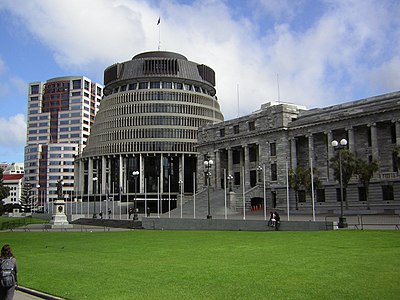

Geographic Context and Architectural Genesis
The Beehive, officially the Executive Wing of New Zealand's Parliament Buildings, is strategically located in Wellington, the nation's capital city. Situated at the intersection of Molesworth Street and Lambton Quay, it forms a prominent part of the parliamentary precinct. Wellington's geographical position at the southern tip of the North Island, known for its dynamic topography and exposed coastal environment, influences the city's character and, by extension, its architecture.
The Beehive's design, conceived by British architect Sir Basil Spence, draws inspiration from a traditional woven beehive, or 'skep.' This deliberate choice moves away from conventional parliamentary architecture, aiming for a more modern and symbolic representation of government. The building's circular form and sloping facade are not merely aesthetic; they contribute to its structural integrity and iconic status within the urban landscape, standing as a bold statement against the backdrop of Wellington's often dramatic weather.
A Decade in the Making
Construction of the Beehive commenced in 1969 and was completed in 1981, marking a significant period of architectural development in New Zealand. This extensive construction timeline reflects the complexity of its design and the ambition to create a state-of-the-art facility. Since 1979, the building has served as the primary location for the offices of government ministers, solidifying its role as the nerve center of New Zealand's executive branch.
Over time, the name 'Beehive' has transcended its literal meaning to become a powerful metonym for the New Zealand Government itself. This linguistic evolution underscores the building's deep integration into the national consciousness and its perceived centrality to political power. The reference to 'the 9th floor,' specifically housing the Prime Minister's office, further illustrates this symbolic association, indicating a precise locus of national leadership within the structure.
The Engine Room of Governance
The Beehive functions as the operational heart of New Zealand's executive government. It houses the ministerial offices where key policy decisions are formulated and implemented. The Prime Minister's office, located on the 9th floor, is the focal point of national leadership, coordinating government strategy.
Crucially, the top floor of the Beehive is dedicated to the Cabinet Room, where the full Cabinet convenes. This is where the collective decision-making process for the nation takes place, addressing critical issues ranging from economic policy and foreign relations to social services and environmental protection. The daily activities within the Beehive represent the intricate workings of a democratic government, where discussions, debates, and strategic planning culminate in actions that shape the country's future.
Heritage, Symbolism, and Enduring Relevance
The Beehive is not merely a functional government building; it is a registered Category I heritage structure, recognized by Heritage New Zealand for its outstanding historical and cultural significance. This designation highlights its importance as a national icon and ensures its preservation for posterity. Its distinctive architectural style and its central role in housing the nation's leaders imbue it with profound symbolic meaning.
The Beehive represents the continuity and evolution of New Zealand's governance. Its unique form challenges traditional notions of parliamentary buildings, offering a modern interpretation of democratic institutions. The building's enduring presence and its frequent use as a metonym for the government demonstrate its deep-seated importance in the political and cultural landscape of New Zealand, making it a subject of ongoing interest and discussion.
The Beehive's Place in the Political Ecosystem
The Beehive's role extends beyond its physical presence; it is intrinsically linked to the functioning of New Zealand's parliamentary democracy. As the seat of the executive, it is where the government of the day directs national policy. The building's design, while iconic, also reflects the functional requirements of housing numerous ministerial departments and facilitating inter-ministerial communication.
Its location within the broader Parliament Buildings complex ensures its integration with the legislative arm of government, though its primary focus remains on executive action. The ongoing use of the Beehive as a symbol and a functional hub underscores its continued relevance in contemporary New Zealand politics. It serves as a tangible representation of governmental authority and a focal point for public engagement with the nation's leadership.
See also
Frequently Asked Questions
What is the Beehive in New Zealand?+
Why does the Beehive look like a beehive?+
Where is the Beehive located?+
When was the Beehive built?+
What happens on the top floor of the Beehive?+
Based on content from Wikipedia · Licensed under CC BY-SA 4.0