

Beach Rugby: Sand, Sun, and Sports!
Images
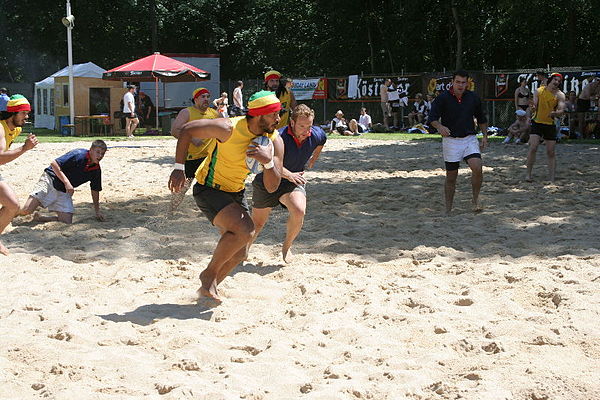
Beach rugby


The Tactical Landscape of Beach Rugby
Beach rugby represents a fascinating evolution in the sport of rugby, adapting its core principles to the demanding and dynamic environment of a sandy beach. The most significant departure from traditional rugby union lies in its condensed format. Typically played with five players per side, often referred to as Beach Five Rugby, the game prioritizes speed, agility, and quick decision-making over the sustained power and territorial dominance seen in 15-a-side rugby.
The playing field is dramatically reduced in size, creating a more intense, close-quarters contest where every player is constantly involved. This spatial compression necessitates a different tactical approach; fewer players mean greater individual responsibility and a need for rapid transitions between attack and defense. Passing becomes even more critical, as does the ability to exploit small gaps in the opposition's formation.
The soft, uneven surface of the sand also introduces unique physical challenges, demanding exceptional balance, core strength, and explosive power for acceleration and change of direction. This makes for spectacular, often acrobatic, plays, as players must adapt their technique for running, tackling, and grounding the ball. The sport's growing popularity, particularly in Europe, is driven by its accessibility, high entertainment value, and the vibrant social atmosphere that often surrounds beach sports events.
From Informal Kickabouts to Formal Competitions
While the precise historical moment of the first beach rugby game is undocumented, the sport's emergence as an organized entity is a more recent phenomenon, mirroring the global rise of other beach sports. Beach rugby can be seen as a natural extension of rugby's inherent appeal – a physically demanding team sport that thrives on camaraderie and competition. Its development has been organic, often starting with informal games played by rugby enthusiasts on holiday or in coastal towns.
The transition to organized leagues and tournaments reflects a desire to formalize these casual encounters and provide a competitive structure. This mirrors the trajectory of beach soccer and beach volleyball, which have successfully established international federations and professional circuits. Beach rugby, while still lacking a single, overarching global governing body, has seen significant progress.
Dedicated organizations in countries like Italy, the UK, USA, and Spain have been instrumental in promoting the sport through annual events and regional competitions. The establishment of the European Beach Five Rugby Championships in Moscow in 2017 was a landmark event, signifying a move towards greater standardization and a more cohesive European competitive landscape. This ongoing development suggests a future where beach rugby could achieve greater international recognition and participation.
The Multifaceted Significance of Beach Rugby
Beach rugby holds significance on multiple levels, extending beyond mere athletic competition. For participants, it offers a unique physical challenge that enhances skills transferable to traditional rugby, such as agility, balance, and explosive power, while also providing a less physically punishing alternative for those seeking a modified rugby experience. The sandy terrain demands a different kind of athleticism, fostering adaptability and resilience.
Socially, beach rugby is a powerful community builder. Its accessible format, with fewer players and a smaller field, encourages participation from a wider range of individuals and skill levels, fostering inclusivity and a strong sense of camaraderie. The informal, often festive atmosphere surrounding beach rugby events contributes to the vibrant culture of coastal communities, promoting active lifestyles and providing engaging entertainment.
Economically, organized beach rugby events can attract tourism and boost local economies. Furthermore, the sport's adaptability and appeal to a younger demographic make it a valuable tool for grassroots development within rugby, potentially serving as an entry point for new players to engage with the sport and its values. Its growing popularity also highlights the broader trend of sports evolving to suit diverse environments and audience preferences.
Navigating the Sands
Beach rugby operates on a simplified rule set derived from rugby union, optimized for speed and the beach environment. The most defining characteristic is the reduced player count, most commonly five per side, which fundamentally alters the game's dynamics compared to the 15-a-side format of rugby union. The playing field is significantly smaller, often measuring around 50-70 meters in length and 20-30 meters in width, with a smaller in-goal area.
Matches are typically short, consisting of two halves lasting between 5 and 10 minutes each, ensuring continuous high-intensity action. The primary objective remains to score by grounding the ball in the opponent's in-goal area, analogous to a try. However, the scoring system is often simplified, with a single try usually worth a set number of points.
Key rugby principles are retained: the ball must be passed backward or laterally, and players can be tackled to stop their progress. However, the rules regarding scrums and line-outs are often modified or omitted entirely to maintain the game's flow. For instance, contested scrums might be replaced by uncontested pushes or simply a handover.
Tackles are generally permitted, but rules may vary regarding the height and nature of tackles to ensure player safety on the sand. This streamlined approach makes beach rugby dynamic, accessible, and exciting, emphasizing continuous play and skillful individual contributions within a team context.
See also
Based on content from Wikipedia · Licensed under CC BY-SA 4.0