

Bayes' Theorem
Images

IMGP3678


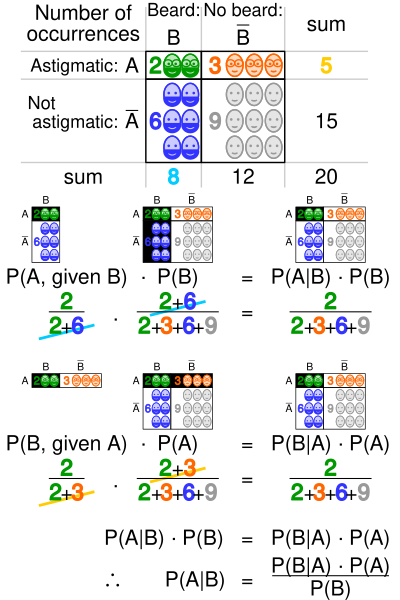


The Art of Inverting Probabilities
Bayes' Theorem, formally stated as P(A|B) = [P(B|A) * P(A)] / P(B), is a cornerstone of probability theory. It provides a rigorous mathematical method for updating the probability of a hypothesis (A) in light of new evidence (B). Its genius lies in its ability to 'invert' conditional probabilities.
Traditionally, we might know the probability of an effect given a cause (P(B|A), the likelihood). Bayes' Theorem allows us to calculate the probability of the cause given the observed effect (P(A|B), the posterior probability). This is revolutionary because it transforms our understanding from 'what happens if X is true?' to 'given that Y happened, how likely is it that X was the cause?' This shift is fundamental to inferential statistics and decision-making under uncertainty.
From Enlightenment Insights to Algorithmic Powerhouses
The theorem's origins trace back to Thomas Bayes' posthumously published essay in 1763, though Pierre-Simon Laplace independently developed similar ideas in the late 18th and early 19th centuries. Initially, its impact was primarily within academic circles. However, with the advent of computational power, Bayesian methods have experienced a renaissance.
They are now integral to fields like machine learning, where algorithms learn and adapt from vast datasets. The concept of 'Bayesian inference' is central here, allowing models to continuously refine their predictions as more data becomes available, much like a scientist iteratively testing and revising hypotheses based on experimental outcomes.
The Clinical and Scientific Imperative
In medicine, Bayes' Theorem is indispensable for interpreting diagnostic tests. Consider a test for a rare condition. Even a highly accurate test can produce a significant number of false positives when applied to a large population where the condition is uncommon.
Bayes' Theorem quantifies this by factoring in the prevalence of the disease (prior probability) and the test's sensitivity and specificity (likelihood). This allows clinicians to determine the true probability of a patient having the disease given a positive test result (posterior probability), preventing over-diagnosis and unnecessary anxiety. Similarly, in scientific research, it helps in evaluating the strength of evidence for competing theories, guiding the direction of future investigations.
The Modern Landscape
Today, Bayes' Theorem is not just a theoretical curiosity; it's a practical engine driving innovation. In artificial intelligence, it underpins algorithms for spam filtering, recommendation systems, and natural language processing, where probabilities are constantly updated based on user interactions and new information. The rise of 'big data' has amplified its utility, providing the vast datasets needed to train sophisticated Bayesian models.
Its principles are also found in fields as diverse as finance, engineering, and even cosmology, wherever probabilistic reasoning and updating beliefs based on evidence are crucial for understanding complex phenomena and making informed decisions in an uncertain world.
See also
Frequently Asked Questions
What is Bayes' Theorem?+
Why is Bayes' Theorem important for medicine?+
How does Bayes' Theorem help computers learn?+
When did Bayes' Theorem first appear?+
Where can we see Bayes' Theorem used today?+
Based on content from Wikipedia · Licensed under CC BY-SA 4.0