

Bay of Fundy
Images

Wpdms Nasa Topo Bay Of Fundy En


The Mechanics of Earth's Highest Tides
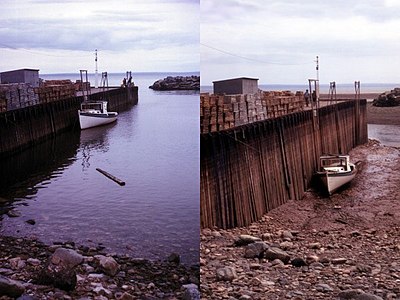
The Bay of Fundy, situated between New Brunswick and Nova Scotia, Canada, and bordering Maine, USA, is globally recognized for hosting the planet's most extreme tidal range. This phenomenon, reaching up to 16 meters (52 feet) at its peak, is a complex interplay of several factors. The bay's funnel-like shape amplifies the tidal bulge created by the gravitational forces of the moon and sun.
Furthermore, the natural period of the bay's water oscillation closely matches the semi-diurnal tidal cycle (approximately 12 hours and 25 minutes), leading to a resonant effect that dramatically increases the tidal amplitude. This constant, powerful influx and outflow of water significantly impacts coastal geomorphology, creating dramatic sea cliffs, extensive intertidal zones, and unique geological formations like the Hopewell Rocks, where visitors can walk on the seabed at low tide and kayak past towering formations at high tide.
Echoes of the First Peoples and European Encounters
The shores of the Bay of Fundy have been inhabited for millennia, with indigenous peoples like the Mi'kmaq and Passamaquoddy leaving a profound cultural imprint. Their names for the bay, such as 'Bakudabakek' ('open way') and 'Wekwabegituk' ('waves at the head of the bay'), reflect a deep understanding of its geography and power. These names highlight the bay's role as a vital corridor for travel and sustenance.
Later, European explorers and settlers arrived. The origin of the name 'Fundy' is debated, with theories ranging from French terms like 'fendu' (split) or 'Fond de la Baie' (head of the bay) to potential Portuguese influences from explorers like João Álvares Fagundes, who may have referred to it as 'Gram Baya' ('Great Bay'). These historical layers underscore the bay's long-standing significance as a point of connection and resource.
Ecological Significance and Biodiversity Hotspot
The extreme tidal range is the driving force behind the Bay of Fundy's exceptional biodiversity. The constant churning of water oxygenates the sea and resuspends nutrients from the seafloor, creating a highly productive marine environment. This makes the bay a critical feeding and breeding ground for a vast array of species.
It is renowned for whale watching, attracting numerous species including humpback, fin, and the endangered North Atlantic right whale. The intertidal zones, exposed for hours each day, support specialized plant and animal life adapted to these fluctuating conditions, including extensive salt marshes that serve as nurseries for fish and vital habitats for migratory birds. The bay's unique conditions necessitate a robust understanding of marine biology and conservation efforts to protect its delicate balance.
Economic Landscape
Historically, the Bay of Fundy's economy has been shaped by its natural resources. Fishing, particularly for species like lobster, scallops, and herring, has been a cornerstone industry for generations, supporting numerous coastal communities. The dramatic tides also influence shipping and marine transportation, requiring careful navigation and port management. In recent decades, tourism has become a significant economic driver, with visitors drawn to the unique tidal phenomena, whale watching, and scenic coastal landscapes.
Looking forward, the Bay of Fundy presents a compelling case for renewable energy development. Its powerful tides offer immense potential for tidal power generation, a clean and sustainable energy source that could significantly contribute to Canada's energy independence and climate change mitigation goals, though careful environmental impact assessments are crucial.
Governance and Educational Pursuits in a Tidal Realm
The governance of the Bay of Fundy involves multiple levels of Canadian federal, provincial (New Brunswick and Nova Scotia), and municipal authorities, alongside federal agencies in the United States for the shared waters. Management of fisheries, marine protected areas, and environmental regulations requires inter-jurisdictional cooperation. Educational institutions in the surrounding provinces play a vital role in researching and understanding the bay's complex systems.
Universities and research centers focus on marine biology, oceanography, and the environmental impacts of human activities, including potential tidal energy projects. Public education initiatives aim to foster stewardship and awareness of the bay's ecological and economic importance, ensuring its preservation for future generations through scientific inquiry and community engagement.
See also
Frequently Asked Questions
What makes the Bay of Fundy have the biggest tides in the world?+
How can people walk on the sea floor at the Hopewell Rocks?+
Why do whales like the Bay of Fundy?+
Where do the Mi'kmaq people live near the Bay of Fundy?+
How do the tides help fish and birds?+
Based on content from Wikipedia · Licensed under CC BY-SA 4.0