

Battle of Preveza
Images

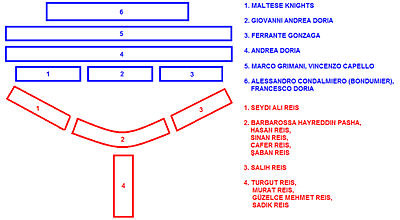
Fleet Configurations at the Battle of Preveza in 1538-ar




The Geopolitical Crucible
The mid-16th century Mediterranean was a complex geopolitical chessboard, dominated by the expanding Ottoman Empire and the formidable Habsburg powers, primarily Spain under Charles V. The Ottoman navy, under the command of the brilliant admiral Hayreddin Barbarossa, had become a formidable force, projecting power across North Africa and challenging Christian shipping.
This expansion was perceived as an existential threat by European powers, particularly Venice and the Papacy, who relied on Mediterranean trade and feared the spread of Ottoman influence. In response, Pope Paul III orchestrated the formation of the Holy League in 1538, an alliance intended to counter Barbarossa's dominance. This league comprised naval forces from the Papal States, Spain, Venice, Genoa, and the Knights Hospitaller.
However, internal rivalries, particularly between Venice and Spain, and differing strategic priorities, plagued the League even before the first shot was fired, foreshadowing the challenges they would face against a more unified Ottoman command.
Commanders, Fleets, and Strategic Imperatives
The Battle of Preveza pitted two distinct naval philosophies and leadership styles against each other. The Ottoman fleet, led by Barbarossa, was a cohesive fighting force, characterized by its speed, maneuverability, and experienced crews. Barbarossa favored the use of galleys, which were well-suited for the relatively calm waters of the Ionian Sea and excelled in ramming and boarding tactics.
His fleet was also adept at utilizing artillery effectively. Conversely, the Holy League fleet, nominally under the command of Andrea Doria, a Genoese admiral in Spanish service, was a more heterogeneous collection of vessels, including galleys and larger sailing ships. Doria's strategic approach was often cautious, prioritizing the preservation of his fleet over aggressive engagement, a stance that frustrated his allies.
The League's objective was to destroy Barbarossa's fleet and disrupt Ottoman control over key maritime territories, thereby stemming the tide of Ottoman expansion into Christian Europe.
The Engagement
The battle commenced on September 28, 1538, near Preveza. Barbarossa, aware of the Holy League's numerical superiority but also their strategic disunity, employed a masterful strategy. He positioned his fleet to draw the Holy League into a disadvantageous position, utilizing the wind and currents to his benefit.
As the Holy League attempted to form a battle line, Barbarossa launched a series of swift, coordinated attacks. The Ottoman galleys, with their superior speed and skilled crews, outmaneuvered the larger, slower Holy League vessels. Crucially, Barbarossa's fleet effectively used its artillery, inflicting significant damage.
The Holy League's command structure faltered, with Doria reportedly hesitant to commit his forces fully, leading to a piecemeal engagement. The result was a catastrophic defeat for the Holy League; many ships were sunk or captured, and thousands of men were lost. The Ottoman victory was decisive, shattering the hopes of a united Christian front against Ottoman naval power.
Enduring Repercussions
The Battle of Preveza was a watershed moment in 16th-century Mediterranean history. It unequivocally established Ottoman naval supremacy in the Eastern Mediterranean for the next three decades, effectively neutralizing the threat posed by the Holy League and allowing the Ottomans to project power with relative impunity. This victory had significant implications for trade, exploration, and the political landscape of Southern Europe and North Africa.
It underscored the limitations of ad hoc alliances against a centralized, professionalized military force. Furthermore, Preveza, alongside subsequent battles like Djerba and Lepanto, contributed to the evolution of naval warfare doctrine, highlighting the importance of coordinated fleet actions, effective artillery use, and skilled seamanship. The battle's legacy is one of strategic brilliance by Barbarossa and a stark reminder of the consequences of disunity among opposing forces, shaping maritime power dynamics for generations.
See also
Frequently Asked Questions
What was the Battle of Preveza?+
Who won the Battle of Preveza?+
Why was the Battle of Preveza important?+
Who was Hayreddin Barbarossa?+
Why did the Holy League lose?+
Based on content from Wikipedia · Licensed under CC BY-SA 4.0