

Battle of Plassey
Images

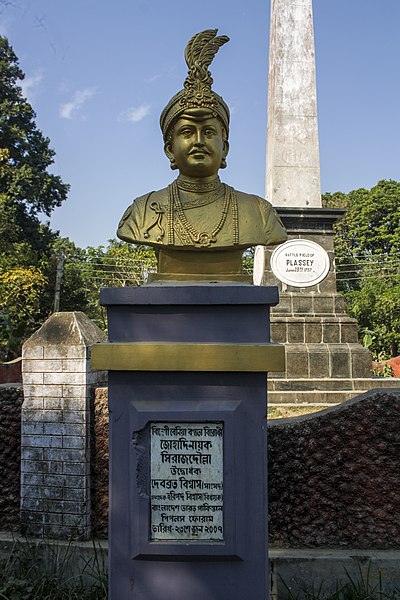
The Monument of Battle of Plassey - Palashi Gate 01




The Crucible of Commerce and Conquest
The mid-18th century saw the British East India Company evolve from a mercantile enterprise into a formidable political and military power in India. Bengal, the wealthiest province of the Mughal Empire, became the focal point of this ambition. The Nawab, Siraj-ud-Daulah, recently ascended to power, inherited a complex political landscape and viewed the expanding fortifications and trading privileges of the British with deep suspicion.
His predecessor, Alivardi Khan, had maintained a delicate balance, but Siraj-ud-Daulah's attempts to assert his sovereignty, including halting British expansion and demanding tribute, directly challenged the Company's burgeoning influence. Simultaneously, the broader geopolitical context of the Seven Years' War (1756-1763) intensified rivalries between European powers, including the British and French, in India, adding another layer of strategic complexity to the situation. The Company, under Robert Clive, recognized that direct confrontation with the numerically superior Nawab was perilous, necessitating a more insidious strategy.
The Architecture of Treachery
Facing an army estimated at 50,000 soldiers, including cavalry and war elephants, against his own force of around 3,000, Robert Clive understood that a conventional military victory was highly improbable. His strategy hinged on exploiting internal dissent within the Nawab's court. Clive orchestrated a sophisticated conspiracy, primarily targeting Mir Jafar, the Nawab's Mir Bakshi (commander-in-chief), who harbored ambitions for the throne and felt slighted by Siraj-ud-Daulah.
Clive offered Mir Jafar the Nawabship in exchange for his allegiance and the neutrality of his troops during the impending battle. This pact was solidified through bribes and promises, involving other influential figures like Yar Lutuf Khan and the wealthy Jagat Seth bankers. The conspiracy ensured that a significant portion of the Nawab's own army would not engage, effectively neutralizing his numerical advantage before the first shot was even fired.
The Battle Itself
The engagement at Plassey on June 23, 1757, was characterized less by pitched combat and more by the unfolding of the pre-arranged betrayal. While the Nawab's army was positioned to encircle the British, Mir Jafar's troops remained largely inactive. A sudden downpour disrupted the Nawab's artillery, and confusion spread through his ranks.
Seeing his forces faltering and his commanders failing to act decisively, Siraj-ud-Daulah, perhaps realizing the extent of the treachery, made the fateful decision to flee the battlefield. This act of desertion demoralized the remaining loyal troops. Clive's disciplined soldiers, seizing the opportunity presented by the chaos and the Nawab's flight, were able to overcome the disorganized remnants of the Nawab's army.
The battle concluded within approximately 11 hours, a testament to the effectiveness of Clive's strategic subversion rather than battlefield prowess.
The Genesis of Empire
The Battle of Plassey stands as a watershed moment in Indian history, marking the effective beginning of British colonial rule. The victory granted the British East India Company unprecedented political and economic leverage over Bengal. They secured substantial financial reparations, trade concessions, and the right to collect taxes (Diwani), which provided the capital to fund their military expansion.
This influx of wealth and power enabled the Company to systematically undermine and conquer other Indian states, gradually extending its dominion across the subcontinent and beyond, including Burma. Plassey demonstrated the efficacy of 'divide and rule' tactics and established a precedent for British intervention in Indian affairs, fundamentally altering the trajectory of South Asian history and initiating a century of colonial exploitation and transformation.
See also
Frequently Asked Questions
What was the Battle of Plassey?+
Why did the British use a secret plan instead of fighting many soldiers?+
Who was Mir Jafar and why did he help the British?+
What happened to the Nawab during the battle?+
How did the Battle of Plassey change India?+
Based on content from Wikipedia · Licensed under CC BY-SA 4.0