

Battle of Perryville
Images

Perryville 1545


The Strategic Stakes of the Kentucky Campaign
The Battle of Perryville, fought on October 8, 1862, was the climax of the Confederate Heartland Offensive, also known as the Kentucky Campaign. This ambitious Confederate push, led by General Braxton Bragg, aimed to shift the momentum of the Civil War in the Western Theater. Capturing Kentucky, a crucial border state rich in resources and manpower, would have been a significant strategic coup for the Confederacy, potentially opening pathways into the Union heartland and influencing Northern public opinion.
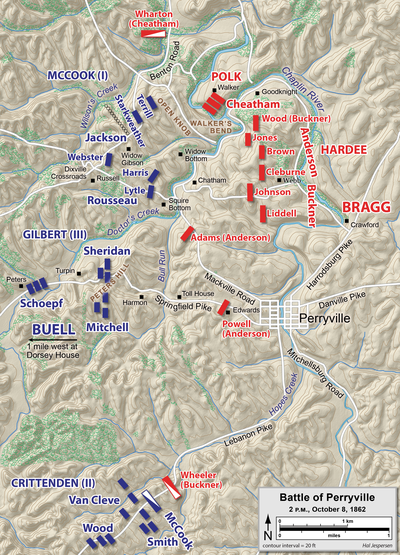
Bragg's Army of Mississippi initially achieved some success, but the Union Army of the Ohio, under Major General Don Carlos Buell, was in hot pursuit. Buell's army, though larger, was spread across three converging columns, a logistical challenge that would prove critical on the battlefield. The convergence on the small crossroads town of Perryville set the stage for a desperate confrontation.
Chaos, Thirst, and Tactical Maneuvers
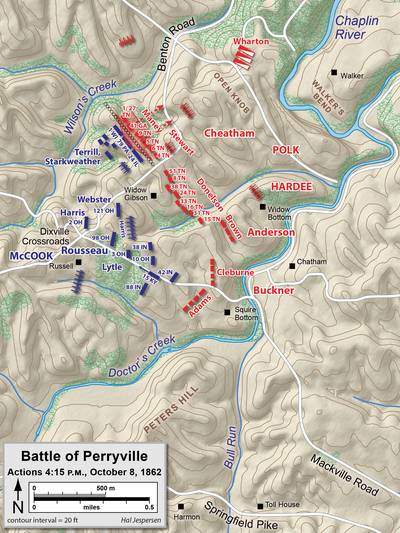
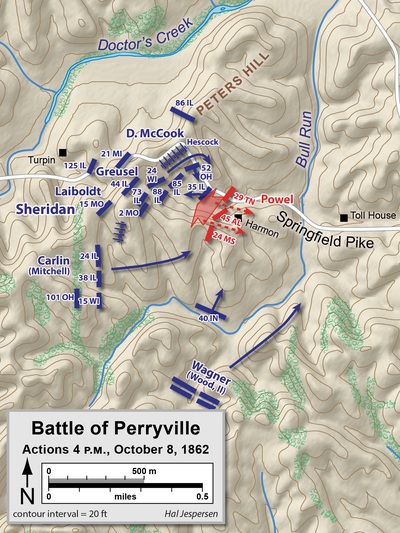
The battle commenced amidst a severe drought, making access to water a primary objective for both armies. This desperate need for water amplified the ferocity of the fighting. Initial skirmishes on the Springfield Pike quickly escalated as Confederate infantry arrived, engaging Union forces on Peters Hill. The Confederates, seeking to exploit any advantage, launched a powerful assault on the Union left flank, primarily targeting the I Corps of Major General Alexander M.
McCook. This attack was devastating, forcing significant Union units to retreat in disarray. The battlefield became a scene of intense close-quarters combat, with soldiers fighting desperately for every inch of ground.
The Union line, though battered, showed resilience, with reinforcements arriving to stabilize the situation.
Command Failures and Battlefield Realities
A significant factor contributing to the battle's outcome was the disconnect in command. Major General Buell, the Union commander, was several miles behind the main fighting and remained largely unaware of the scale of the engagement until late in the afternoon. This lack of immediate situational awareness meant that crucial reserves were not deployed effectively until the Union left flank was on the verge of collapse.
Conversely, Confederate command, while achieving tactical success in pushing back the Union I Corps, struggled with coordination and suffered from shortages of men and supplies. Later Confederate assaults on the Union positions along the Springfield Pike were repulsed, and skirmishes extended into the streets of Perryville as Union troops pressed their advantage.
Strategic Victory Amidst Tactical Gains
Despite inflicting heavy casualties and achieving a tactical victory on October 8th, General Bragg was forced to make a strategic withdrawal. Facing dwindling supplies, insufficient manpower, and the looming threat of Buell's reinforced army, Bragg ordered his troops to retreat during the night. They withdrew through Cumberland Gap back into East Tennessee.
The Battle of Perryville, though one of the bloodiest engagements of the war relative to the forces engaged, resulted in a decisive strategic Union victory. The Union retained control of Kentucky, a state vital for its resources, industry, and strategic position, for the remainder of the conflict. The battle underscored the importance of logistics, command communication, and the high human cost of the Civil War.
Enduring Legacy and Historical Significance
The Battle of Perryville holds a significant place in Civil War historiography as the largest battle fought in Kentucky and a critical moment in the Western Theater. While often overshadowed by Eastern battles like Gettysburg, Perryville represented a major turning point. Had Bragg succeeded in securing Kentucky, the Confederacy's strategic position would have been dramatically improved, potentially prolonging the war or altering its outcome.
The battle's immense casualties, estimated at over 7,000 combined killed, wounded, and missing, served as a grim reminder of the war's brutal reality. Its outcome solidified Union control over a key border state, bolstering Union morale and resources, and effectively ending major Confederate attempts to conquer Kentucky.
See also
Based on content from Wikipedia · Licensed under CC BY-SA 4.0