

Battle of Midway
Images

USFWS Commemorates 77th Anniversary of the Battle of Midway




Strategic Imperatives and Pre-Battle Maneuvers
The Battle of Midway, fought from June 4-7, 1942, was a direct consequence of Japan's ambitious expansionist policies and the United States' determination to halt them. Six months after the devastating attack on Pearl Harbor, Japan sought to extend its defensive perimeter and eliminate the U.S. Pacific Fleet's carrier strength.
Admiral Isoroku Yamamoto's plan was audacious: capture Midway Atoll, a strategically vital outpost, and draw out the remaining American carriers into a decisive engagement. This would cripple U.S. naval power and secure Japanese dominance in the Pacific. However, Yamamoto's plan suffered from overconfidence and a dispersal of forces, leaving his strike force, the Kidō Butai under Vice Admiral Chuichi Nagumo, vulnerable.
The Doolittle Raid on Tokyo in April had also heightened Japanese anxieties, prompting them to seek a swift, conclusive victory to deter further American aggression.
The Unseen Advantage
Japan's meticulously planned operation was critically undermined by the U.S. Navy's cryptanalytic success. Station Hypo, led by Commander Joseph Rochefort, had broken key Japanese naval codes, allowing them to anticipate the timing and target of the upcoming offensive. This intelligence provided Admiral Chester Nimitz, Commander-in-Chief of the U.S.
Pacific Fleet, with an invaluable strategic advantage. Knowing that Midway was the target and anticipating the approximate arrival of the Japanese fleet, Nimitz was able to assemble a superior carrier force under Admirals Frank Jack Fletcher and Raymond Spruance. This force lay in wait northeast of Midway, preparing an ambush.
The Japanese, expecting to surprise the Americans, were instead walking into a trap, a testament to the power of intelligence in modern warfare.
The Clash of Carriers
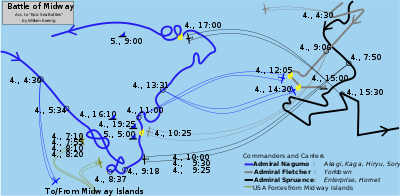
The Battle of Midway was primarily an air battle, fought entirely by aircraft launched from carriers. On June 4, Nagumo launched his first wave of bombers against Midway. While the attack caused damage, it failed to neutralize the island's defenses.
Crucially, the Japanese strike force remained vulnerable, with their aircraft rearming and refueling on deck, a highly dangerous procedure. U.S. torpedo bombers, though suffering horrific losses, drew the Japanese fighter cover down to sea level. This allowed successive waves of American dive bombers to attack the Japanese carriers virtually unopposed.
In a matter of minutes, the Akagi, Kaga, and Sōryū were engulfed in flames. The Hiryū, the last remaining Japanese carrier, launched a counterattack that severely damaged the USS Yorktown, but it too was subsequently sunk by American planes. This concentrated destruction of Japan's carrier fleet was the battle's defining moment.
Consequences and Historical Significance
The Battle of Midway was a catastrophic defeat for Japan, resulting in the loss of four fleet carriers, a heavy cruiser, and over 3,000 men, including many highly trained pilots who were irreplaceable. The U.S. lost the carrier Yorktown and the destroyer Hammann. Strategically, Midway was the turning point of the Pacific War.
It halted Japan's eastward expansion and marked the end of their offensive capability. From this point forward, the United States, with its superior industrial capacity and manpower, began to seize the initiative, pushing Japan back across the Pacific. Historians widely regard Midway as one of the most decisive naval battles in history, fundamentally altering the course of World War II and shaping the geopolitical landscape of the post-war era.
See also
Frequently Asked Questions
What was the Battle of Midway and when did it happen?+
Why did Japan want to capture Midway?+
How did the U.S. win the Battle of Midway?+
What happened to the Japanese carriers during the battle?+
Why is the Battle of Midway important?+
Based on content from Wikipedia · Licensed under CC BY-SA 4.0