

Battle of Gaugamela
Images

Rendition of the Alexander Mosaic of the Battle of Gaugamela in Erbil 04




The Prelude to Confrontation
The Battle of Gaugamela, fought in 331 BC, was the culmination of Alexander the Great's ambitious campaign to dismantle the Achaemenid Persian Empire. Following his victories at Granicus and Issus, Alexander had secured Asia Minor and the Levant, but the heart of the empire, ruled by Darius III, remained. Darius, having learned from his previous defeats, meticulously prepared for this decisive encounter.
He chose the plains of Gaugamela, a location he believed offered the best terrain for his numerically superior army, which included scythed chariots, war elephants, and diverse contingents from across his vast empire. Darius's strategy was to negate Alexander's tactical advantages by creating a broad battlefield where his sheer numbers and specialized units could envelop and crush the Macedonian forces. This was not merely a territorial dispute; it was a clash between two vastly different political and military systems, with Alexander representing the dynamic, expansionist Hellenic world and Darius defending the established, multi-ethnic Persian order.
Tactical Ingenuity vs. Overwhelming Force
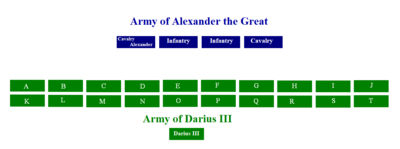
The battlefield at Gaugamela presented a stark contrast in military philosophy. Alexander's army, though significantly outnumbered (estimates vary widely, but often place the Persian force at least 3-4 times larger), was a highly disciplined and cohesive fighting force, renowned for its combined arms tactics, particularly the Macedonian phalanx and elite Companion cavalry. Darius deployed his army in a crescent formation, intending to flank Alexander.
Alexander, anticipating this, employed a brilliant counter-strategy. He weakened his center and reinforced his flanks, deliberately creating a gap in the Persian line by advancing his oblique formation. When Darius's chariots were launched, they were largely ineffective due to the disciplined response of the Macedonian infantry.
Alexander then masterfully led his Companion cavalry in a wedge formation, striking directly at Darius's position in the Persian center. This bold maneuver, a hallmark of Alexander's personal leadership, caused Darius to flee, shattering the morale and cohesion of the Persian army and leading to its disintegration.
Architects of Destiny
The central figures of Gaugamela were Alexander the Great and Darius III. Alexander, at roughly 25 years old, was a military prodigy. His leadership was characterized by personal bravery, strategic foresight, and an uncanny ability to adapt to battlefield conditions.
He was not just a commander but a charismatic figure who inspired fierce loyalty in his troops, often fighting alongside them. His tactical genius lay in his understanding of maneuver warfare and the psychological impact of decisive strikes. Darius III, on the other hand, was the last effective ruler of the Achaemenid Empire.
While he commanded immense resources and a vast army, his military acumen was less pronounced. His decision-making at Gaugamela, including the choice of battlefield and deployment, has been criticized by historians as being too rigid and predictable, ultimately playing into Alexander's hands. The contrast between their leadership styles and strategic capabilities was a critical factor in the battle's outcome.
The Shattering of an Empire
The victory at Gaugamela was not merely a military triumph; it was the death knell for the Achaemenid Persian Empire. Darius III's flight led to the immediate collapse of his authority, and he was later assassinated by his own satraps. Alexander marched into Babylon, Susa, and Persepolis, seizing immense treasures and consolidating his control over the former Persian heartlands.
This conquest marked the end of over two centuries of Achaemenid rule. The battle effectively transferred imperial power from Persia to Macedon, initiating a new era. Alexander's subsequent campaigns further expanded his dominion, creating an empire that, though short-lived in its unified form, had profound and lasting consequences for the geopolitical and cultural landscape of the ancient world.
Enduring Legacies
The Battle of Gaugamela's significance extends far beyond its immediate military and political ramifications. It ushered in the Hellenistic Age, a period characterized by the widespread dissemination of Greek language, culture, art, and philosophy across the vast territories conquered by Alexander. This cultural fusion created a cosmopolitan world where Eastern and Western traditions interacted, influencing everything from science and mathematics to religion and governance.
The strategic principles demonstrated by Alexander, such as the use of combined arms, decisive cavalry charges, and exploiting enemy weaknesses, have been studied and emulated by military leaders for millennia. Furthermore, the concept of a single, dominant empire stretching across diverse regions, a legacy of both Persia and Alexander's conquests, continued to shape political aspirations and conflicts throughout history, influencing the formation of later empires and the very notion of global power.
See also
Based on content from Wikipedia · Licensed under CC BY-SA 4.0