

Aula Magna (Central University of Venezuela)
Images
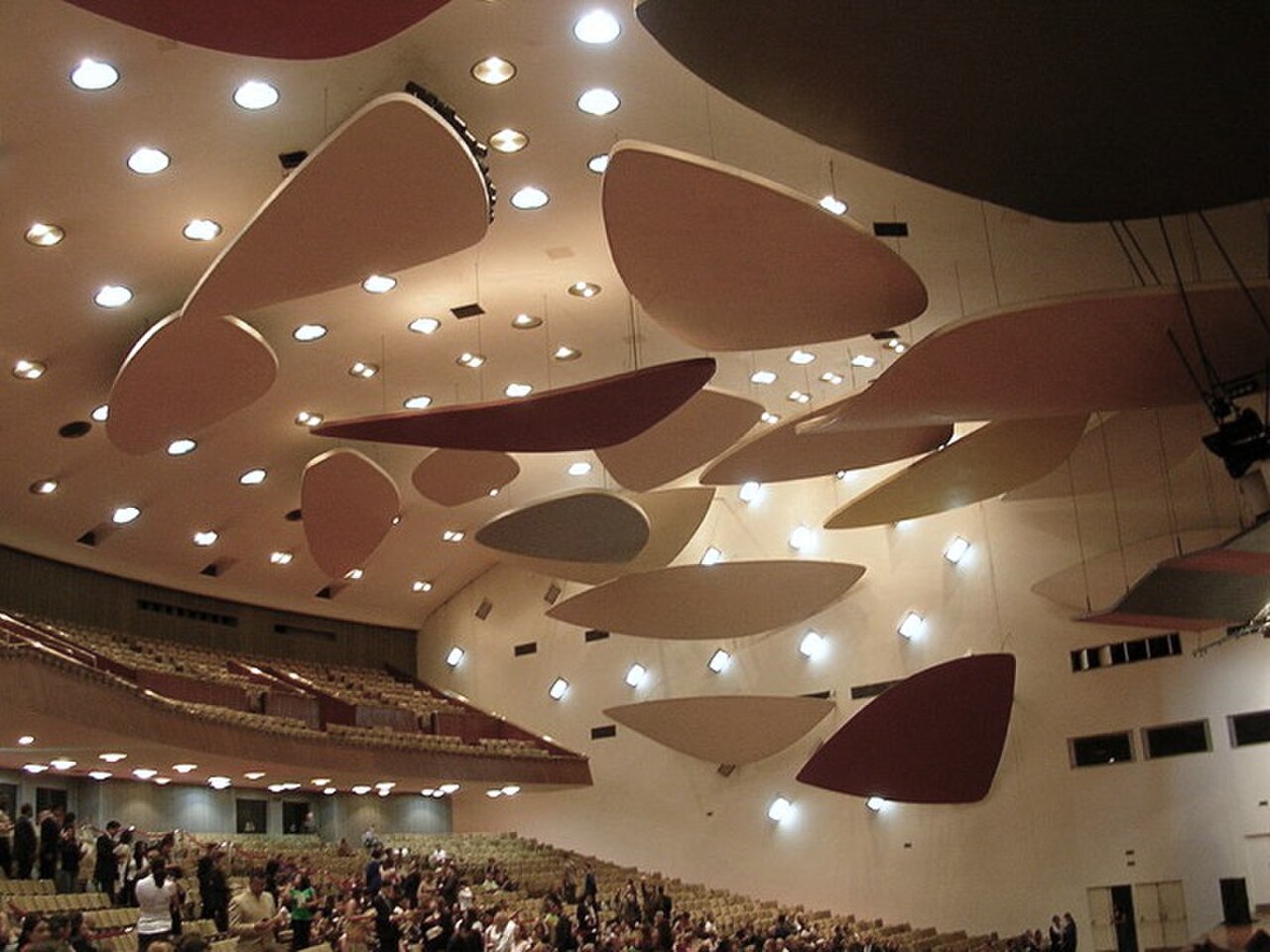
Aula Magna-Calder-UCV

Villanueva's Vision
The Aula Magna, a jewel within the University City of Caracas, stands as a monumental achievement of 20th-century modernism, conceived by the visionary Venezuelan architect Carlos Raúl Villanueva. Commissioned in the 1940s and realized between 1952 and 1953 by the Danish firm Christiani & Nielsen, the auditorium is a prime example of Villanueva's holistic approach to design, where architecture, art, and urban planning converge.
Its inclusion as a UNESCO World Heritage Site in 2000 underscores its international importance, recognizing it not merely as a building but as a significant contribution to global architectural heritage. The exterior of the Aula Magna is striking in its own right, reflecting the bold aesthetic principles of its era. However, it is the interior, particularly its revolutionary acoustic treatment, that elevates it to a status of unparalleled distinction, showcasing a profound understanding of how space can shape human experience.
The 'Clouds'
The most iconic and revolutionary element of the Aula Magna is undoubtedly its 'clouds.' These are not mere decorative features but sophisticated, movable acoustic diffusers designed by Villanueva himself. Comprising a series of large, colorful, and dynamically shaped panels suspended from the ceiling, they represent a groundbreaking fusion of artistic expression and scientific application. The clouds were meticulously engineered to manipulate sound waves within the vast auditorium.
Their placement and form are calculated to reflect and scatter sound, preventing echoes and ensuring that speech and music are delivered with exceptional clarity and fidelity to every seat. This innovative system was at the forefront of acoustic science for interior spaces, influencing subsequent architectural designs worldwide. Beyond their functional prowess, the clouds imbue the hall with a vibrant, almost surreal aesthetic, transforming the ceiling into a dynamic canvas that enhances the overall sensory experience of the audience.
A Nexus of Culture, Politics, and National Identity
The Aula Magna's designation as the 'most important auditorium' at the Central University of Venezuela is well-earned, stemming from both its physical capacity and its profound historical and cultural resonance. With a seating capacity of approximately 2,700, expandable through the removal of seats, it is the largest venue on campus, perfectly suited for large-scale events. However, its true significance lies in its role as a stage for pivotal moments in Venezuelan history.
It has hosted countless influential academic lectures, world-class artistic performances, and critical political assemblies. Many of these events have been instrumental in shaping national discourse, fostering intellectual movements, and even influencing the course of the country's political trajectory. The hall has thus become a symbol of collective memory and a space where national identity has been forged and debated.
Enduring Legacy and Contemporary Challenges
In contemporary Caracas, the Aula Magna continues to serve as a vital cultural and intellectual hub, hosting a diverse range of events that engage the university community and the wider public. Despite its monumental status, the building faces significant challenges common to many historic structures. The source notes its involvement in political controversies and, crucially, a persistent lack of funding for essential maintenance.
This situation highlights the delicate balance between preserving architectural heritage and ensuring its continued functionality and relevance in the modern era. The ongoing need for resources to maintain its structural integrity and its unique artistic and acoustic features is paramount to safeguarding this irreplaceable landmark for future generations. The Aula Magna remains a powerful testament to human ingenuity, artistic vision, and the enduring importance of public spaces for civic life and cultural expression.
See also
Frequently Asked Questions
What is the Aula Magna at the Central University of Venezuela?+
Why are the "clouds" in the Aula Magna important?+
How many people can the Aula Magna seat?+
Who designed the Aula Magna?+
What kinds of events are held in the Aula Magna?+
Based on content from Wikipedia · Licensed under CC BY-SA 4.0