

ATP synthase: Your Body's Tiny Energy Makers!
Images

ATP Synthase Model


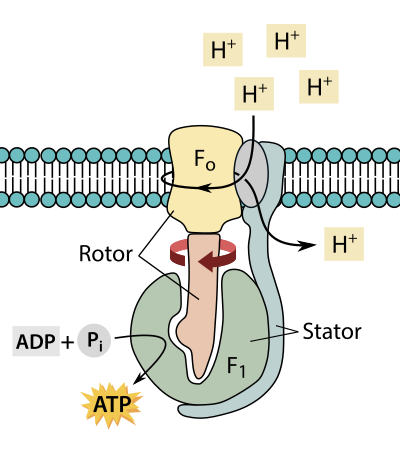


The F1Fo-ATPase
ATP synthase, classified as an F-type ATPase (though primarily functioning in ATP synthesis in vivo), represents one of the most sophisticated molecular machines known to science. This enzyme complex is strategically embedded within cellular membranes, spanning the lipid bilayer to harness electrochemical gradients. In eukaryotes, it resides on the inner mitochondrial membrane, crucial for oxidative phosphorylation.
In photosynthetic organisms, it's found on the thylakoid membrane of chloroplasts, powering photophosphorylation. Its structure is bipartite, comprising the membrane-bound F₀ component and the catalytic F₁ component, which protrudes into the mitochondrial matrix or chloroplast stroma. The F₀ portion acts as a proton channel, while F₁ contains the enzymatic sites for ATP synthesis.
This intricate design allows for the efficient conversion of proton motive force into chemical energy stored in ATP.
Rotational Catalysis
The groundbreaking discovery that ATP synthase operates via a rotational mechanism revolutionized our understanding of enzyme function. The F₀ subunit contains a central stalk that connects to the F₁ subunit. As protons translocate through the F₀ complex, they induce the rotation of this central stalk and the c-ring within F₀.
This rotation is transmitted to the F₁ subunit, specifically to its alpha and beta subunits. Each beta subunit cycles through different conformational states, driven by the rotation, which facilitates the binding of ADP and inorganic phosphate, their catalytic conversion to ATP, and the subsequent release of ATP and water. This continuous rotary motion, often described as a 'molecular turbine,' allows for the synthesis of hundreds of ATP molecules per second per enzyme, showcasing remarkable efficiency and precision.
Bioenergetic Gradients
ATP synthase does not operate in isolation; it is intrinsically linked to the generation of proton gradients across cellular membranes. In mitochondria, the electron transport chain pumps protons from the mitochondrial matrix to the intermembrane space, creating a significant electrochemical potential difference. This gradient, known as the proton motive force, is the direct energy source for ATP synthesis.
Similarly, in chloroplasts, light-dependent reactions of photosynthesis establish a proton gradient across the thylakoid membrane. This gradient is then utilized by ATP synthase to produce ATP, which is subsequently used in the Calvin cycle to fix carbon dioxide. The efficiency of ATP synthase is directly proportional to the strength of these bioenergetic gradients.
Evolutionary Significance and Modern Relevance
The F₁F₀-ATPase/synthase is considered one of the most ancient molecular machines, with homologs found in all domains of life, underscoring its fundamental role in bioenergetics. Its evolutionary conservation suggests that the basic mechanism of rotational catalysis was established very early in life's history. Studying ATP synthase has profound implications for modern science.
Understanding its structure and function is key to comprehending cellular metabolism, energy diseases, and aging. Furthermore, its efficiency inspires biomimetic approaches in nanotechnology and the development of novel energy harvesting systems. Research into inhibiting or modulating ATP synthase activity also holds potential for therapeutic interventions, particularly in cancer treatment, where targeting cellular energy production is a promising strategy.
Beyond ATP Synthesis
While primarily known for its role in synthesizing ATP, ATP synthase can also function in reverse as an ATPase, hydrolyzing ATP to ADP and Pi. This reverse activity is typically observed under specific cellular conditions, such as low oxygen availability or when proton gradients dissipate. The ability to hydrolyze ATP allows the enzyme to act as a proton pump, helping to maintain membrane potential. Regulation of ATP synthase activity is complex and involves various factors, including the proton motive force, substrate availability, and interactions with regulatory proteins.
Understanding these regulatory mechanisms is crucial for comprehending cellular energy homeostasis and adapting to changing metabolic demands. The intricate balance between synthesis and hydrolysis highlights the enzyme's adaptability and central role in cellular energy management.
See also
Frequently Asked Questions
What is ATP synthase and why is it important?+
How does ATP synthase make ATP?+
Where is ATP synthase found in our bodies?+
Why does ATP synthase spin like a turbine?+
How many ATP molecules can it make?+
Based on content from Wikipedia · Licensed under CC BY-SA 4.0