

Atmosphere of Jupiter
Images

Jupiter




Compositional Anomalies and Atmospheric Structure
Jupiter's atmosphere is a colossal entity, predominantly composed of molecular hydrogen (H₂) and helium (He) in proportions closely matching the Sun's. However, significant deviations exist. Abundances of nitrogen, sulfur, and noble gases are found to be roughly three times the solar values, a phenomenon not fully explained by standard solar nebula models.
This suggests either enrichment from planetesimals during formation or later accretion of volatile-rich materials. Trace gases like methane (CH₄), ammonia (NH₃), hydrogen sulfide (H₂S), and water (H₂O) are crucial for cloud formation. While water is thought to reside deep within the troposphere, its directly measured concentration is remarkably low, posing a challenge for atmospheric models.
The Jovian atmosphere lacks a distinct lower boundary, smoothly transitioning into a liquid metallic hydrogen interior. It is stratified into distinct layers: the troposphere, stratosphere, thermosphere, and exosphere, each defined by characteristic temperature gradients and atmospheric processes.
The Energetics of Jovian Cloud Decks and Zonal Jets
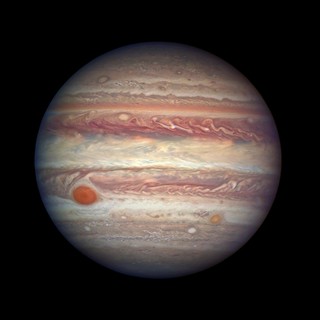
The visually striking banded structure of Jupiter, with alternating dark belts and light zones, is a manifestation of powerful zonal atmospheric flows, or jets. These jets exhibit a phenomenon known as atmospheric super-rotation, where equatorial winds can exceed 360 miles per hour. The visible clouds are layered, with the uppermost ammonia (NH₃) clouds forming the bright zones, believed to be regions of upwelling gas.
Deeper layers consist of ammonium hydrosulfide (NH₄SH) and water (H₂O) clouds. The exact composition and processes responsible for the darker belts, which are associated with descending gas, remain uncertain. The origins of these banded structures and super-rotating jets are subjects of ongoing research, with competing 'shallow' and 'deep' models attempting to explain their formation and maintenance, likely involving complex interactions between convection, rotation, and internal heat transport.
Vortices and Atmospheric Instabilities
Jupiter's atmosphere is a dynamic arena for a wide array of energetic phenomena, including band instabilities, vortices, storms, and lightning. Vortices, observed as large colored spots (ovals), are significant features. The Great Red Spot (GRS), a massive anticyclonic vortex in the southern hemisphere, has persisted for at least three centuries and is large enough to encompass two to three Earths.
Oval BA, another prominent red anticyclonic storm, formed in 2000 from the merger of three white ovals. Smaller anticyclones tend to appear white. These vortices are generally considered relatively shallow structures, with depths not exceeding several hundred kilometers, despite their enormous horizontal scale.
Their stability and longevity are key areas of study, providing insights into fluid dynamics on a planetary scale.
Electrical Phenomena and Storm Dynamics
Powerful storms are a common occurrence in Jupiter's atmosphere, driven by moist convection linked to the evaporation and condensation cycle of water. These storms are characterized by strong updrafts, leading to the formation of bright, dense clouds, primarily in the belt regions. A particularly intriguing aspect is Jovian lightning, which is hundreds of times more powerful than terrestrial lightning.
Recent observations from the Juno mission suggest that Jovian lightning strikes may occur at higher altitudes than the main water clouds. A leading hypothesis for this high-altitude lightning involves charge separation generated between falling liquid ammonia-water droplets and rising water ice particles. This electrical activity, potentially extending significantly above the visible cloud tops, points to a complex and energetic atmospheric electrical system on Jupiter.
See also
Frequently Asked Questions
What is the atmosphere of Jupiter made of?+
Why does Jupiter have colorful bands and bright spots?+
How fast do the winds on Jupiter move?+
What are the Great Red Spot and Oval BA?+
Why is lightning on Jupiter so strong?+
Based on content from Wikipedia · Licensed under CC BY-SA 4.0