

Artaxerxes I
Images

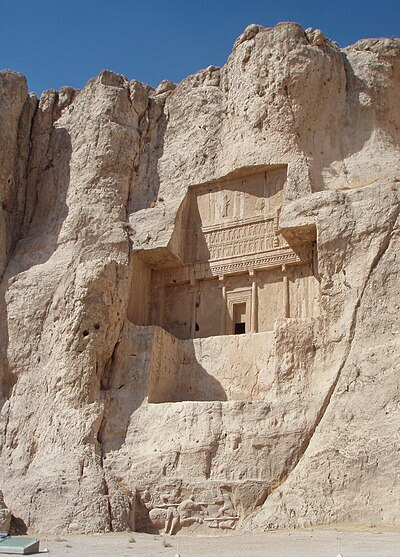
The Tomb of Darius I (right) and Artaxerxes I (left) and four Sasanian rock reliefs, Naqsh-e Rostam, Iran




Ascension and the Weight of the Crown
Artaxerxes I ascended to the throne of the Achaemenid Empire in August 465 BC, following a period of potential intrigue surrounding his father Xerxes I's assassination. As the third son, his path to kingship was not guaranteed, suggesting a complex political landscape within the Persian court. His reign, lasting until December 424 BC, spanned over two decades, a significant duration that allowed him to leave his mark on the empire.
He inherited a vast and diverse realm, a complex tapestry of cultures, languages, and peoples stretching from the Aegean Sea to the Indus River. The responsibilities of a 'King of Kings' were immense, involving not only military leadership and territorial defense but also sophisticated administration, economic management, and the delicate balancing of regional powers. Artaxerxes I's rule was a continuation of the imperial policies established by his predecessors, aiming to maintain the stability and prosperity of this colossal state, which was a marvel of ancient governance and organization.
The Enigma of 'Longimanus'
The epithet 'Longimanus,' meaning 'Long-handed,' bestowed upon Artaxerxes I by Greek sources, adds a layer of intrigue to his historical persona. This appellation, derived from the Greek 'Makrókheir,' was reportedly due to a physical anomaly where his right hand was noticeably longer than his left. While seemingly a minor detail, such distinctive physical traits were often recorded by ancient chroniclers and could signify a person's perceived uniqueness or even divine favor.
The persistence of this nickname across different historical accounts suggests it was a widely recognized characteristic. In an era where visual representation was limited, such descriptive nicknames served as powerful identifiers, distinguishing rulers and embedding them in collective memory. The 'Long-handed' king remains a figure defined, in part, by this curious physical attribute, prompting speculation about its potential symbolic interpretations or simply its factual occurrence.
Artaxerxes I and the Biblical Narrative of Esther
A significant aspect of Artaxerxes I's historical identity is the strong tradition, notably championed by the historian Josephus, that he is King Ahasuerus from the biblical Book of Esther. This identification is profoundly impactful, linking the secular history of the Achaemenid Empire with a pivotal religious narrative. The Book of Esther recounts the story of a Jewish queen who, through her courage and strategic intervention, thwarts a genocidal plot against her people in the Persian Empire.
If Artaxerxes I was indeed Ahasuerus, his reign becomes the backdrop for a foundational story of Jewish survival and divine providence. This connection imbues his rule with a spiritual dimension, making him a figure of immense importance in Jewish tradition and history, even if the exact historical accuracy of the identification is debated among scholars. It highlights how historical figures can become intertwined with cultural and religious narratives, shaping perceptions across millennia.
Imperial Administration and Cultural Context
Artaxerxes I presided over an empire that was a melting pot of cultures, a testament to the Achaemenid policy of relative tolerance and administrative efficiency. The empire was structured into satrapies, or provinces, each governed by a satrap who reported to the king. This decentralized yet controlled system allowed for the management of diverse populations and economies.
Artaxerxes I, like his predecessors, would have overseen the collection of tribute, the maintenance of infrastructure such as the Royal Road, and the administration of justice. The empire's vastness meant that the king's authority was often mediated through layers of officials, making effective communication and loyalty crucial. His reign occurred during a period of significant interaction between the Persian Empire and the Greek city-states, a dynamic that would continue to shape the geopolitical landscape of the ancient world.
Understanding Artaxerxes I requires appreciating the complexities of ruling such a vast and multifaceted empire in its specific historical and cultural context.
Legacy and Historical Interpretation
The legacy of Artaxerxes I is multifaceted, shaped by both historical records and later interpretations. As the fifth King of Kings, he was a key figure in the continuation of one of the most powerful empires of antiquity. His reign contributed to the stability and longevity of the Achaemenid state, influencing the political and cultural trajectory of the Near East for decades.
The persistent association with King Ahasuerus in the Book of Esther has cemented his place in religious and cultural history, providing a narrative framework for understanding Jewish identity within the Persian imperial context. While the precise details of his personal life and reign may be subject to scholarly debate, Artaxerxes I remains a compelling figure. His 'long hands' and his potential role in a dramatic biblical saga ensure his enduring presence in historical consciousness, bridging the gap between secular power and sacred narrative.
See also
Frequently Asked Questions
Who was Artaxerxes I?+
Why was he called "Long-handed"?+
Did Artaxerxes I have any connection to the story of Esther?+
How big was the empire he ruled?+
How did he manage his empire?+
Based on content from Wikipedia · Licensed under CC BY-SA 4.0