

Argonauta: The Amazing Paper Nautilus!
Images

Papierboot Argonauta 200705181139


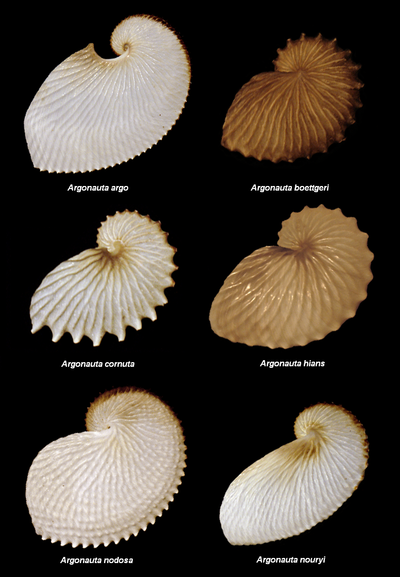

The 'Paper Nautilus' Shell
The Argonauta genus, commonly referred to as the paper nautilus, presents a fascinating case of sexual dimorphism and unique biological adaptation. The most striking characteristic is the elaborate, fragile shell secreted by the adult female. This shell, composed of calcium carbonate and organic material, is not a permanent exoskeleton like that of true nautiluses or mollusks.
Instead, it is a temporary structure, secreted from the dorsal arms of the female, serving a dual purpose: buoyancy and reproduction. The shell's intricate coiling and thin walls allow the Argonauta to float at the ocean's surface, acting as a natural floatation device. More critically, it functions as a protective brood chamber, housing the female's eggs until they hatch.
This remarkable structure is absent in the minuscule males, highlighting a profound difference in their life roles and morphology. The males are parasitic or semi-parasitic, attaching to the female and receiving nourishment, a stark contrast to the female's independent, shell-building existence.
Global Distribution and Pelagic Lifestyle
Argonautas are distributed across the world's temperate and tropical oceanic waters, inhabiting the epipelagic zone, or the 'sunlit layer,' of the ocean. Their preference for surface waters makes them highly susceptible to oceanic currents and weather patterns. While they are found globally, specific species have regional distributions, such as Argonauta argo in the Atlantic and Indo-Pacific, and Argonauta nodosa in the Southern Hemisphere.
Their pelagic lifestyle means they are constantly drifting, relying on currents for dispersal and migration. This open-ocean existence also exposes them to predation from larger fish and marine mammals, and their delicate shells offer limited defense. Their presence near the surface is crucial for their feeding strategies and reproductive cycles, but it also makes them vulnerable to environmental changes and human impacts like pollution and bycatch.
Dietary Habits and Predatory Adaptations
As active carnivores, Argonautas occupy a niche within the oceanic food web. Their diet primarily consists of small pelagic invertebrates, including various species of gastropods (sea snails), small crustaceans, and notably, jellyfish. The Argonauta employs a combination of its natural buoyancy and its eight arms to capture prey.
While the shell itself is not used offensively, the extended arms are equipped with suckers that allow for grasping and manipulating food items. Their hunting strategy involves patiently waiting for small organisms to drift within reach, then quickly ensnaring them. The ability to efficiently capture these often-gelatinous or small prey items is vital for their survival and reproductive success, particularly for the female who needs to sustain herself while nurturing her eggs.
Reproductive Strategies and Life Cycle Dynamics
The reproductive cycle of the Argonauta is characterized by extreme sexual dimorphism and a relatively brief lifespan, typically ranging from one to two years. Following maturation, the male Argonauta, which is significantly smaller and lacks a shell, seeks out a female. He may attach himself to her, becoming a parasitic or semi-parasitic appendage, or live more independently.
The female, after mating, begins the process of secreting her characteristic shell. She then deposits her eggs within this shell, which serves as both a protective incubator and a floatation device. The female dedicates her remaining life to guarding her eggs, ensuring their development.
Once the eggs hatch into paralarvae, they are immediately independent, drifting into the ocean to begin their own life cycles. The female's life concludes shortly after her reproductive duty is fulfilled, underscoring the ephemeral nature of their existence.
Ecological Role and Conservation Considerations
While Argonautas are not currently assigned a formal conservation status by major bodies like the IUCN, their pelagic lifestyle and dependence on surface waters make them potential indicators of ocean health. Their role in the marine ecosystem involves controlling populations of smaller invertebrates and serving as prey for larger marine animals. However, their vulnerability to ocean pollution, particularly plastic debris which can be mistaken for prey or obstruct their movement, is a growing concern.
Furthermore, their presence in areas with commercial fishing operations could lead to accidental bycatch. Understanding their distribution and life cycle is crucial for assessing any potential threats and for appreciating their unique place in the biodiversity of the world's oceans. Further research is needed to fully understand population dynamics and potential conservation needs.
See also
Based on content from Wikipedia · Licensed under CC BY-SA 4.0