

Argentine Antarctica
Images

AntáRtida Argentina
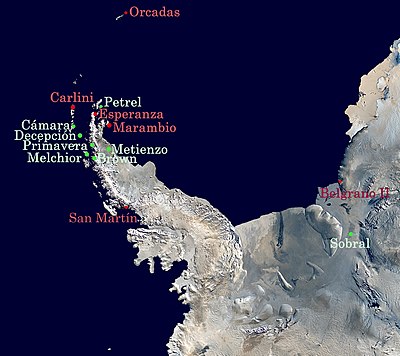


Defining Argentine Antarctica
Argentine Antarctica, or 'Antártida Argentina,' represents Argentina's assertion of sovereignty over a significant portion of the Antarctic continent. This claim is geographically defined as a triangular sector bounded by the 25° West and 74° West meridians and the 60° South parallel, extending to the geographic South Pole. This vast area, comprising approximately 1,461,597 square kilometers, includes the strategically important Antarctic Peninsula and a substantial landmass.
However, this claim is not universally recognized and notably overlaps with territorial claims made by the United Kingdom and Chile, leading to complex geopolitical considerations. The existence of these overlapping claims underscores the unique international legal status of Antarctica, governed primarily by the Antarctic Treaty System, which suspends, denies, or does not recognize territorial claims while the treaty is in force.
Historical Footprints
Argentina's engagement with Antarctica has a rich history rooted in early 20th-century exploration. The nation's presence was solidified with the establishment of the Orcadas Permanent Base in the South Orkney Islands in 1904, making it one of the oldest continuously operating bases in Antarctica. Prior to this, José María Sobral's participation in a Swedish expedition in 1902 marked the first Argentine footsteps on the continent.
The formal claim over the mainland sector began to be formulated in 1941, with subsequent adjustments and official declarations solidifying Argentina's position. The establishment of permanent bases on the Antarctic mainland, such as Esperanza Base in 1951, further demonstrated Argentina's commitment. A significant achievement was 'Operación 90' in 1965, the first Argentine expedition to successfully reach the South Pole, highlighting their dedication to polar exploration and scientific advancement.
Governance and Administration
Administratively, Argentine Antarctica is integrated into the national structure of Argentina as a department of the province of Tierra del Fuego, Antarctica, and South Atlantic Islands. The provincial authorities are headquartered in Ushuaia, the southernmost city in Argentina, which serves as a crucial gateway to the Antarctic region. The national coordination of Argentine activities in Antarctica is managed by the Instituto Antártico Argentino (IAA) and the Argentine Antarctic Program.
This administrative framework ensures that scientific research, logistical support, and territorial presence are systematically organized and executed. Residents of Argentine Antarctica participate in general elections within Tierra del Fuego Province, reinforcing the notion of their inclusion within the Argentine national community despite their remote location.
Life and Science at the Extremes
The human population in Argentine Antarctica is modest but significant, comprising individuals dedicated to scientific research and maintaining the national presence. According to the 2010 national census, approximately 230 inhabitants resided across six permanent bases, including families and children, with notable populations at Marambio (75) and Esperanza (66). Provisional results from the 2022 census indicated a population of around 130.
These residents live and work in an extreme environment where temperatures can plummet to -82°C (-115°F) in winter, though summer temperatures can occasionally reach 18°C (65°F). Argentina operates six permanent Antarctic stations and seven summer stations, facilitating continuous scientific endeavors. Research focuses on climatology, glaciology, biology, and geology, contributing vital data to global scientific understanding and fulfilling the objectives of the Antarctic Treaty System.
Education and Cultural Identity in a Polar Outpost
Education in Argentine Antarctica presents a unique challenge and opportunity, particularly for the children residing at bases like Esperanza. These children receive their primary and secondary education within the Antarctic territory, often in schools established at the bases. The curriculum aligns with the national Argentine educational standards, ensuring that students receive a comprehensive education comparable to their peers on the mainland.
This educational provision is crucial for fostering a sense of national identity and belonging among the younger generation growing up in such an isolated environment. Learning about the Antarctic ecosystem, its scientific importance, and Argentina's role in its preservation forms a core part of their schooling, preparing them to be informed citizens and potential future contributors to Antarctic science and policy.
See also
Frequently Asked Questions
What is Argentine Antarctica?+
Where is Argentine Antarctica located?+
How did Argentina start exploring Antarctica?+
What are some Argentine bases in Antarctica?+
How many people live in Argentine Antarctica?+
Based on content from Wikipedia · Licensed under CC BY-SA 4.0