

Archimedes' Screw: The Water-Lifting Wonder!
Images
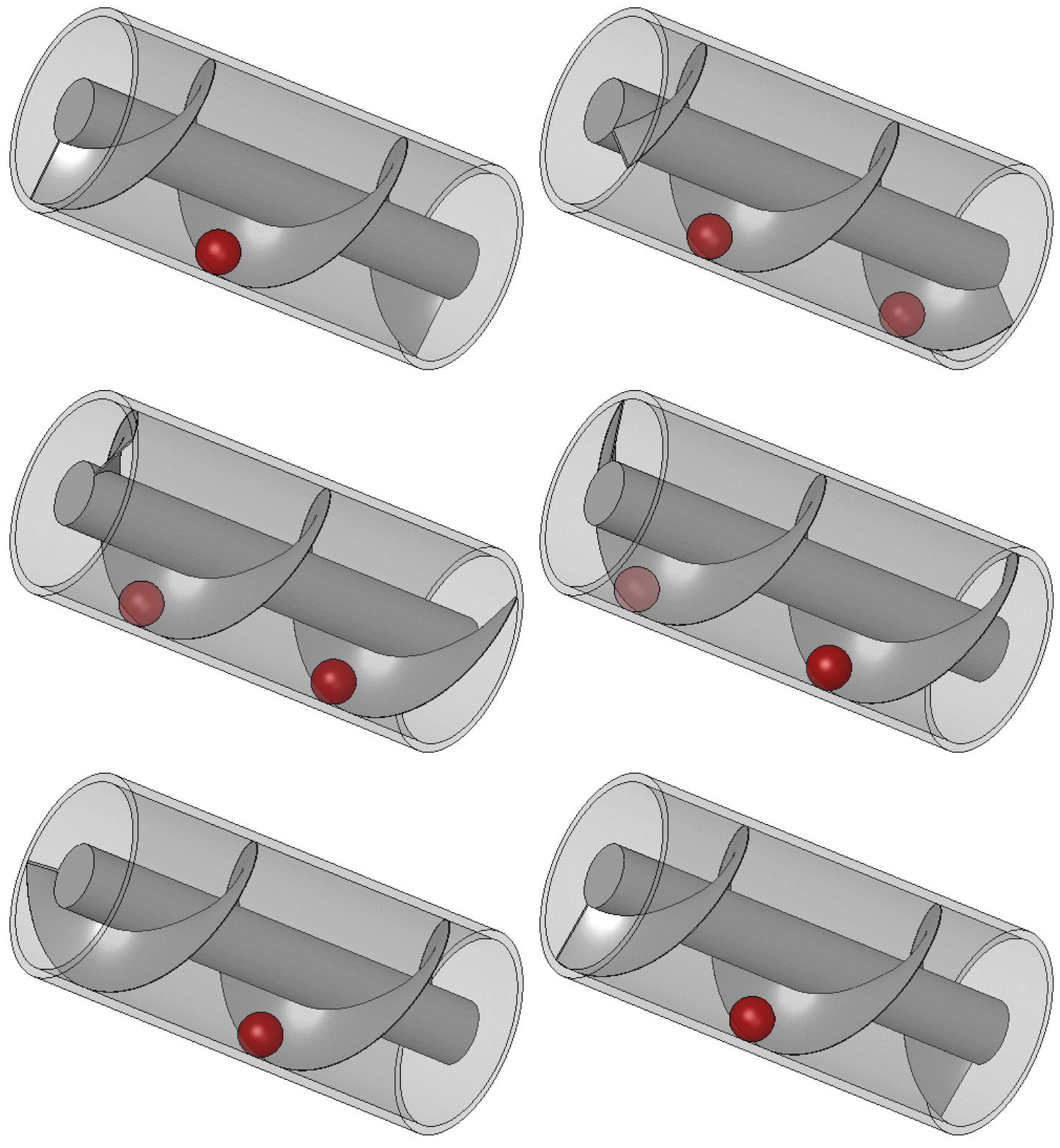
Archimedes' screw


The Genesis of an Engineering Icon
The Archimedes' screw, a device for transferring bulk solid materials or liquids upwards, stands as a testament to the ingenuity of ancient Hellenistic engineering. Attributed to the brilliant mathematician and inventor Archimedes of Syracuse (c. 287–212 BCE), this invention emerged during a period of significant scientific advancement. While the exact historical context of its invention is debated, it is widely believed to have been developed to address practical needs, such as irrigating fields in Egypt or emptying ship bilges.
The screw's design is elegantly simple yet profoundly effective: a helical surface is fixed around a central shaft, and this entire assembly is enclosed within a tube. When the screw is angled and rotated, the helical threads capture volumes of fluid or granular material at the lower intake. As the screw turns, these captured portions are progressively moved along the helix towards the upper discharge point, effectively defying gravity.
This mechanical advantage made it an indispensable tool for water management and agriculture in the ancient world, predating more complex pumping mechanisms by centuries.
Mechanics of Ascent
The operational principle of the Archimedes' screw is rooted in basic physics and geometry. The screw's effectiveness hinges on the interplay between the helical shape, the enclosing tube, and the angle of inclination. When the screw rotates, each segment of the helix acts as a moving conveyor.
The water or material is trapped in the void between the helix and the tube. As the screw turns, this trapped volume is displaced upwards. Crucially, the tube prevents significant backflow, ensuring that the material progresses towards the outlet.
The efficiency of the screw is influenced by factors such as the pitch of the helix (the distance between successive turns), the diameter of the screw and tube, the speed of rotation, and the angle at which the screw is set. A steeper angle or faster rotation generally increases the rate of transfer, but also requires more energy. The ability to move viscous fluids or materials containing solids without significant damage or clogging is a key advantage, distinguishing it from some other fluid transport methods.
This inherent robustness contributes to its enduring utility.
Enduring Relevance
Despite the advent of sophisticated centrifugal pumps and other modern fluid handling technologies, the Archimedes' screw has maintained a remarkable presence in various industrial and environmental applications. Its simplicity, reliability, and low maintenance requirements make it an attractive option in numerous scenarios. In agriculture, modern versions are still employed for irrigation and grain handling.
Environmental engineering frequently utilizes Archimedes' screws in wastewater treatment plants for sludge transfer and in water treatment facilities for raw water intake. They are also used in mining and construction for dewatering sites and moving slurries. The food industry employs them for transporting bulk ingredients like flour, sugar, and coffee beans.
Furthermore, the principle has been adapted into innovative technologies, such as Archimedes' screw turbines, which generate electricity from low-head water sources. This adaptability underscores the timelessness of Archimedes' design, demonstrating how a fundamental understanding of mechanical principles can lead to solutions that transcend millennia and technological revolutions.
Comparative Advantages and Limitations in Fluid Transport
The Archimedes' screw offers distinct advantages over other fluid transport methods. Its ability to handle a wide range of viscosities and to transport solids mixed with liquids (like sludge or grain) without damage is a significant benefit. Unlike pumps that rely on impellers or pistons, the screw's continuous flow mechanism is less prone to clogging.
It also operates at relatively low speeds, which can be advantageous for delicate materials and reduces wear and tear. However, the screw is not without its limitations. Its efficiency can be reduced by leakage between the flights and the casing, especially when pumping against higher heads.
The maximum lift height is also constrained by the screw's length and angle. Furthermore, for very high-volume or high-pressure applications, more modern pump designs are typically more efficient and compact. The energy input required is directly proportional to the volume of material moved and the height it is lifted, meaning its power consumption can be substantial for large-scale operations.
Beyond Water
While historically associated with water, the Archimedes' screw's principle extends to the transport of a diverse array of materials. Its application in moving bulk solids, such as grains, powders, and pellets, is widespread in manufacturing and agriculture. In the realm of environmental technology, its use in managing waste and water resources is critical.
The development of Archimedes' screw turbines represents a significant advancement, harnessing renewable energy from slow-moving water bodies like rivers and tidal streams. These turbines are particularly suited for low-head environments where conventional hydropower is not feasible. Future potential lies in optimizing designs for greater efficiency, exploring new materials for enhanced durability, and integrating them into smart systems for automated material handling and energy generation.
The enduring legacy of Archimedes' screw lies not just in its historical significance but in its continued capacity to inspire practical, sustainable, and innovative engineering solutions.
See also
Frequently Asked Questions
What is the Archimedes' screw?+
How does the Archimedes' screw lift water?+
Why did Archimedes invent the screw?+
Where is the Archimedes' screw used today?+
Can the Archimedes' screw make electricity?+
Based on content from Wikipedia · Licensed under CC BY-SA 4.0