

Arch bridge
Images

'Minneapolis, Minn., the Milling District, east side mills, Stone Arch Bridge and Mississippi River' / postcard


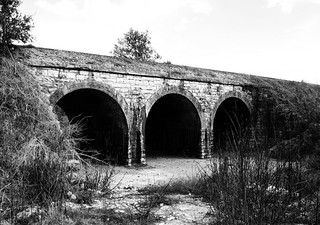


The Physics of the Curve
The fundamental principle behind an arch bridge's remarkable strength lies in its unique method of load transfer. Unlike a simple beam bridge, which primarily relies on bending resistance, an arch bridge converts the vertical loads (from the bridge deck, vehicles, and environmental factors) into compressive forces. As weight is applied to the deck, it is channeled into the curved arch structure.
This curve then directs the forces outwards towards the abutments at either end. This outward push is known as horizontal thrust, and it is a critical component of the arch's stability. The abutments must be robust enough to withstand this thrust, effectively restraining the arch and preventing it from spreading.
This mechanism allows arch bridges to span considerable distances with relatively simple materials, as the primary stress within the arch material is compression, which many materials, like stone and concrete, handle exceptionally well. The efficiency of this load distribution is why arch bridges have been a cornerstone of civil engineering for millennia.
From Antiquity to the Industrial Age
The arch bridge boasts a lineage stretching back to ancient civilizations, with the Romans being preeminent practitioners. Their mastery of stonework and understanding of the arch allowed them to construct durable aqueducts and bridges that facilitated the expansion and maintenance of their empire. These structures, often built with precisely cut voussoirs (wedge-shaped stones), demonstrated an advanced grasp of structural mechanics.
Following the Roman era, the arch bridge continued to be a dominant form, particularly with the advent of brick and later, cast iron and steel during the Industrial Revolution. These new materials enabled engineers to design taller, longer, and more complex arches, pushing the boundaries of what was structurally possible. The evolution from simple stone arches to sophisticated steel structures showcases a continuous refinement of design principles and material utilization, adapting an ancient concept to meet modern demands for greater capacity and span.
Enduring Relevance and Modern Applications of Arch Bridge Design
Despite the development of other bridge types like suspension and cable-stayed bridges, arch bridges retain significant relevance in contemporary civil engineering. Their inherent strength and aesthetic appeal make them a preferred choice for certain applications. For instance, when crossing deep gorges or valleys, the arch's ability to transfer loads efficiently to well-defined abutments can be highly advantageous, minimizing the need for intermediate supports.
Modern arch bridges often utilize reinforced concrete or structural steel, allowing for greater spans and more innovative designs, such as tied-arch bridges where the horizontal thrust is contained by a tension tie rather than external abutments. Furthermore, the visual impact of a well-designed arch bridge can be substantial, contributing to a region's identity and becoming iconic landmarks. Their historical continuity also provides a sense of permanence and connection to the past, making them valuable not just for function but also for form and cultural significance.
Variations on a Theme
Arch bridges manifest in several distinct forms, each suited to different topographical and load requirements. The most basic is the deck arch, where the roadway is situated above the arch. In contrast, a through arch bridge has the roadway passing through the arch structure itself, often suspended from it.
A tied-arch bridge is a variation where the arch's horizontal thrust is resisted by a tension member (the tie) connecting the ends of the arch, allowing construction in areas where massive abutments are not feasible. When a bridge consists of multiple arches placed side-by-side or end-to-end, it is termed a viaduct. Famous examples span centuries and continents: the ancient Pont du Gard (Roman aqueduct/viaduct), the medieval Ponte Vecchio in Florence (shops built on arches), and modern marvels like the Sydney Harbour Bridge (a steel through arch) and the New River Gorge Bridge in West Virginia (a steel deck arch, one of the longest single-span arch bridges in the world).
These examples highlight the versatility and enduring appeal of the arch bridge design.
See also
Frequently Asked Questions
What is an arch bridge and how does it stay strong?+
Why did the Romans build arch bridges?+
How do modern arch bridges differ from ancient ones?+
Where can we see arch bridges today?+
What happens if the ends of an arch bridge are not strong enough?+
Based on content from Wikipedia · Licensed under CC BY-SA 4.0