

Aoraki / Mount Cook
Images

Aoraki/Mount Cook. New Zealand.


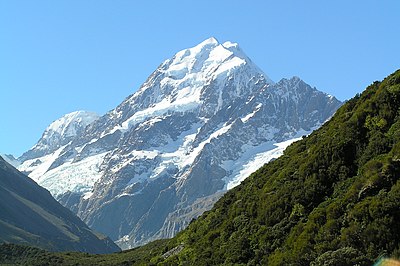


The Apex of New Zealand's Alpine Realm
Aoraki / Mount Cook, standing at a formidable 3,724 meters (12,218 feet), reigns as the undisputed highest mountain in New Zealand. It is an integral part of the Southern Alps, a colossal mountain range that bisects the South Island, sculpted by immense geological forces over millennia. The mountain itself is a complex massif, featuring three distinct summits: the Low Peak (3,593 m), the Middle Peak (3,717 m), and the dominant High Peak.
These summits are situated slightly to the south and east of the main alpine divide, a geographical nuance that influences weather patterns and glacial activity. To the east, the vast Tasman Glacier, one of New Zealand's largest glaciers, stretches out, while the Hooker Glacier carves its path to the southwest. This dramatic topography makes Aoraki a focal point for both scientific study and adventurous pursuits, attracting climbers and researchers alike to its challenging slopes and surrounding glacial environments.
Geological Genesis and Glacial Sculpting
The formation of Aoraki / Mount Cook is intrinsically linked to the tectonic activity that shaped the Southern Alps. The collision of the Pacific and Indo-Australian tectonic plates has uplifted and folded the landmass, creating the dramatic mountain ranges seen today. Over geological timescales, massive glaciers have played a crucial role in sculpting Aoraki's current form.
The relentless movement of ice, as seen in the Tasman and Hooker Glaciers, has carved out valleys, cirques, and sharp arêtes, contributing to the mountain's rugged and imposing appearance. The presence of these active glaciers also means that the landscape is in a constant state of flux, with erosion and deposition shaping the terrain. Understanding Aoraki's geological history provides insight into the dynamic processes that continue to mold New Zealand's dramatic landscapes, offering a living laboratory for geologists.
Significance
Aoraki / Mount Cook holds profound significance on multiple levels. For the mountaineering community, it represents a premier challenge, often compared to the world's highest peaks in terms of technical difficulty and objective hazards. Its ascent requires advanced climbing skills, acclimatization, and a deep respect for the mountain's formidable conditions.
Beyond its appeal to adventurers, Aoraki is a vital component of New Zealand's natural heritage. It anchors the Aoraki / Mount Cook National Park, a UNESCO World Heritage site renowned for its spectacular alpine scenery, unique biodiversity, and significant glaciers. The mountain and its surrounding glaciers are also crucial for hydrological systems, feeding rivers that support diverse ecosystems and human activities downstream.
Its sheer scale and isolation contribute to its global recognition as a significant topographic feature.
A Unique Vantage Point
One of Aoraki / Mount Cook's most fascinating attributes is its remarkable topographic isolation, ranking it 10th globally. This metric quantifies how far one must descend and then ascend to reach a higher point, effectively measuring how 'isolated' a peak is from surrounding higher terrain. Aoraki's high ranking signifies that from its summit, the line of sight to any higher ground is exceptionally distant.
This means that from the top of Aoraki, one can experience an unparalleled panoramic vista, largely unobstructed by other mountains. This extreme isolation contributes to its majestic presence and its allure for those seeking the ultimate alpine experience. It underscores the mountain's dominance over its geographical region and its status as a truly exceptional natural landmark on a global scale.
See also
Based on content from Wikipedia · Licensed under CC BY-SA 4.0