

Antony Gormley
Images

Antony Gormley office art


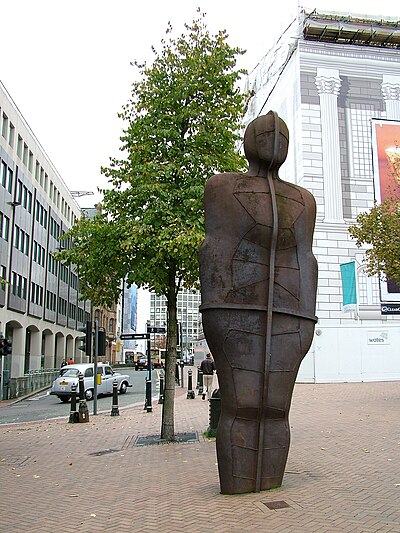

The Body as a Vessel for Universal Experience
Antony Gormley, born in 1950, is a British sculptor whose oeuvre is characterized by its profound engagement with the human body as a site of universal experience. His artistic genesis, marked by studies in archaeology and art history, instilled a deep appreciation for humanity's past and its enduring presence. Gormley's signature approach involves using his own body as the primary source material, employing casting techniques to create an intimate yet universally relatable form.
This direct connection imbues his sculptures with a palpable sense of lived experience. Works like 'Angel of the North' (1998) transcend mere representation; they become totems of regional identity and resilience, their immense scale dwarfing the viewer and prompting introspection. His sculptures are not static objects but rather catalysts for contemplation, inviting us to consider our own physicality, our place within the vastness of the world, and the shared human condition.
Gormley's art consistently challenges our perception of scale, presence, and the very definition of being human in a contemporary context.
Site-Specific Interventions
Gormley's artistic practice extends beyond the studio, with many of his most impactful works being site-specific installations that radically alter our perception of public spaces. 'Another Place' (2005), situated on Crosby Beach, features 100 identical cast-iron figures spread across a mile of coastline. These figures, facing the sea, engage in a silent dialogue with the tides, the weather, and the passing of time, creating a powerful meditation on human presence against the backdrop of nature's immensity.
His 'Event Horizon' (2007 onwards) series, which has appeared in cities like London, New York, São Paulo, and Hong Kong, involves placing 31 life-size casts of his body on the rooftops of buildings. This installation generates a subtle yet pervasive sense of unease and wonder, prompting urban dwellers to look up and question what they are seeing, blurring the lines between art, architecture, and everyday life.
These interventions transform familiar urban and natural landscapes into stages for profound existential inquiry.
The Significance of Scale and Materiality
The monumental scale of Antony Gormley's sculptures is a deliberate choice, designed to confront the viewer and evoke a visceral response. The sheer size of works like the 'Angel of the North' (20 meters high with a 54-meter wingspan) ensures they cannot be ignored, demanding attention and contemplation. This scale serves to magnify the human form, making it a powerful symbol of collective identity and individual presence.
Gormley's choice of materials is equally significant. He frequently employs industrial materials such as cast iron and steel, often allowing them to weather naturally. The Cor-Ten steel used for the 'Angel of the North' develops a rich, rust-like patina, connecting the sculpture to the earth and the passage of time.
This materiality grounds the abstract concept of the human form in tangible reality, creating sculptures that feel both ancient and contemporary. The weight and permanence of these materials underscore the enduring nature of human existence.
Conceptual Frameworks
Antony Gormley's work is deeply rooted in philosophical inquiry, exploring fundamental questions about existence, consciousness, and our relationship with the environment. His sculptures act as anchors, grounding the viewer in their physical reality while simultaneously prompting them to consider their place in the broader cosmos. The repetition of his own body form across diverse locations suggests a universal human experience, transcending cultural and geographical boundaries.
Gormley is interested in how art can foster a sense of connection, both between individuals and with the natural world. His installations often encourage communal engagement, as people gather to observe and discuss the works. In an era often characterized by digital detachment, Gormley's tangible, imposing sculptures serve as powerful reminders of our physical embodiment and our interconnectedness.
His art challenges us to be present, to observe, and to reflect on what it means to inhabit a body in space.
Artistic Process
The creation of Gormley's monumental sculptures is a testament to meticulous planning and sophisticated engineering. The process typically begins with Gormley creating a body cast, often using plaster or alginate, capturing the nuances of his own physique. This personal mold serves as the foundational template.
From this, detailed models are made, and then the full-scale sculpture is fabricated. For works like 'Angel of the North,' this involved welding thousands of steel plates together, a process akin to shipbuilding. The logistical challenges of transporting and erecting these colossal pieces are immense, requiring specialized equipment and extensive collaboration with engineers, architects, and local authorities.
Gormley's commitment to using his own body as the source material, combined with the industrial scale of production, creates a compelling tension between the intimate and the public, the personal and the universal. This rigorous process ensures that each monumental work is not only an artistic statement but also an engineering marvel.
See also
Frequently Asked Questions
Who is Antony Gormley?+
What is the Angel of the North?+
How does Gormley make his sculptures?+
What is Another Place and why are there many figures?+
Why does Gormley put sculptures on rooftops?+
Based on content from Wikipedia · Licensed under CC BY-SA 4.0