

Amundsen–Scott South Pole Station
Images

Amundsen–Scott South Pole Station 01
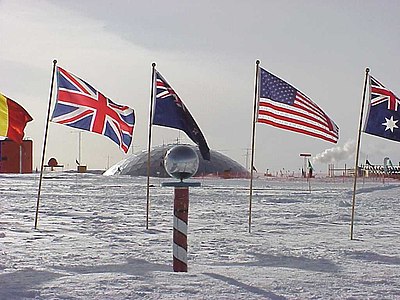


Pioneering Research at the Earth's Axis
The Amundsen–Scott South Pole Station, operated by the United States Antarctic Program, stands as a testament to human ingenuity and scientific ambition at the planet's southernmost point. Situated at 9,301 feet (2,835 m) on the high Antarctic plateau, it is the southernmost U.S. territory and a vital hub for research that spans atmospheric science, astrophysics, glaciology, and more. Its location is unparalleled for certain types of scientific observation, particularly astronomy, due to the prolonged periods of darkness and the exceptionally dry, stable atmosphere.
The station's existence is a direct result of international scientific cooperation, specifically stemming from the International Geophysical Year (IGY) of 1957-1958, which recognized the critical need for continuous polar research.
From Explorers' Dreams to a Permanent Presence
The station's name honors two legendary figures of polar exploration: Roald Amundsen, who led the first expedition to reach the South Pole in 1911, and Robert Falcon Scott, who led the second expedition shortly after. The original station was constructed by U.S. Navy Seabees in November 1956, marking the beginning of a continuous human presence at the pole. Prior to this, Antarctica's interior was largely unexplored and uninhabited, with scientific outposts concentrated along the coast.
The station has undergone significant transformations since its inception, including multiple rebuilds and upgrades, reflecting advancements in technology and the evolving demands of polar research, ensuring its operational viability in one of the planet's most extreme environments.
The Extremes of Polar Day and Night
The station experiences a unique astronomical phenomenon: a six-month period of continuous daylight, followed by a six-month period of continuous darkness. During the 'polar day,' the sun traces a slow, circular path above the horizon, gradually rising from the September equinox to its highest point at the December solstice and setting at the March equinox. Conversely, the 'polar night' brings prolonged darkness, during which air temperatures can plummet below -73°C (-99°F), accompanied by frequent blizzards.
Despite these harsh conditions, the extended darkness and extremely dry atmosphere create exceptional conditions for astronomical observations, making the station a premier site for telescopes studying the cosmos.
Logistics and Life in Isolation
The operational rhythm of Amundsen–Scott Station is dictated by the Antarctic seasons. The summer population peaks at around 150 individuals, comprising scientists and essential support staff, who benefit from more accessible conditions for research and resupply. During the austral winter, the population dwindles to approximately 50 people, who endure the extreme cold and darkness, maintaining critical infrastructure and continuing specialized research. Logistics are a major undertaking, with supplies arriving seasonally via aircraft and the South Pole Traverse, an overland route established in 2005 that links the station to McMurdo Station and Scott Base, thereby reducing reliance on air transport and enhancing supply chain resilience.
A Hub for Scientific Discovery
The scientific endeavors at Amundsen–Scott Station are diverse and groundbreaking. Its location offers unique advantages for fields like astrophysics and cosmology, where telescopes like the South Pole Telescope (SPT) and the BICEP (Background Imaging of Cosmic Extragalactic Polarization) experiment utilize the clear, dark skies to study the cosmic microwave background radiation and distant galaxies. Atmospheric research benefits from the pristine air quality, allowing for precise measurements of greenhouse gases and ozone depletion.
Glaciologists study the ice sheet's history and dynamics, providing crucial data for understanding climate change. The station also serves as a critical node for global seismological networks and meteorological monitoring, contributing vital data to Earth system science.
See also
Frequently Asked Questions
What is the Amundsen–Scott South Pole Station?+
Why does the station have six months of daylight and six months of darkness?+
Who built the original station and when?+
How many people live at the station during summer and winter?+
How do supplies get to the station?+
Based on content from Wikipedia · Licensed under CC BY-SA 4.0