

Amphioctopus marginatus: The Clever Coconut Octopus!
Images

Coconut Octopus (Amphioctopus marginatus) (8468811738)


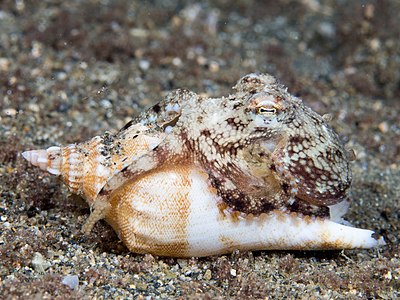


The Enigmatic Amphioctopus marginatus
Amphioctopus marginatus, commonly referred to as the coconut octopus or veined octopus, represents a fascinating case study in cephalopod evolution and behavior. Inhabiting the shallow, tropical waters of the western Pacific Ocean, this medium-sized octopus has carved out a distinct ecological niche. Its preferred habitat consists of sandy substrates, often interspersed with shells and detritus, providing both camouflage opportunities and resources for its unique behaviors.
Unlike many octopuses that rely solely on crawling or jet propulsion, Amphioctopus marginatus exhibits bipedal locomotion, a trait shared by only one other known octopus species. This unusual mode of movement, utilizing two arms to walk across the seabed, allows for efficient navigation and potentially aids in predator evasion or prey pursuit in its specific environment. The species' ability to adapt and thrive in these conditions highlights the diverse strategies employed by marine invertebrates.
Cognitive Prowess
The most striking characteristic of Amphioctopus marginatus is its advanced cognitive abilities, particularly its capacity for tool use. This octopus is renowned for its practice of collecting and carrying discarded coconut shells. It then meticulously arranges these shells to form protective shelters, often carrying them to new locations as needed.
This behavior is not merely instinctual; it demonstrates foresight, planning, and problem-solving skills. The octopus can manipulate the shells, fitting them together to create a secure den, and even closing them to conceal itself from potential threats. This sophisticated use of external objects for shelter construction is a rare phenomenon in the animal kingdom, placing Amphioctopus marginatus among a select group of intelligent invertebrates.
The selection and transport of these shells suggest an understanding of their utility and a capacity for delayed gratification, as the shells are gathered and prepared for future use.
Dietary Habits and Life Cycle Dynamics
As a carnivore, Amphioctopus marginatus actively hunts a variety of benthic invertebrates. Its diet primarily consists of small crustaceans such as shrimp and crabs, as well as mollusks like clams. The octopus employs its eight flexible arms to capture prey, often using its powerful beak to break through shells or extract soft-bodied organisms.
Its hunting strategies are likely influenced by its bipedal movement and tool-using capabilities, allowing it to access prey in ways other octopuses might not. While precise lifespan data for Amphioctopus marginatus in the wild is not extensively documented, octopuses generally have relatively short lifespans, typically ranging from one to two years. Reproduction is often semelparous, meaning individuals reproduce once and then die, with the female dedicating her final efforts to guarding her eggs.
This life cycle strategy is common among many cephalopod species.
Ecological Significance and Conservation Considerations
Amphioctopus marginatus plays a role in the marine ecosystem as both a predator and prey. Its unique behaviors, especially tool use, contribute to our understanding of animal intelligence and the evolution of complex behaviors. While the species is not currently listed with a specific conservation status, its habitat in shallow coastal waters is susceptible to anthropogenic impacts, including pollution, habitat degradation, and climate change.
The sandy substrates it relies on can be disturbed by dredging and coastal development. Continued research into its population dynamics, behavioral ecology, and the specific threats it faces is essential for ensuring its long-term survival. Preserving its natural habitat is paramount to allowing this remarkable octopus to continue its fascinating existence, offering invaluable insights into the adaptive potential of marine life.
See also
Frequently Asked Questions
What does the coconut octopus look like?+
How does the coconut octopus move?+
Why does the coconut octopus collect coconut shells?+
What does the coconut octopus eat?+
How long does a coconut octopus live and what happens when it reproduces?+
Based on content from Wikipedia · Licensed under CC BY-SA 4.0