

American Football Field
Images
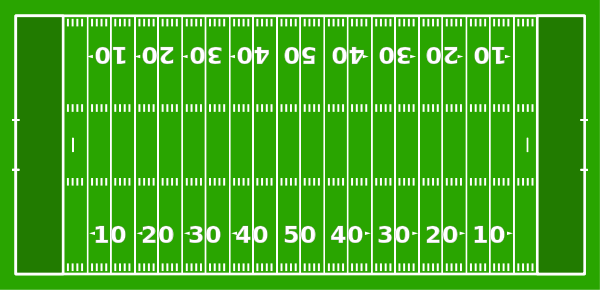
American football field


![The Meadowlands, Site of Super Bowl XLVIII [close up]](https://live.staticflickr.com/5522/12270840736_093074158d.jpg)


The Geometry of Gridiron Warfare
The American football field is a precisely engineered rectangular space, measuring 100 yards (91.44 m) between the goal lines and 160 feet (48.8 m) wide. This standardized playing area is fundamental to the sport's structure and strategy. The inclusion of two 10-yard end zones at either extremity extends the total length to 120 yards (109.7 m), creating distinct scoring territories.
While the 100-yard playing field is often used as a unit of measurement, understanding the full 120-yard length is crucial for appreciating the complete scope of play. The total area of 57,600 square feet (5,350 m2) provides a vast canvas for athletic performance. The field's surface, whether natural grass or artificial turf, also impacts play dynamics, affecting ball bounce, player traction, and injury potential.
This meticulous design ensures a consistent and fair playing environment across all levels of the sport.
Evolution of the 'Gridiron' Markings
The distinctive markings of the American football field, earning it the moniker 'gridiron,' have evolved over time. The current system features lines spanning the width of the field at 5-yard intervals between the goal lines. These yard lines, along with the hash marks, create the characteristic grid pattern that aids in tracking progress and strategizing plays.
Historically, the field's appearance was even more complex. For a period in the early 20th century, perpendicular lines also ran the length of the field, resulting in a checkerboard effect. This visual complexity was eventually simplified to the current grid system, which remains essential for officiating and player awareness.
The evolution of these markings reflects the sport's development and its increasing need for precise measurement and clear visual cues.
The Vertical Challenge
The goalposts, situated at the rear of each end zone, represent a critical scoring objective and a significant architectural feature of the field. In professional and collegiate football, they are positioned 18 feet 6 inches apart with a crossbar set 10 feet above the ground. The uprights extend a minimum of 35 feet above the crossbar, presenting a challenging target for placekickers.
The height and width of the goalposts are designed to test kicking accuracy and power, making successful field goals and extra points a testament to skill. Their presence defines the boundaries for kicking scores and adds a vertical dimension to the strategic elements of the game, influencing play-calling and game management.
The Field as a Strategic Chessboard
American football is fundamentally a strategic game played by two teams of 11 players, with the objective of scoring by advancing the ball into the opponent's end zone. The field itself acts as a dynamic chessboard, where every yard gained or lost carries significant weight. The dimensions and markings dictate offensive and defensive strategies, influencing play design, formation choices, and player positioning.
Teams must constantly manage field position, aiming to gain first downs and move closer to scoring while preventing the opposition from doing the same. The concept of 'field advantage' – being closer to the opponent's end zone – is a crucial strategic consideration. The field's design is not merely functional; it is intrinsically linked to the sport's complex tactical nature, making it a vital element in understanding the game's appeal and challenges.
See also
Frequently Asked Questions
What are the dimensions of an American football field?+
Why are there lines every 5 yards on the field?+
How tall and wide are the goalposts?+
What kind of surface does a football field have?+
What is the purpose of the end zones?+
Based on content from Wikipedia · Licensed under CC BY-SA 4.0