

Alexander Mosaic
Images

Detail of the Alexander Mosaic depicting the Battle of Issus between Alexander the Great & Darius III of Persia, from the House of the Faun in Pompeii, Naples Archaeological Museum
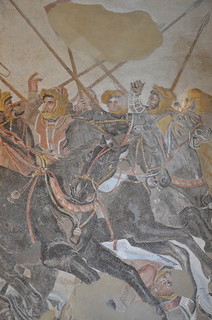


The Alexander Mosaic
The Alexander Mosaic, discovered in the House of the Faun in Pompeii, stands as one of the most significant surviving examples of Roman floor mosaics. Dated between 120 and 100 BC, it is a testament to the sophisticated artistic sensibilities of the late Roman Republic. The mosaic's subject matter, the climactic Battle of Issus, is rendered with an astonishing level of detail and dynamism, capturing the ferocity of ancient warfare.
It is not merely a depiction but an interpretation, believed to be a Roman copy of a lost Hellenistic masterpiece, possibly by Philoxenus of Eretria or even the legendary Apelles. This suggests a profound engagement with Greek artistic traditions, integrating them into the Roman context. The mosaic’s composition, the dramatic foreshortening, and the emotional intensity of the figures all point to its Hellenistic roots, while its scale, material, and placement as a floor decoration firmly establish its Roman identity.
It represents a crucial bridge between Greek artistic ideals and Roman practical application and appreciation.
The Technical Virtuosity of Ancient Mosaic Art
The creation of the Alexander Mosaic involved a level of technical skill that remains awe-inspiring. Artists employed the opus tessellatum technique, meticulously cutting and arranging thousands of small cubes, or tesserae, of marble, glass, and other colored stones. The palette used is remarkably rich, allowing for subtle gradations of tone and shade that create a sense of depth and volume, particularly in the rendering of musculature, armor, and the expressions of the combatants.
The mosaic’s sheer size, approximately 5.5 by 3 meters (18 by 10 feet), demanded immense planning and labor. The artists had to consider not only the visual impact from a distance but also the intricate details visible up close. The precision with which the tesserae are laid, following the contours of the forms and conveying movement, highlights a mastery of the medium that allowed for painterly effects to be achieved in stone.
This technical prowess was essential in translating the presumed fluidity of a painted original into the more rigid medium of mosaic.
Historical Significance and Cultural Resonance
The Alexander Mosaic holds immense historical and cultural significance. As a depiction of a pivotal battle, it offers insights into how ancient Romans perceived Alexander the Great and his military achievements, portraying him as a heroic, almost divine, figure. The mosaic’s subject matter reflects the Roman fascination with Greek history and military prowess, often used to legitimize their own imperial ambitions.
Its discovery in Pompeii, a city preserved by volcanic eruption, provides a unique archaeological context, allowing us to understand its original setting within a wealthy Roman domus. The mosaic’s survival and subsequent preservation at the National Archaeological Museum in Naples have made it a cornerstone for studying ancient art, Roman domestic decoration, and the transmission of artistic styles across cultures. It serves as a tangible link to the past, allowing us to connect with the visual culture and historical narratives that shaped the ancient world.
From Excavation to Enduring Legacy
The Alexander Mosaic was unearthed during the systematic excavations of Pompeii, which began in the mid-18th century. Found within the expansive House of the Faun, named for a small statue found in its courtyard, the mosaic occupied a prominent position, likely in the tablinum (the master’s study or reception room). The preservation of Pompeii, though tragic in its cause, was exceptional, protecting many artworks, including this mosaic, from decay.
Following its discovery, the mosaic was carefully removed and transported to Naples, where it underwent conservation. Its exhibition has been central to understanding the artistic achievements of the period. The mosaic’s enduring legacy lies not only in its artistic merit but also in its role as a cultural ambassador, representing the pinnacle of Roman mosaic art and the enduring fascination with Alexander the Great’s legend.
It continues to inspire artists, historians, and the public alike.
Relevance and Interpretation in Contemporary Discourse
In contemporary discourse, the Alexander Mosaic remains a subject of scholarly debate and public fascination. Its status as a copy of a lost painting raises questions about artistic originality, reproduction, and the dissemination of art in antiquity. Scholars analyze its stylistic elements to understand the evolution of Hellenistic and Roman art, debating the precise attribution of the original painting and the skill of the mosaicists.
Beyond art history, the mosaic prompts reflection on the nature of historical representation. How did the Romans choose to depict this crucial battle? What does it reveal about their values and their perception of leadership and conflict?
In a world saturated with digital imagery, the Alexander Mosaic stands as a powerful reminder of the enduring impact of physical, handcrafted art. It challenges us to consider the permanence of artistic expression and the profound ways in which ancient creations continue to inform our understanding of history, culture, and the human condition.
See also
Frequently Asked Questions
What is the Alexander Mosaic?+
Where was the Alexander Mosaic found?+
Why is the Alexander Mosaic special?+
How were the tiny stones used to make the mosaic?+
Who might have painted the original picture that the mosaic copies?+
Based on content from Wikipedia · Licensed under CC BY-SA 4.0