

Alemannic German
Images

Chorfenster der Pfarrkirche Skt. Stephan in Mainz von Marc Chagall




Defining Alemannic
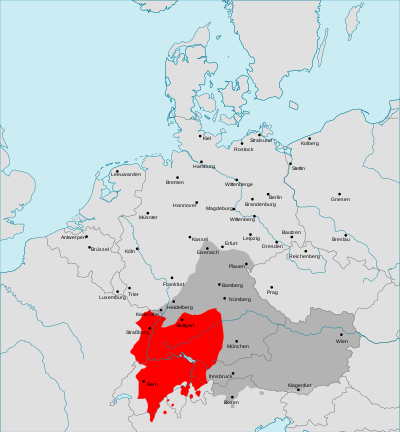
Alemannic German is not a monolithic entity but rather a continuum of closely related West Germanic dialects spoken primarily in southwestern Germany, Switzerland, Alsace (France), and parts of Austria. It belongs to the High German subgroup, which is distinguished by the High German consonant shift. The term 'Alemannic' itself is a direct inheritance from the Alemanni, an ancient confederation of Germanic tribes whose name, derived from 'all men,' signifies their historical role as a significant and widespread tribal entity.
This linguistic classification highlights its distinct phonetic and grammatical features that differentiate it from other German dialects, such as Low German. The study of Alemannic offers a window into the historical migrations and cultural interactions of Germanic peoples in Central Europe.
The Genesis of Alemannic
The origins of Alemannic German can be traced back to the dialects spoken by the Alemanni tribes. These tribes, prominent from the 3rd century AD onwards, gradually expanded their territory and influence. As their settlements became more established and interacted with neighboring populations, their language began to evolve.
Over centuries, regional variations emerged, influenced by local geography, political developments, and contact with other languages. This process of linguistic divergence led to the formation of the distinct Alemannic dialects we observe today, each with its own unique vocabulary, pronunciation, and grammatical structures. The historical development of Alemannic is a prime example of how language adapts and diversifies through human settlement and interaction.
Cultural and Historical Significance
The enduring presence of Alemannic German underscores its profound cultural and historical significance. For the communities that speak it, these dialects serve as vital carriers of regional identity, heritage, and tradition. They are repositories of local folklore, music, and historical narratives that might otherwise be lost.
Linguistically, Alemannic dialects provide invaluable data for understanding the evolution of the German language and the broader history of Germanic linguistics. Their study contributes to our knowledge of historical sound changes, grammatical developments, and the impact of cultural contact. In an era of increasing globalization, the preservation of such distinct linguistic traditions is crucial for maintaining Europe's rich cultural tapestry and linguistic diversity.
The Alemannic Linguistic Landscape
The Alemannic language landscape is characterized by considerable internal variation. While sharing common roots and features, the dialects spoken in different regions exhibit noticeable differences. For instance, Swiss German, a prominent form of Alemannic, has developed unique characteristics and is widely used in public life in Switzerland.
Similarly, Alsatian German in France and Swabian in parts of Germany represent distinct branches within the Alemannic family. This diversity is not merely superficial; it reflects centuries of independent development influenced by local socio-political factors and linguistic contact. Understanding this spectrum is key to appreciating the complexity and richness of Alemannic German as a living linguistic phenomenon.
Modern Relevance and Future Trajectories
In contemporary times, Alemannic German faces challenges and opportunities. While some dialects are robustly spoken, others are under pressure from the dominance of Standard German. Efforts are underway in various regions to promote and preserve these dialects through education, media, and cultural initiatives.
The continued use of Alemannic in everyday life, particularly in Switzerland, demonstrates its resilience. For scholars, Alemannic remains a critical area of research, offering insights into language variation, language change, and the complex relationship between language and identity. Its future trajectory will likely depend on the ongoing commitment of its speakers and communities to its vitality.
See also
Frequently Asked Questions
What is Alemannic German?+
Where do people speak Alemannic German?+
Why is it called Alemannic?+
How did Alemannic German change over time?+
Are there different kinds of Alemannic German?+
Based on content from Wikipedia · Licensed under CC BY-SA 4.0