

Aeolipile
Images
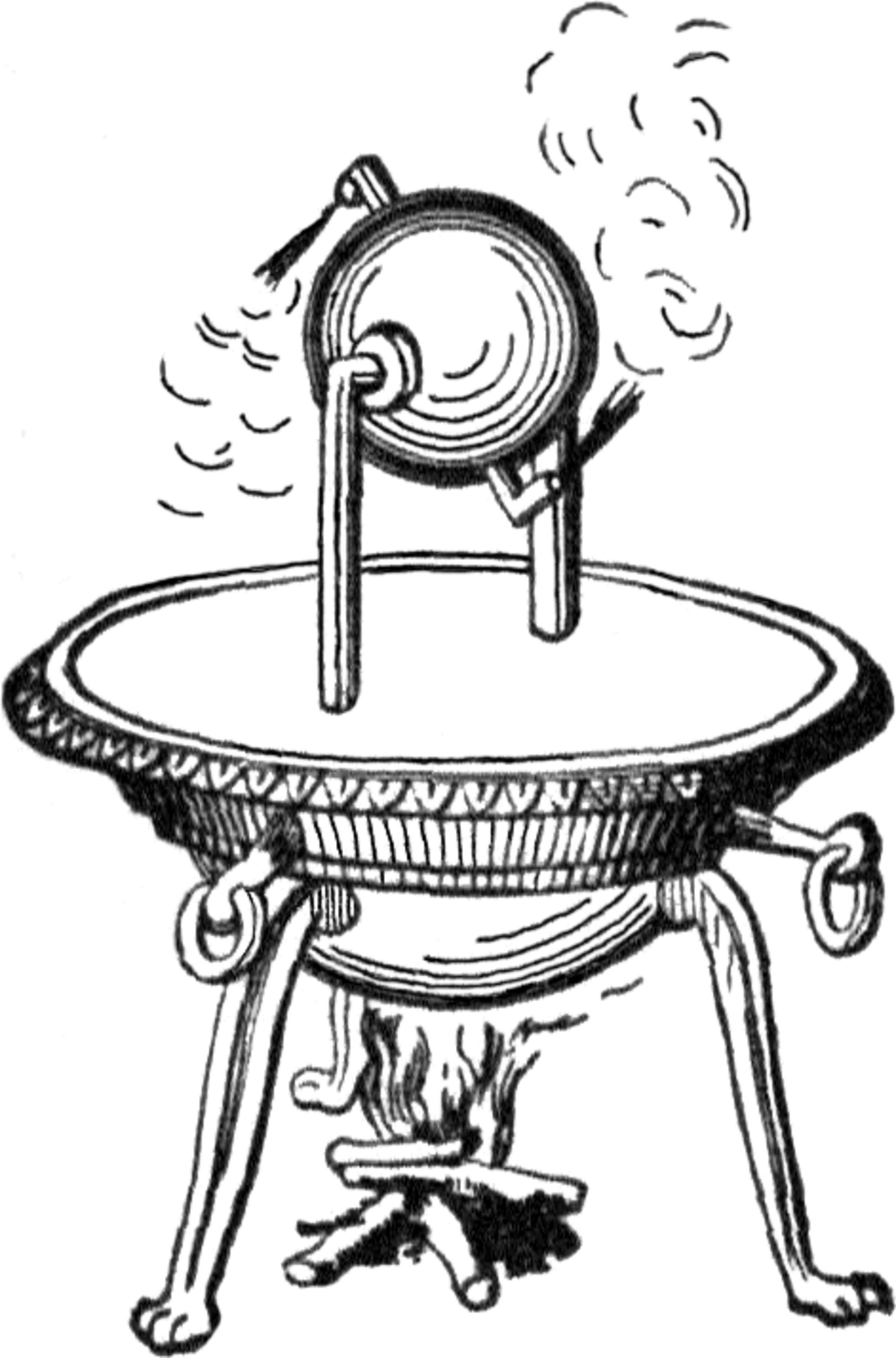
Aeolipile
An Ancient Marvel
The Aeolipile, also known as Hero's engine, stands as a remarkable testament to ancient ingenuity, representing the earliest known example of a reaction steam turbine. While often attributed to Hero of Alexandria, a brilliant mathematician and engineer of the 1st century AD, its initial description predates him. Vitruvius, a Roman architect and engineer, documented the appliance in his seminal work 'De architectura' between 30 and 20 BC.
This early account establishes the fundamental concept: a spherical vessel containing water, heated to produce steam, which then escapes through angled nozzles, generating rotational force. Hero's detailed description in his 'Pneumatica' further elaborated on its construction and operation, solidifying its place in the annals of mechanical history. The name itself, derived from 'Aeolus,' the Greek god of winds, and 'pila' (ball), aptly captures its essence as a wind-like spinning sphere powered by steam.
It is crucial to understand that the Aeolipile was not a practical power source in its era, nor was it a direct precursor to the high-pressure steam engines of the Industrial Revolution. Its significance lies in its conceptual demonstration of harnessing thermal energy to produce mechanical work through reactive force.
The Physics of Spin
The operation of the Aeolipile is a clear, albeit simple, application of fundamental physics principles, most notably Newton's Third Law of Motion: for every action, there is an equal and opposite reaction. The device consists of a hollow sphere, often made of bronze, mounted on a pivot to allow free rotation. Water is introduced into the sphere, and heat is applied externally, typically from a brazier.
As the water boils, it transforms into steam, significantly increasing in volume and exerting pressure within the confined space of the sphere. This pressurized steam is then directed through two opposing, bent nozzles or pipes attached to the sphere's surface. The steam is expelled from these nozzles in jets.
The action of the steam forcefully exiting the nozzles creates a reactive force that pushes the sphere in the opposite direction. This continuous expulsion of steam generates a torque, causing the Aeolipile to spin. The bladeless nature of this turbine is a key characteristic; unlike modern turbines that use blades to capture steam's kinetic energy, the Aeolipile relies solely on the reactive thrust of the steam jets.
This makes it a 'reaction turbine,' where the steam does work by pushing against the nozzles as it escapes.
Historical Context and Enduring Significance
The Aeolipile emerged during a period of advanced Hellenistic and Roman engineering, where principles of mechanics and hydraulics were being explored with remarkable sophistication, albeit often for amusement or demonstration rather than industrial application. While the practical utility of the Aeolipile was limited-it generated insufficient torque for meaningful work and required a constant heat source-its conceptual importance cannot be overstated. It represents the first recorded instance of a device that converts thermal energy into rotational mechanical energy using steam.
This fundamental principle, demonstrated by Hero, laid the groundwork for future developments in steam power. Although the Industrial Revolution's steam engines were primarily 'impulse' engines that used high-pressure steam to push against stationary blades, the Aeolipile's demonstration of reactive force was a crucial conceptual precursor. Its continued recognition, such as its use as a symbol for the U.S. Navy's Boiler Technician rating, underscores its historical significance as a pioneering invention that foreshadowed the transformative power of steam technology.
Beyond the Ancient World
The Aeolipile's legacy extends beyond its historical novelty; it serves as an educational tool and a symbol of early thermodynamic exploration. Its simple yet effective design makes it an ideal subject for understanding basic principles of thermodynamics and fluid dynamics. Related concepts include the fundamental laws of thermodynamics, particularly the conversion of heat into work, and Newton's laws of motion.
Modern steam turbines, which are the backbone of electricity generation worldwide, operate on similar principles of steam expansion and force generation, though they are vastly more complex and efficient, employing multiple stages, precisely engineered blades, and high-pressure steam. The Aeolipile's historical context also invites comparison with other ancient mechanical marvels, highlighting a sophisticated understanding of physics and engineering that often goes unrecognized. Its enduring presence in engineering symbolism is a testament to its foundational role in the long journey of harnessing steam power, a journey that began with this simple, spinning sphere.
See also
Frequently Asked Questions
What is an Aeolipile?+
How does the Aeolipile spin?+
Who first described the Aeolipile?+
Why is the Aeolipile important?+
Is the Aeolipile used today?+
Based on content from Wikipedia · Licensed under CC BY-SA 4.0