

Adsorption
Images

Adsorption



The Energetics of Surface Adhesion
Adsorption is fundamentally a surface phenomenon defined by the adhesion of atoms, ions, or molecules (the adsorbate) from a gaseous, liquid, or dissolved solid phase onto the surface of a solid or liquid material (the adsorbent). This process results in the formation of a film of the adsorbate on the adsorbent's surface. It is critically distinct from absorption, where the absorbate permeates into the bulk volume of the absorbent material.
The driving force behind adsorption lies in the surface energy of the adsorbent. Atoms within the bulk of a material satisfy their bonding requirements through interactions with neighboring atoms. However, surface atoms possess unsaturated bonding capabilities due to their incomplete coordination environment.
These unsatisfied forces create a surface energy that can be reduced by attracting and binding adsorbate species. This reduction in surface energy is thermodynamically favorable, often leading to a spontaneous adsorption process.
Classifying the Surface Bond
The nature of the interaction between the adsorbent surface and the adsorbate dictates the type of adsorption. Physisorption, or physical adsorption, is characterized by weak van der Waals forces, similar to intermolecular forces. These interactions are non-specific, reversible, and typically occur at low temperatures.
The adsorbate molecules retain their chemical identity. In contrast, chemisorption, or chemical adsorption, involves the formation of strong chemical bonds (covalent or ionic) between the adsorbate and the adsorbent. This process is highly specific, often irreversible, and requires significant activation energy, meaning it usually occurs at higher temperatures.
Chemisorption effectively transforms the adsorbate into a new chemical species on the surface. Electrostatic attraction can also play a role in adsorption, particularly in systems involving charged species or polar molecules.
Ubiquitous Roles
Adsorption is a pervasive process with profound implications across numerous fields. In biological systems, it's fundamental to enzyme-substrate interactions and cell membrane transport. Industrially, its applications are vast and critical.
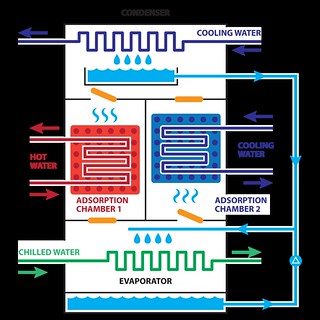
Heterogeneous catalysis, a cornerstone of chemical manufacturing, relies heavily on adsorption to bring reactants into close proximity on catalyst surfaces, facilitating reactions. Activated carbon, a highly porous material with an enormous surface area, is widely used in purification processes for water and air, effectively adsorbing contaminants and odors. Adsorption chillers leverage the heat released during adsorption to provide cooling, offering an energy-efficient alternative to conventional refrigeration. Ion exchange resins, used in water softening and chromatography, also operate on adsorption principles, selectively binding ions from a solution.
Historical Context and Precision in Terminology
The scientific community's understanding and precise description of this phenomenon evolved over time. The term 'adsorption' itself was formally introduced in 1881 by the German physicist Heinrich Kayser. This specific terminology was crucial for distinguishing the surface phenomenon from bulk absorption.
Kayser's contribution provided a clear linguistic tool for researchers to discuss and investigate the intricate mechanisms governing the interaction of substances at interfaces. This precision in language has been instrumental in the development of sophisticated applications, from advanced materials science to pharmaceutical drug delivery systems, where controlled adsorption is paramount for efficacy and safety.
Go deeper
Frequently Asked Questions
What is adsorption?+
How does adsorption differ from absorption?+
What are the two main types of adsorption?+
Why does activated carbon clean water and air?+
When does chemisorption usually happen?+
Based on content from Wikipedia · Licensed under CC BY-SA 4.0