

2nd century BC
Images
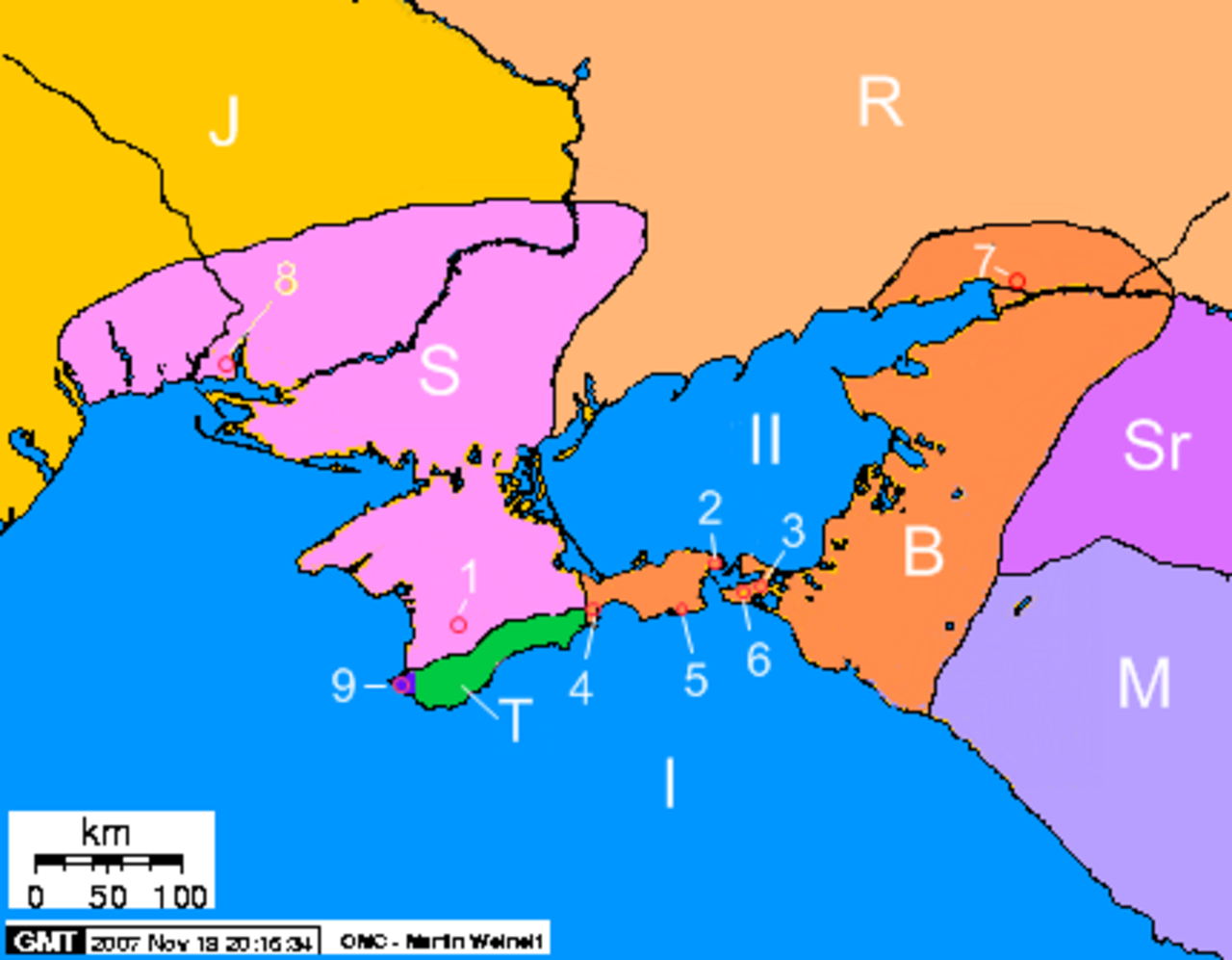
Crimea 2nd century BC map


The Unstoppable March of the Roman Republic
The 2nd century BC witnessed the Roman Republic solidify its position as the preeminent power in the Mediterranean. Having decisively concluded the Second Punic War, Rome embarked on sustained campaigns in Hispania, gradually bringing the Iberian Peninsula under its control. The destruction of Carthage at the end of the Third Punic War in 146 BC eliminated its most formidable rival in North Africa, paving the way for Roman dominance.
Rome's military might extended eastward as well; through the Macedonian Wars, it dismantled Antigonid Macedonia, and the Achaean War culminated in the brutal sack of Corinth in the same year as Carthage's fall. These victories fundamentally altered the geopolitical landscape, transforming the once-independent Hellenistic kingdoms of Ptolemaic Egypt and Attalid Pergamon into client states, with Pergamon eventually being annexed outright.
This era also marked the nascent evolution of the Roman army from a citizen militia into a more professional, standing force, a transformation often anachronistically attributed to later reforms. This military professionalization was crucial for sustaining Rome's ever-expanding territorial ambitions and its capacity for prolonged overseas campaigns.
The Fragmentation of the East and the Rise of New Powers
While Rome expanded westward and northward, the eastern Hellenistic world experienced significant fragmentation and upheaval. The once-vast Seleucid Empire, already weakened by territorial losses to Rome in Asia Minor, succumbed to internal strife and civil war by the mid-century. This power vacuum was exploited by the ascendant Parthian Empire, which consolidated its control over the Iranian plateau and Mesopotamia, establishing a formidable new rival to Rome.
The decline of the Seleucids also led to the emergence of independent or semi-independent kingdoms in its former territories, such as the Hasmonean kingdom in Judea, which navigated complex relationships with its powerful neighbors. This period represents a critical transition from the unified Hellenistic world order established after Alexander the Great to a more fractured and multi-polar geopolitical environment, characterized by the rise of new empires and the assertion of local autonomies.
The Han Dynasty's Zenith and the Genesis of the Silk Road
In East Asia, China under the Han Dynasty reached a remarkable peak of power and influence. The Han Empire extended its dominion from Korea in the east to Vietnam in the south, and westward towards the borders of modern-day Kazakhstan. At the beginning of the century, the nomadic Xiongnu confederation posed a significant threat, extracting tribute from the Han.
However, Han military pressure and the Xiongnu's own westward expansion against the Yuezhi triggered a cascade of migrations across Central Asia. Crucially, Han diplomatic and exploratory missions, undertaken in search of allies against the Xiongnu, began to forge connections with peoples and kingdoms further west. These efforts laid the groundwork for the eventual establishment of the Silk Road, a network of trade routes that would revolutionize transcontinental exchange, facilitating not only the movement of goods like silk and spices but also the diffusion of technologies, ideas, and religions between East and West for centuries to come.
South Asian Transformations and Enduring Legacies
The Indian subcontinent also experienced significant political shifts during the 2nd century BC. The once-dominant Mauryan Empire, which had unified much of India, collapsed. Its final emperor, Brihadnatha, was assassinated by his own general, Pushyamitra Shunga, who then founded the Shunga Empire.
This marked a significant dynastic change and a shift in political power. Concurrently, the Greco-Bactrian Kingdom, established by Greek rulers in Central Asia, pushed south across the Hindu Kush mountains to form the Indo-Greek Kingdom in parts of northwestern India. However, their original homeland in Bactria was lost to the Sakas, themselves displaced by the westward migrations of the Yuezhi.
This complex interplay of collapsing empires, rising dynasties, and migrating peoples highlights the dynamic and interconnected nature of historical change across Eurasia during this pivotal century.
The Long Shadow of the 2nd Century BC
The events of the 2nd century BC cast a long shadow over subsequent history. Rome's unchecked expansion and military reforms directly contributed to the eventual transition from Republic to Empire, shaping the trajectory of Western civilization. The collapse of the Seleucid Empire and the rise of Parthia redefined the strategic balance in the Near East, setting the stage for centuries of Roman-Parthian rivalry.
The opening of the Silk Road was arguably one of the most transformative developments, initiating a period of unprecedented global interconnectedness that fostered cultural synthesis and economic interdependence on a scale previously unimaginable. The societal and political realignments in South Asia also had lasting impacts on the region's development. This century, therefore, stands as a critical juncture where ancient powers consolidated, new ones emerged, and the foundations for a more interconnected world were irrevocably laid.
See also
Frequently Asked Questions
What happened to Carthage in the 2nd century BC?+
How did Rome become the most powerful country in the Mediterranean?+
What was the Silk Road and why was it important?+
Who were the Seleucid Empire and what happened to them?+
How did the Roman army change during this time?+
Based on content from Wikipedia · Licensed under CC BY-SA 4.0