

1985 Mexico City earthquake
Images
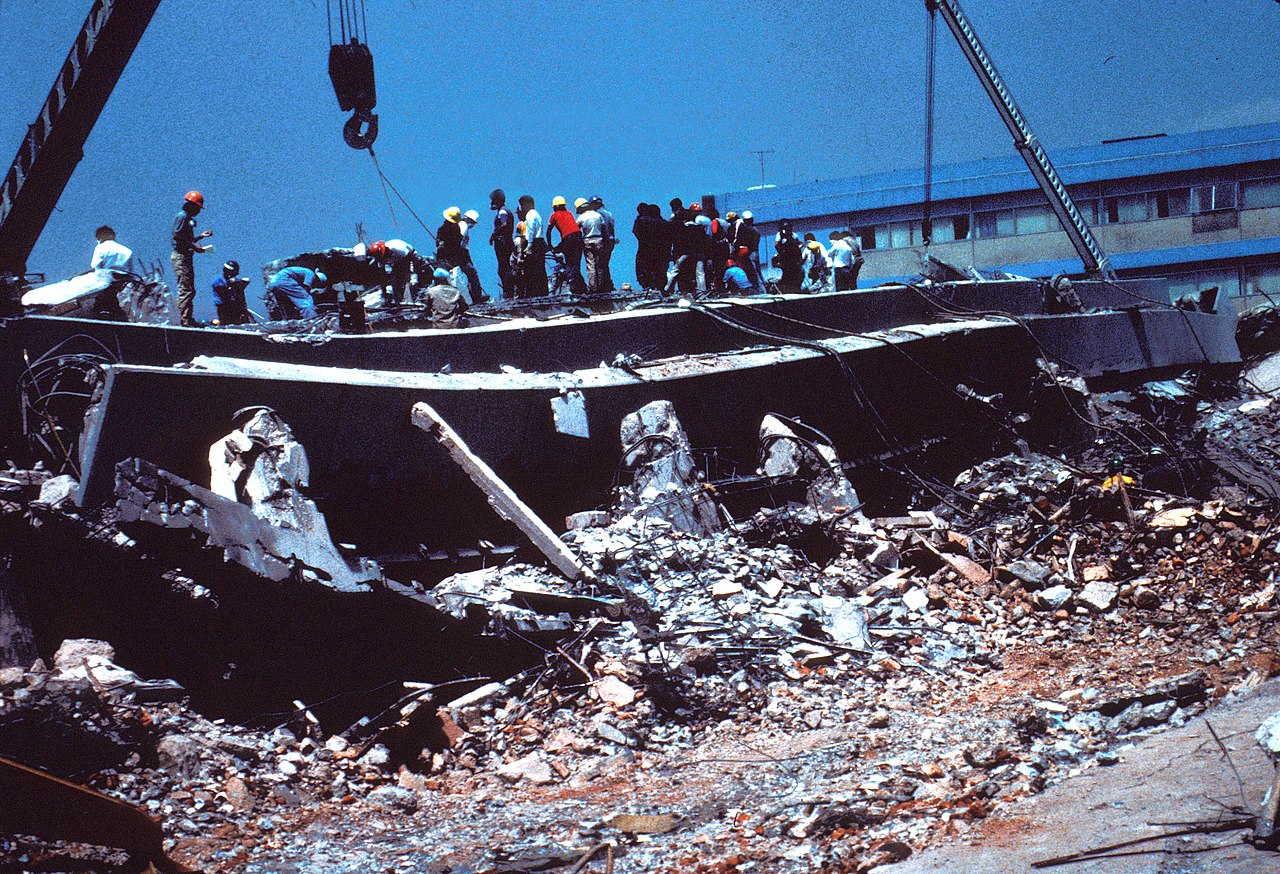
1985 Mexico Earthquake Collapsed General Hospital
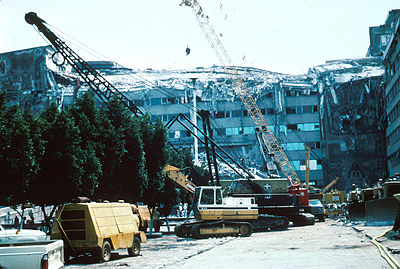


Geological Vulnerability
Mexico City's extreme vulnerability to seismic events is intrinsically linked to its unique geological foundation. The city is situated on the remnants of a large ancient lake, characterized by deep layers of soft clay and sediment. This lacustrine soil possesses peculiar amplification properties.
When seismic waves from distant earthquakes, like the one on September 19, 1985, travel through this soft material, their energy is concentrated and their duration is prolonged. This phenomenon, known as site amplification, transforms moderate ground motion into violent shaking, particularly affecting taller buildings that resonate with the long-period waves prevalent in such environments. The earthquake's epicenter was located off the coast, over 350 kilometers away, yet the amplified shaking in Mexico City reached a Mercalli intensity of IX (Violent), causing catastrophic damage despite the distance.
The Cataclysm of September 19, 1985
The main shock, a powerful magnitude 8.0 earthquake, struck at 07:17:50 CST on September 19, 1985. This was preceded by a foreshock in May and followed by significant aftershocks, including a magnitude 7.5 on September 20 and a 7.0 in April 1986. The sheer force of the main event led to the collapse of 412 buildings and severe damage to over 3,000 others.
The human toll was immense, with official figures stating at least 5,000 fatalities, though many believe the actual number to be significantly higher. The economic impact was also staggering, estimated between three and five billion USD. The destruction was not uniform; buildings constructed on the firmer volcanic highlands fared better than those on the soft lake bed, starkly illustrating the geological factor.
Critique of the Official Response and Citizen Mobilization
The government's reaction to the earthquake was widely criticized. President Miguel de la Madrid and the ruling Institutional Revolutionary Party (PRI) were perceived as slow and inefficient in their response. An initial refusal of international aid further exacerbated the situation, leading to widespread public anger and distrust.
In stark contrast, ordinary citizens demonstrated remarkable initiative and solidarity. Neighborhoods organized spontaneous rescue operations, with volunteers forming human chains to clear rubble and search for survivors. This citizen-led mobilization became a defining characteristic of the post-earthquake period, highlighting a profound disconnect between the state's capacity and the immediate needs of the population, and fostering a more active civil society.
Urban Planning and Seismic Resilience
The 1985 Mexico City earthquake served as a pivotal moment, fundamentally reshaping seismic engineering and urban planning practices. It underscored the critical importance of understanding and mitigating the effects of site amplification. In response, Mexico City implemented some of the world's most stringent seismic building codes, focusing on designing structures capable of withstanding prolonged, intense shaking.
This included advancements in base isolation, energy dissipation systems, and stricter regulations for construction on soft soils. The disaster also spurred greater public awareness and preparedness for seismic events, influencing disaster management strategies not only in Mexico but globally, serving as a case study for seismic risk assessment and mitigation in urban environments.
See also
Frequently Asked Questions
What caused the 1985 Mexico City earthquake to feel so strong even though the epicenter was far away?+
Why did some buildings in Mexico City collapse while others stayed standing?+
How did people in Mexico City help after the earthquake?+
When did the main earthquake happen and how big was it?+
What changes were made to building rules after the earthquake?+
Based on content from Wikipedia · Licensed under CC BY-SA 4.0