

1976 United States presidential election
Images

ElectoralCollege1976




The Shadow of Watergate and Economic Malaise
The 1976 presidential election unfolded against a backdrop of profound national disillusionment. The Watergate scandal, which forced President Richard Nixon's resignation in 1974, had severely damaged public trust in the Republican Party and the presidency itself. Gerald Ford, who ascended to the presidency without being elected to either the presidency or vice presidency, inherited this crisis of confidence.
His controversial decision to pardon Nixon further alienated a significant portion of the electorate, creating a deep rift within the Republican Party and fueling conservative opposition, notably from Ronald Reagan during the primaries. Compounding these political challenges were persistent economic woes, including high inflation and unemployment, which left many Americans feeling insecure about the nation's future. This environment created fertile ground for an alternative message.
Jimmy Carter
Jimmy Carter's victory was a masterclass in political strategy and perception management. Initially an obscure figure outside of Georgia, Carter meticulously built his campaign by emphasizing his status as a Washington outsider and a political moderate. He positioned himself as a reformer, untainted by the cynicism and corruption associated with the capital.
His campaign slogan and rhetoric focused on honesty, integrity, and a return to traditional values, resonating deeply with a populace weary of political scandals. Carter's success in the Democratic primaries, where he defeated a crowded field of more established politicians, demonstrated the public's appetite for change. His 'Rose Garden strategy' was effectively countered by Carter's narrative of being a fresh, incorruptible voice ready to lead the nation out of its malaise.
Gerald Ford's Defensive Campaign and the Debates
President Ford's campaign was largely defensive, attempting to highlight his experience and steady leadership while grappling with the negative legacy of the Nixon administration. His 'Rose Garden strategy' aimed to project an image of presidential gravitas, focusing on his executive duties rather than engaging in extensive campaigning. However, this approach struggled to overcome the deep-seated distrust stemming from Watergate and the ongoing economic difficulties.
Ford's campaign gained momentum following a strong performance in the first presidential debate, where he appeared more presidential and articulate than anticipated. This debate significantly narrowed the gap in the polls, transforming what had been a comfortable Carter lead into a nail-biting contest on election day. The debates underscored the critical role of direct candidate engagement in shaping public opinion.
The Electoral Landscape and Shifting Alliances
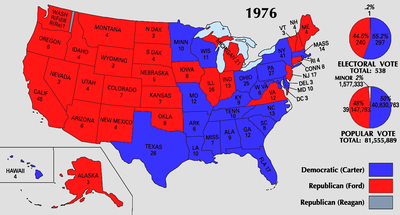
The 1976 election resulted in a narrow victory for Jimmy Carter, securing 297 Electoral College votes and 50.1% of the popular vote. A significant aspect of Carter's win was his success in the Deep South, a region that had largely shifted Republican in previous decades. He became the first Democrat since Franklin D.
Roosevelt in 1944 to carry the South, a testament to his Southern roots and the broader realignment occurring in American politics. Carter's crucial victories in swing states like Ohio and Wisconsin, with their combined 36 electoral votes, were pivotal. Conversely, Gerald Ford carried the Western states, but his 48.0% popular vote share and defeat marked him as the first president to lose a national election while holding the office or having served as vice president.
The election's outcome reflected a national desire for a new direction, signaling a significant shift in voter priorities and party allegiances.
Demographic Tides and Lasting Implications
The electorate in 1976 was largely composed of older voters, primarily from the Greatest Generation and the Silent Generation, who had experienced the Great Depression and World War II. These generations constituted the majority of voters, influencing the election's outcome with their perspectives on stability and change. Carter's election marked a significant moment, as he was the first president from a Southern state to be elected since Zachary Taylor in 1848.
As of 2024, this election remains the last time a Democratic ticket won a majority of states in the South, and it was also the most recent election where the losing candidate carried more states than the winner. The 1976 election thus stands as a critical juncture, reflecting a nation's complex response to political scandal, economic hardship, and a yearning for a new era of leadership.
See also
Frequently Asked Questions
Who won the 1976 U.S. presidential election?+
Why did people choose Jimmy Carter over Gerald Ford?+
What was the "Rose Garden strategy" and why did it matter?+
How did the first presidential debate change the race?+
Why was the South important in the 1976 election?+
Based on content from Wikipedia · Licensed under CC BY-SA 4.0