

1960 United States presidential election
Images
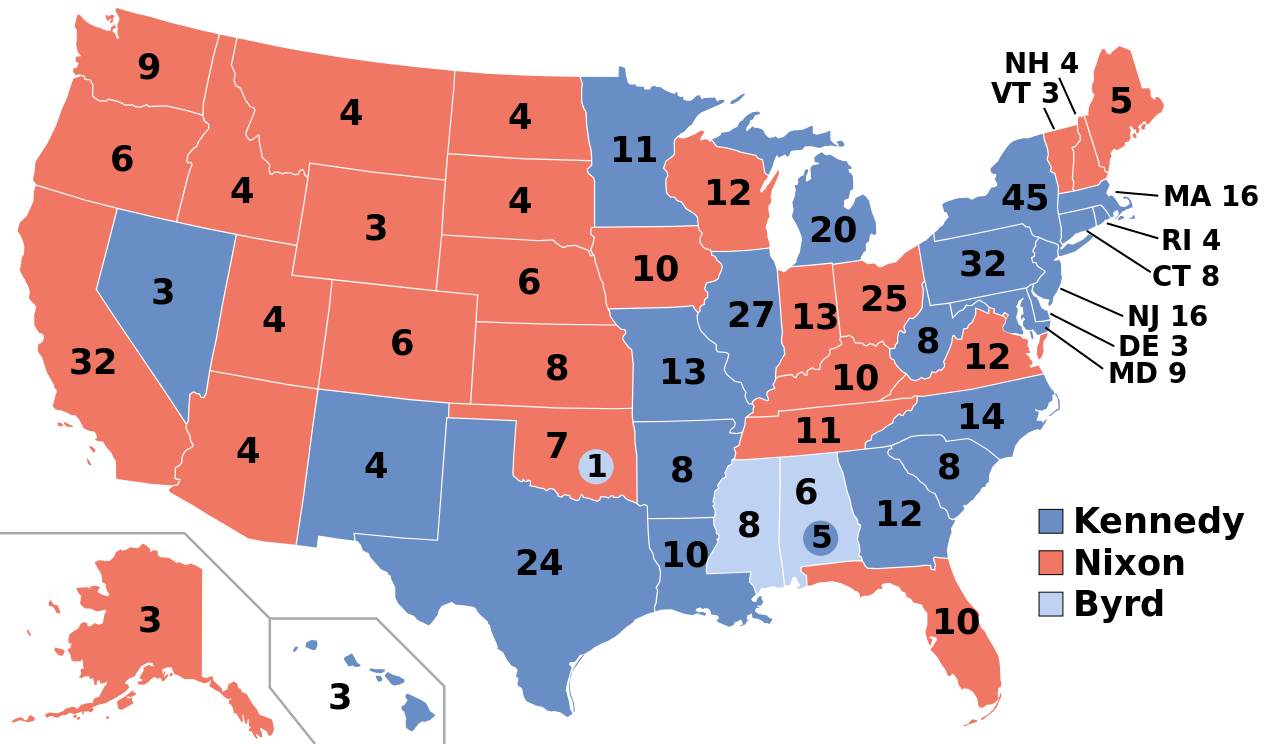
ElectoralCollege1960


The Candidates and the Shifting Political Landscape
The 1960 United States presidential election pitted two prominent figures against each other: Senator John F. Kennedy, a young and ambitious Democrat from Massachusetts, and incumbent Vice President Richard Nixon, a seasoned Republican politician. Kennedy's nomination was solidified through strong primary performances, notably against Senator Hubert Humphrey, and his strategic selection of Senate Majority Leader Lyndon B.
Johnson as his running mate aimed to unify the party and appeal to Southern voters. Nixon, meanwhile, faced little opposition for the Republican nomination, benefiting from the popularity of outgoing President Dwight D. Eisenhower.
This election was historically significant as the first in which all 50 states participated, including the newly admitted states of Alaska and Hawaii. It also marked the final election before the District of Columbia would be allowed to vote and the last time an incumbent president would be ineligible to run due to the 22nd Amendment's term limits.
Factors Influencing the Narrow Outcome
The election's outcome was remarkably close, with Kennedy winning by a razor-thin margin in both the popular and Electoral College votes. Several key factors contributed to this tight race. The economic recession of 1957-1958 weakened the standing of the incumbent Republican administration, providing Kennedy with a favorable environment.
Furthermore, the Democratic Party held a significant advantage in registered voters. A crucial dynamic was the religious factor: Kennedy, as a Roman Catholic, mobilized a substantial portion of the Catholic vote, which largely offset the gains Nixon made among Protestant voters. Nixon's strengths included President Eisenhower's enduring popularity and the general economic prosperity of the preceding eight years.
However, Kennedy's campaign strategy, which concentrated resources on populous swing states, proved more effective than Nixon's approach of campaigning across all fifty states.
The Television Era and Campaign Strategies
The 1960 election is often cited as the first major presidential contest where television played a decisive role. The series of televised debates between Kennedy and Nixon became legendary. Kennedy, with his youthful vigor and polished appearance, was perceived as more compelling on screen, while Nixon, appearing fatigued and somewhat uncomfortable, struggled to match Kennedy's charisma.
This visual difference significantly impacted public perception. Kennedy's campaign masterfully utilized television advertising and media appearances to project an image of dynamism and forward-thinking leadership. In contrast, Nixon focused heavily on his extensive experience and policy knowledge.
Kennedy's reliance on Johnson was also a strategic move to secure the Democratic South, a region that was beginning to shift politically.
A Historic Presidency and Enduring Legacy
John F. Kennedy's victory made him the youngest person ever elected to the U.S. presidency, at 43 years and 5 months old. He secured 303 Electoral College votes to Nixon's 219.
The national popular vote was exceptionally close, with Kennedy winning by a mere 112,827 votes, representing 0.17% of the total cast. This margin remains one of the narrowest in presidential election history. Fourteen unpledged electors cast votes for Senator Harry F.
Byrd, and one elector voted faithlessly, highlighting lingering divisions. Kennedy's election ushered in an era of youthful leadership and inspired a generation, though his presidency was tragically cut short. The 1960 election serves as a critical case study in campaign strategy, the impact of media, and the complex interplay of social, economic, and religious factors in shaping electoral outcomes.
See also
Frequently Asked Questions
Who won the 1960 United States presidential election?+
Why was the 1960 election so close?+
How did television change the 1960 election?+
What was new about the states in the 1960 election?+
Who was Kennedy’s running mate and why?+
Based on content from Wikipedia · Licensed under CC BY-SA 4.0