

1936 United States presidential election
Images
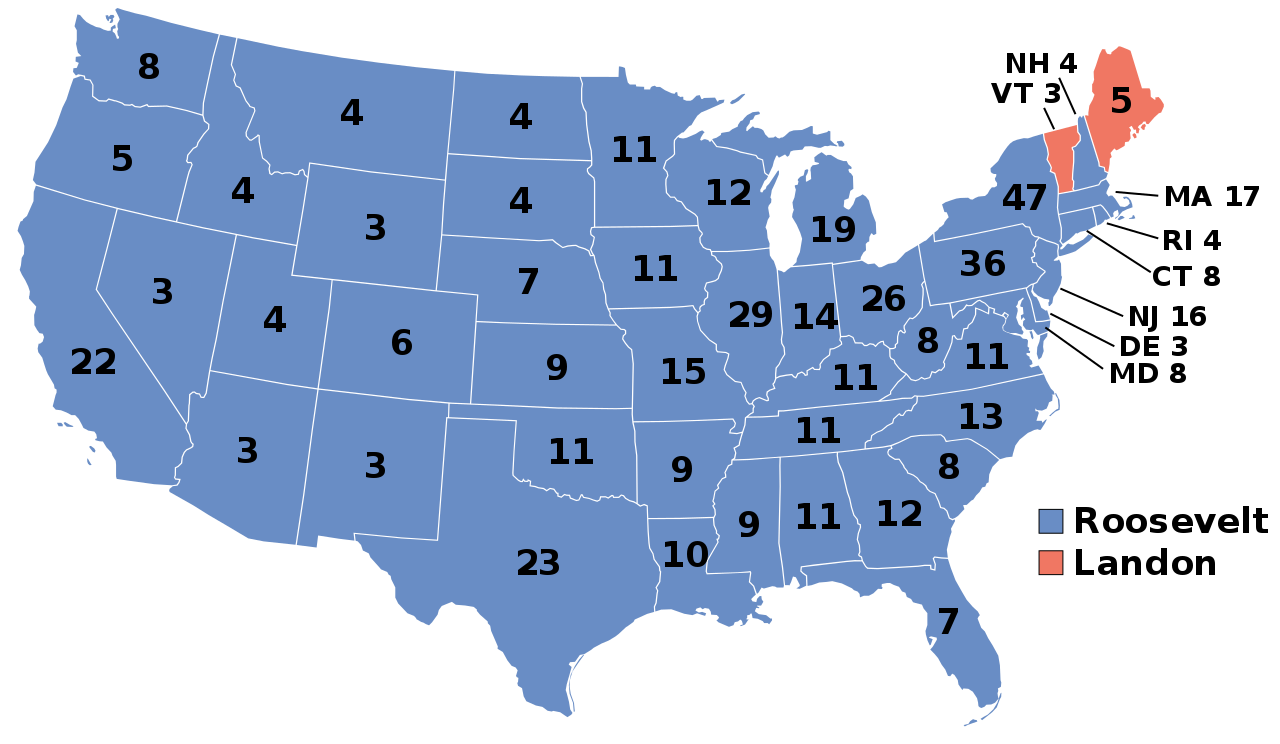
ElectoralCollege1936


Context
The 1936 United States presidential election unfolded against the backdrop of the Great Depression, an economic catastrophe that had gripped the nation for nearly eight years. Unemployment soared, businesses failed, and widespread poverty fueled social unrest. In this environment, President Franklin D. Roosevelt, a Democrat, sought re-election, campaigning on the successes and promises of his ambitious New Deal programs.
His opponent, Republican Governor Alf Landon of Kansas, represented a more moderate approach, acknowledging some New Deal successes but criticizing its scope and efficiency. The election was thus a referendum on Roosevelt's transformative policies and the very role of the federal government in American life.
The Landslide
Franklin D. Roosevelt achieved a victory of historic proportions in 1936. He secured 60.8% of the popular vote, a significant margin, but it was his performance in the Electoral College that truly stunned observers.
Roosevelt garnered an astonishing 523 electoral votes, representing 98.49% of the total. He carried every state except for Maine and Vermont, a feat unmatched since the largely uncontested election of 1820. This overwhelming mandate demonstrated profound public confidence in Roosevelt's leadership and his New Deal agenda, solidifying his position as a dominant political figure.
The New Deal Coalition and the Fifth Party System
Roosevelt's victory was instrumental in consolidating the 'New Deal Coalition,' a diverse alliance of voters that included labor unions, urban ethnic groups, African Americans, Southern whites, and farmers. This coalition provided the Democratic Party with a powerful and enduring base of support. The 1936 election effectively ushered in the 'Fifth Party System,' characterized by Democratic hegemony that would last for several decades.
This realignment shifted the political landscape, with the Democrats becoming the party of government intervention and social welfare, while the Republicans struggled to redefine their identity.
Campaign Strategies and Public Perception
Roosevelt's campaign effectively leveraged the perceived successes of the New Deal. Programs like Social Security and unemployment insurance had provided tangible relief and a sense of security to millions, fostering loyalty. His administration skillfully portrayed Landon and the Republicans as defenders of the old order that had failed during the Depression.
Landon, while attempting to moderate his image, was unable to overcome the widespread belief that Roosevelt was the only leader capable of navigating the nation out of its economic woes. The election was also notable for the role of media; while Landon was featured in the influential Literary Digest poll, its predictions proved disastrously wrong, highlighting the limitations of traditional polling.
Legacy and Modern Relevance
The 1936 election stands as a critical turning point in American political history. It validated the expansion of federal power and the concept of a social safety net, principles that continue to shape policy debates today. Roosevelt's landslide victory demonstrated the power of a president to reshape public expectations of government during times of crisis.
The enduring legacy of the New Deal Coalition and the political realignment it triggered profoundly influenced subsequent elections and the ongoing dialogue about the balance between individual liberty and collective responsibility in the United States.
See also
Frequently Asked Questions
What happened in the 1936 U.S. presidential election?+
Who was Franklin D. Roosevelt's opponent in 1936?+
Why did so many people support Roosevelt in 1936?+
Which states did Roosevelt not win in 1936?+
What was the New Deal Coalition?+
Based on content from Wikipedia · Licensed under CC BY-SA 4.0