

The Year 1507!
Images
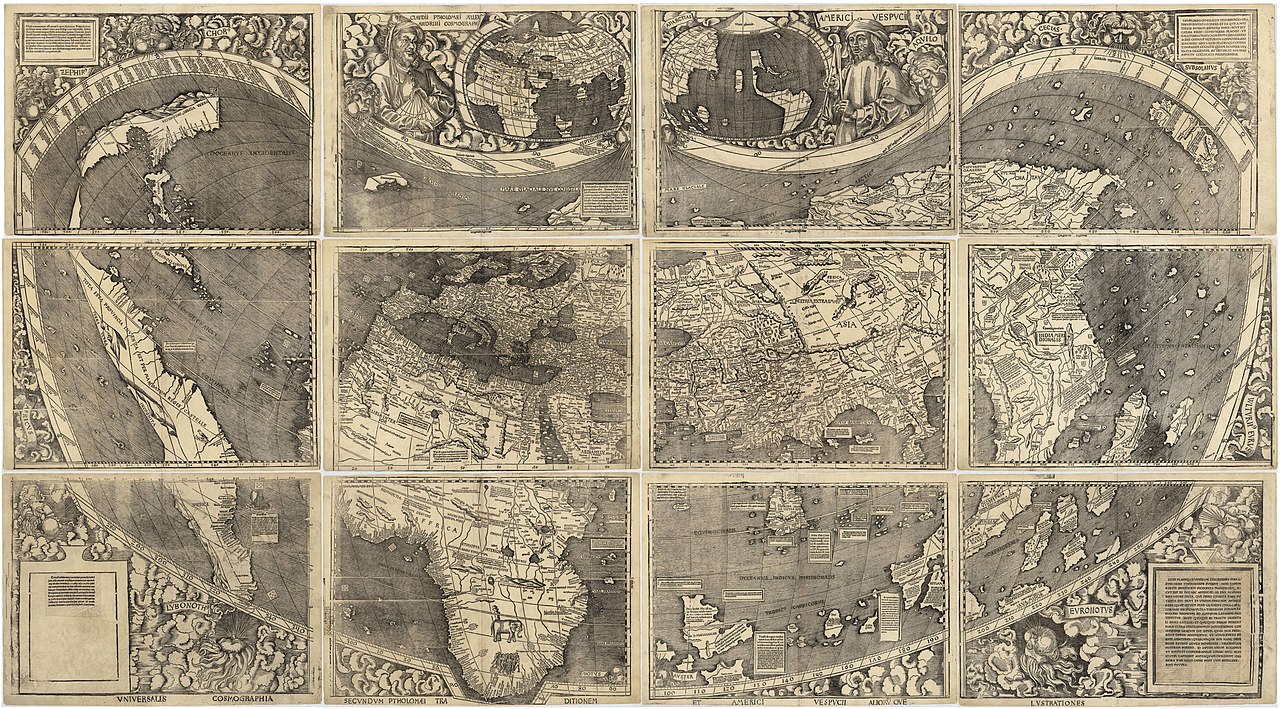
Waldseemuller Map 2


The Mechanics of the Julian Calendar in 1507
The year 1507 was a common year, meaning it comprised 365 days and did not include the intercalary day of February 29th that characterizes a leap year. Its commencement on a Friday was determined by the prevailing Julian calendar, a solar calendar introduced by Julius Caesar in 45 BCE. This calendar was designed to approximate the tropical year by having 365 days in most years, with an extra day added every fourth year.
However, the Julian calendar's average year length of 365.25 days was slightly longer than the actual tropical year (approximately 365.2422 days). By 1507, this discrepancy, though small on an annual basis, had accumulated over centuries, causing the calendar to drift relative to the seasons. This drift meant that astronomical events like the vernal equinox were occurring earlier in the calendar year than they had at the time of the calendar's inception.
The year 1507, therefore, operated within this established, yet gradually diverging, temporal framework, influencing agricultural cycles, religious observances, and civic planning across the regions that adhered to it.
The Significance of 'Common Year' in Historical Analysis
The designation of 1507 as a 'common year' is more than a mere calendrical footnote; it is a critical piece of data for historical scholarship. In chronological studies, distinguishing between common and leap years is fundamental for accurate dating and the calculation of temporal intervals. When historians analyze primary sources, such as diaries, official records, or correspondence, the precise date of an event is paramount.
Knowing that 1507 was a common year allows for the exact calculation of the number of days between events, the duration of campaigns, or the time elapsed between significant discoveries. This precision is vital for constructing reliable historical narratives and for understanding the pace of change and development. The consistent application of calendrical rules, even with the Julian system's inherent inaccuracies, provided a shared temporal reference point for societies, enabling coordination and historical memory.
1507
While the provided source focuses on the calendrical definition of 1507, its historical context is rich with ongoing transformations. The year falls within the broader period of the Renaissance and the Age of Discovery. In Europe, this era was characterized by a burgeoning interest in classical learning, advancements in art and science, and significant geopolitical shifts.
Explorers were actively mapping the globe, leading to increased trade, cultural exchange, and colonial expansion. Philosophically and scientifically, new ideas were challenging established doctrines, laying groundwork for the Scientific Revolution. Although 1507 may not be marked by a singular, epoch-defining event in the limited scope of the source, it was a year where these profound societal and intellectual currents were deeply embedded.
The daily lives of people, the political machinations of nascent nation-states, and the intellectual ferment of the era all contributed to the historical trajectory that would shape the following centuries.
The Enduring Legacy of Roman Numerals
The representation of 1507 as MDVII highlights the persistent influence of Roman numerals. This system, with its additive and sometimes subtractive principles (e.g., IV for 4, IX for 9), was the standard for numerical notation in Europe for centuries. Its use in dating important documents, inscriptions, and even years, as seen with MDVII, connects the present to the ancient world.
The Roman numeral system, while less practical for complex mathematical calculations compared to the Hindu-Arabic numeral system (which was gradually being adopted in Europe during this period), served as a crucial bridge in numerical literacy. Understanding MDVII requires recognizing the values of M (1000), D (500), V (5), and I (1), and applying the rules of their combination. This practice not only aids in deciphering historical texts but also underscores the evolution of mathematical notation and its role in recording and disseminating knowledge across time.
See also
Frequently Asked Questions
What was special about the year 1507?+
Was 1507 a leap year?+
What calendar did people use in 1507?+
When did the year 1507 begin in the week?+
Why did the calendar drift in 1507?+
Based on content from Wikipedia · Licensed under CC BY-SA 4.0