

The Amazing Year 1100!
Images
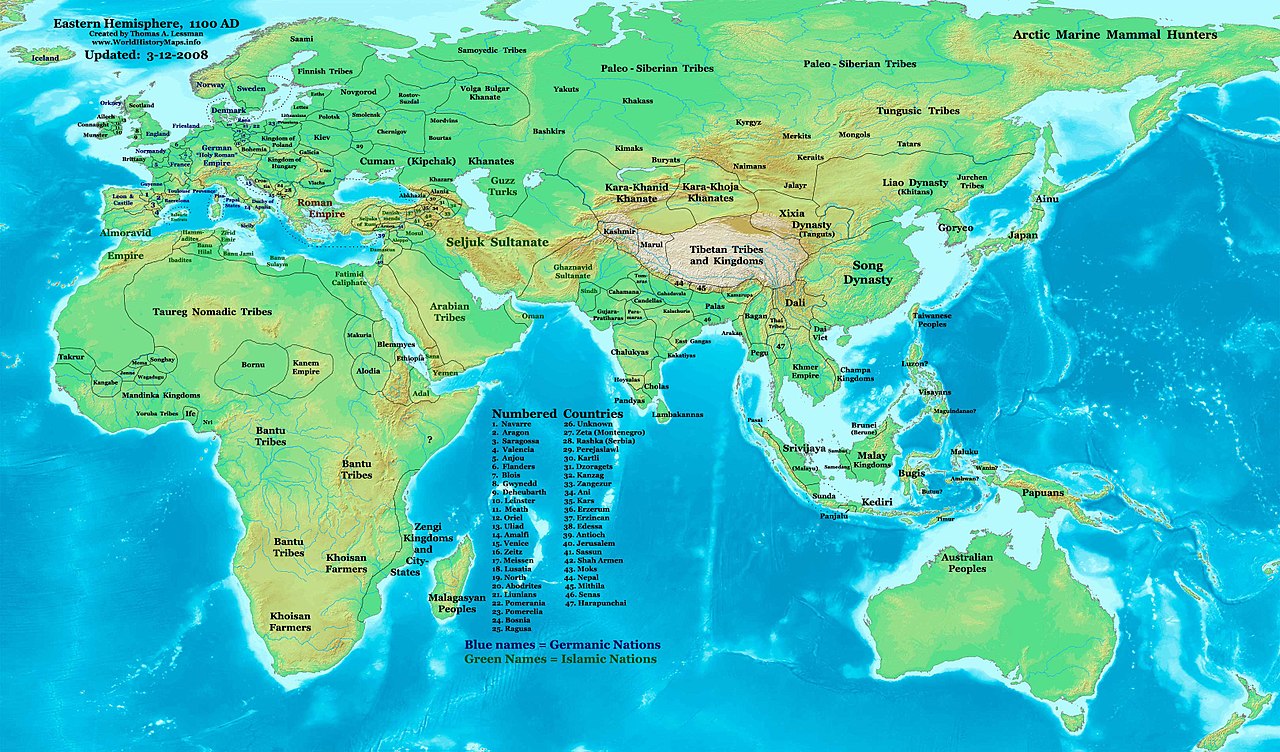
East Hem 1100ad


The Chronological Fulcrum
The year 1100 AD occupies a unique position in historical analysis, serving as a temporal nexus where the concluding trends of the 11th century met the nascent developments of the 12th. The 11th century was a period of profound transformation, marked by the consolidation of monarchies in Western Europe, the expansion of the Byzantine Empire's influence, and the dramatic impetus of the First Crusade, which concluded in 1099.
As 1100 dawned, the reverberations of these events were still shaping the geopolitical and socio-cultural landscape. It was a year that inherited the momentum of feudal expansion, religious fervor, and burgeoning trade networks, while simultaneously laying the groundwork for the High Middle Ages. The intellectual currents, such as the rediscovery of classical texts and the development of scholasticism, were gaining traction, setting the stage for the universities and philosophical debates that would define the subsequent century.
Thus, 1100 is not merely a numerical marker but a dynamic period reflecting the culmination of one era's challenges and the inception of another's ambitions.
Calendrical Divergence
The year 1100 offers a compelling case study in the history of timekeeping, particularly through the lens of differing calendar systems. In the Julian calendar, the prevailing standard across Christendom at the time, 1100 was designated as a leap year. This was determined by the rule of adding a leap day every four years.
Consequently, the Julian calendar assigned 366 days to 1100, with February comprising 29 days. However, the proleptic Gregorian calendar, which retroactively applies the rules of the calendar introduced in 1582, classifies 1100 as a non-leap century year. This divergence stems from the Julian calendar's slight inaccuracy, which caused it to drift by approximately one day every 128 years.
By 1582, this drift had amounted to about 10 days, necessitating the Gregorian reform. The fact that 1100 exhibits this calendrical difference underscores the long-term scientific endeavor to synchronize human timekeeping with astronomical cycles, a process that spanned centuries and involved significant intellectual and societal adjustments.
The Enduring Resonance of 1100
The historical significance of 1100 extends beyond its transitional nature; it represents a point where established powers and emerging forces were in dynamic interplay. In the Holy Roman Empire, the Investiture Controversy was winding down, leaving a legacy of altered Church-state relations. England, under the Norman kings, was solidifying its administrative structures. The Kingdom of Jerusalem, established by the First Crusade, was beginning its precarious existence, setting the stage for centuries of conflict and cultural exchange in the Levant.
Furthermore, the year falls within a period of significant population growth and agricultural innovation in Europe, which supported the expansion of trade and the development of urban centers. The intellectual life of the era, though not yet at its medieval peak, was characterized by a growing interest in law, theology, and the burgeoning field of natural philosophy. Therefore, 1100 serves as a crucial reference point for understanding the complex web of political, religious, social, and intellectual developments that characterized the transition from the early to the high medieval period.
Societal Structures and Worldviews in 1100
The world of 1100 was fundamentally shaped by hierarchical social structures and distinct worldviews. Feudalism remained the dominant organizing principle in much of Europe, dictating relationships of land tenure, military service, and political obligation. The Church exerted immense spiritual and temporal authority, influencing daily life, education, and governance. For the vast majority of the population, life was agrarian, with limited mobility and a strong connection to the land.
In contrast, urban centers were experiencing growth, fostering new forms of commerce and social interaction. Beyond Europe, the Byzantine Empire, though diminished, maintained its imperial traditions and Orthodox Christian faith. The Islamic world, spanning from the Iberian Peninsula to Central Asia, continued to be a vibrant hub of scientific inquiry, philosophy, and artistic achievement, preserving and expanding upon classical knowledge.
Understanding these diverse societal structures and worldviews is essential for appreciating the global context in which the year 1100 unfolded and its place in the broader sweep of human history.
Legacy and Modern Relevance
While the year 1100 itself might seem distant, its legacy is woven into the fabric of modern society. The political boundaries and institutions that began to solidify in the 11th and 12th centuries have evolved into the nation-states we recognize today. The legal and philosophical traditions that were being refined during this period continue to influence contemporary thought.
Moreover, the historical narratives and cultural exchanges initiated by events around 1100, such as the Crusades, have had long-lasting and complex impacts on inter-cultural relations. The very way we measure time, through the Gregorian calendar, is a testament to the centuries-long scientific progress that began with earlier systems like the Julian calendar. Studying 1100 allows us to trace the origins of many contemporary phenomena, fostering a deeper understanding of historical continuity and change, and providing valuable context for analyzing the present and anticipating the future.
See also
Frequently Asked Questions
What happened in the year 1100?+
Why was 1100 a leap year in the Julian calendar but not in the Gregorian calendar?+
How did the First Crusade influence the year 1100?+
Where did the Investiture Controversy happen in 1100?+
When did people start to change the calendar to fix the drift?+
Based on content from Wikipedia · Licensed under CC BY-SA 4.0